
Struggling to make your essays coherent, persuasive, and truly reflective of your ideas? Understanding the essay format is the essential first step to organizing your thoughts, presenting arguments logically, and ensuring your work meets academic standards. Without a clear structure, even the most brilliant ideas can get lost, paragraphs may feel disconnected, and your essay risks leaving readers confused—or worse, losing marks.
The good news is that mastering the standard essay format doesn’t just make your writing look organized—it gives your ideas a framework to shine. From a compelling introduction that grabs attention, to evidence-driven body paragraphs, to a conclusion that leaves a lasting impression, every part of your essay plays a critical role in communicating your argument effectively.
In this guide, you’ll discover exactly how to structure your essay step by step, why each component matters, and practical templates and examples you can apply immediately. By the end, you won’t just know the steps—you’ll understand how essay format turns scattered thoughts into a coherent, academically rigorous essay that impresses both instructors and peers.
What Is the Standard Essay Format? Understanding Its Purpose and Logic
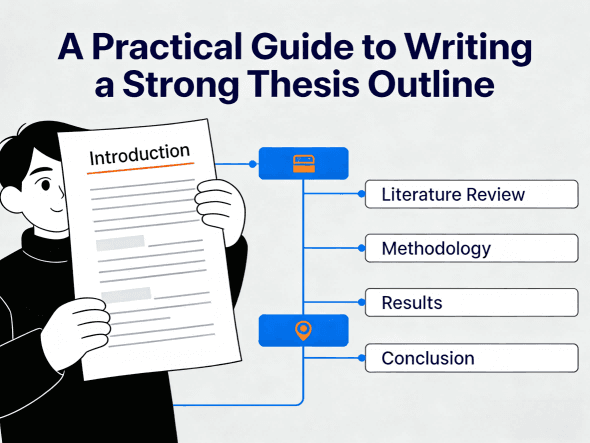
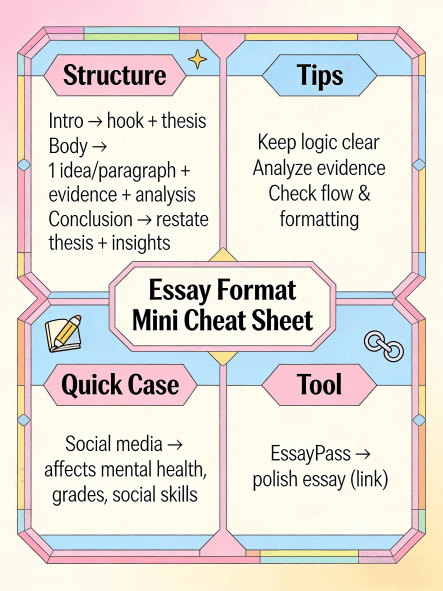
The standard essay format is a structural blueprint that ensures clarity and coherence. It consists of:
-
Introduction – frames the topic and establishes your argument
-
Body Paragraphs – develop evidence-based points supporting your thesis
-
Conclusion – synthesizes insights and reinforces your argument
Why Structure Matters in Academic Writing
A strong structure does more than organize content; it guides the reader’s cognitive processing (how the brain understands and interprets information). According to research in cognitive psychology, readers comprehend information more effectively when presented in predictable, logical sequences. Thus, the standard essay format is not arbitrary—it reflects how humans naturally interpret complex ideas.
Student pain point addressed: Many students write ideas as they come to mind, creating a “stream of consciousness” essay that loses marks for incoherence. The format acts as a scaffold for clarity.
The Academic Principle Behind Formatting
Formatting—font, spacing, margins, indentation—is often dismissed as cosmetic. In fact, well-designed presentation supports comprehension and reduces cognitive load (the mental effort required to process information), allowing your argument to shine without distractions.
Insight: Times New Roman, 12 pt, double spacing, and consistent margins are not arbitrary—they optimize readability and professional perception.
Crafting a Sophisticated Introduction
The introduction is more than a starting paragraph; it is the intellectual anchor of your essay. A compelling introduction should:
-
Hook the Reader – Start with a statistic, question, or surprising fact
-
Provide Context – Situate your topic within scholarly discourse or societal relevance
-
Present a Thesis Statement – Declare your central, arguable claim
The Thesis as the Cognitive Spine
The thesis is the guiding logic of your essay. Every paragraph should support, expand, or analyze this claim. Writing a thesis first allows for a coherent chain of reasoning, preventing tangent paragraphs.
Student pain point addressed: Unclear or vague thesis leads to meandering essays. Clear thesis = essay with direction.
Engaging Readers While Establishing Authority
Advanced students can employ rhetorical strategies: analogy, contrast, or provocative questions. This demonstrates critical thinking and positions you as an informed writer.
Example hook: “By 2026, teenagers spend over three hours daily on social media, profoundly shaping their cognitive and social behaviors.”
This introduces the topic, gives concrete data, and primes readers for analysis.
Developing Body Paragraphs with Advanced Analytical Rigor
Body paragraphs are not merely containers for information—they are mini-arguments within your essay, each advancing the thesis through evidence, analysis, and reasoning. At an advanced level, crafting body paragraphs involves understanding argumentation techniques, logical progression, and evidence evaluation.
Argumentation Strategies
A sophisticated paragraph can employ multiple strategies:
-
Cause-and-Effect Analysis – Demonstrates how one phenomenon leads to another.
-
Example: “High social media use increases anxiety levels in adolescents, which in turn reduces academic focus.”
-
Insight: Clearly links evidence to outcomes, showing logical causality.
-
-
Comparison and Contrast – Highlights differences or similarities to strengthen a point.
-
Example: Comparing offline vs. online communication skills development among teens.
-
Insight: Demonstrates critical thinking by situating evidence within context.
-
-
Counterargument and Refutation – Shows awareness of alternative perspectives.
-
Example: “While social media may enhance connectivity, studies reveal its negative impact on mental health, which outweighs these benefits in teenage populations.”
-
Insight: Advanced writing evaluates competing evidence, strengthening credibility.
-
Constructing the Logical Chain
Each paragraph should follow a micro-logic structure—a mini logical chain within the paragraph:
-
Topic sentence: Introduces the main idea.
-
Explanation: Expands with reasoning and context.
-
Evidence: Supported by research, statistics, or examples.
-
Analysis: Interprets evidence in relation to the thesis.
-
Link-back: Bridges the paragraph to the overarching argument.
Think of it as a logic chain: break one link, and the argument weakens. Teaching students to explicitly connect each link cultivates critical reasoning.
Advanced Tips for Depth
-
Integrate disciplinary theories (psychology, sociology) to contextualize evidence.
-
Use qualitative and quantitative sources for balanced argumentation.
-
Employ transitional reasoning words (“therefore,” “consequently,” “in contrast”) to maintain clarity and flow.
Conclusion as an Exercise in Critical Synthesis
The conclusion is not a mere summary—it is the culmination of analytical reasoning, demonstrating higher-order thinking.
Synthesizing Ideas
A high-level conclusion should:
-
Restate the thesis with nuance: Reflects evolved understanding.
-
Integrate insights: Show how individual body paragraphs cohere into a holistic argument.
-
Offer broader implications: Extend analysis to societal, academic, or practical contexts.
Student insight: Conclusions are opportunities to demonstrate meta-cognition (thinking about your own thinking), showing that you can not only argue but also reflect on your argument’s significance.
Techniques for Intellectual Depth
-
Predictive analysis: Suggest future trends or implications.
-
Comparative reflection: Relate your findings to broader academic debates.
-
Critical evaluation: Discuss limitations or potential objections, enhancing credibility.
Advanced students treat conclusions as a demonstration of reasoning mastery, not just a closing paragraph.
Case Study – Social Media and Teenagers (Fully Dissected)
A case study shows theory in practice. Each paragraph below illustrates how logical reasoning, evidence, and analysis converge.
Introduction Setup
-
Hook: “In 2026, over 90% of teenagers interact with social media daily, shaping cognition, behavior, and social norms.”
-
Contextualization: Situates the topic in adolescent psychology and educational research.
-
Thesis: “Although social media facilitates communication, it negatively affects teenagers’ mental health, academic performance, and social skills.”
Teaching point: Each sentence introduces context, stakes, and argumentative direction, showing how to craft a compelling introduction with analytical foresight.
Body Paragraph Breakdown
-
Mental Health
-
Topic sentence: “Excessive social media use correlates with rising anxiety among adolescents.”
-
Evidence: Empirical studies (Journal of Adolescent Health, 2025)
-
Analysis: Interprets the evidence, explaining causality and linking to broader developmental psychology
-
Teaching insight: Demonstrates linking data to theory, a skill essential for advanced essays
-
-
Academic Performance
-
Topic sentence: “Academic engagement declines as social media usage increases.”
-
Evidence: Statistical correlations from educational studies
-
Analysis: Explains behavioral causation and implications for learning strategies
-
Teaching insight: Shows critical assessment of quantitative evidence
-
-
Social Skills
-
Topic sentence: “Heavy reliance on online communication diminishes face-to-face interpersonal abilities.”
-
Evidence: Behavioral observations and case reports
-
Analysis: Connects micro-level effects to macro-level thesis
-
Teaching insight: Illustrates integrating multiple evidence types into a cohesive argument
-
Conclusion of Case Study
-
Synthesizes insights across paragraphs
-
Restates thesis with analytical reflection
-
Suggests interventions: balanced social media engagement for cognitive and social development
-
Teaching insight: Shows how to apply conclusions to practical recommendations while maintaining academic rigor
Avoiding Mistakes and Conducting a High-Level Self-Check
Writing a strong essay is not just about ideas on paper; it is an exercise in reasoning, evidence evaluation, and cognitive clarity. Many students lose marks due to subtle intellectual pitfalls, formatting inconsistencies, or insufficient reflection. Combining awareness of common mistakes with a strategic final checklist ensures both analytical rigor and structural precision.
Structural and Logical Pitfalls
-
Weak or Vague Thesis: Prevents coherent argumentation. Ensure your thesis is precise, arguable, and guiding.
-
Paragraph Incoherence: Avoid mixing multiple ideas. Apply one paragraph = one argument principle.
-
Illogical Sequence: Organize points in a clear logical progression (cause-effect, comparison, problem-solution).
Analytical and Reasoning Pitfalls
-
Evidence Without Analysis: Always interpret and explain significance.
-
Overgeneralization: Avoid claims beyond evidence; qualify statements.
-
Ignoring Counterarguments: Strengthen credibility by addressing alternative perspectives.
Formatting, Presentation, and Final Self-Check
-
Ensure consistent style: fonts, spacing, headings, margins.
-
Check paragraphs for clarity and readability; avoid visual clutter.
-
Conduct a meta-cognitive review—think about your own reasoning:
-
Does each paragraph contribute to the thesis?
-
Are transitions smooth and reasoning clear?
-
Would a skeptical reader be convinced?
-
-
Consider peer or mentor feedback to enhance critical evaluation.
Advanced Insight: This combined approach transforms revision from a mechanical task into a high-level cognitive exercise, training students in logical evaluation, clarity, and academic reasoning—covering both mistakes to avoid and final quality assurance.
Perfect Conclusion – Turning Knowledge into Action
Mastering the standard essay format is more than a mechanical exercise—it is a skill that transforms the way you think, reason, and communicate. By understanding the logic behind structure, the power of a clear thesis, and the art of analytical paragraphs, you not only improve your grades but also develop critical thinking skills that extend beyond academia.
Every step—from crafting a compelling introduction, developing evidence-backed arguments, to synthesizing ideas in the conclusion—teaches you how to present complex ideas with clarity and authority. Mistakes and formatting pitfalls are no longer obstacles but opportunities to refine reasoning and elevate your writing.
Now, imagine having a tool that helps you polish your arguments, refine clarity, and ensure a professional academic standard without replacing your intellectual effort. That’s where EssayPass in: it helps you transform your hard work into a cohesive, rigorous, and high-impact essay, making the process smoother and the results stronger.
By applying these principles and leveraging smart tools responsibly, you can confidently produce essays that are structurally perfect, analytically sharp, and academically impressive—truly reflecting your potential as a student and thinker.