
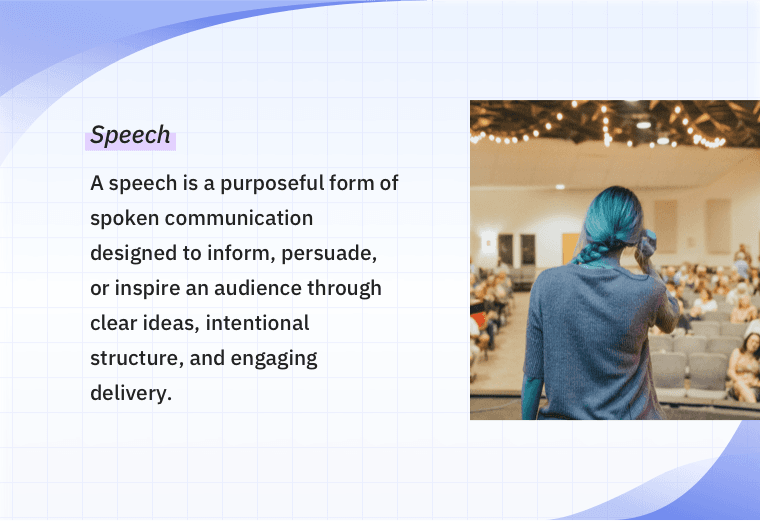
A speech is a purposeful form of communication designed to inform, persuade, or inspire. But writing one can feel challenging.
Many people struggle with how to start, what to include, and how to shape ideas that truly resonate.
If you’ve ever faced a blank page or felt unsure about crafting an engaging message, you’re not alone. Balancing clarity, structure, and impact often makes the process overwhelming.
This guide simplifies it. You’ll learn a clear, step-by-step method to define your message, organize your content, and add the touches that make a speech memorable.
Ready to write with confidence? Let’s dive in.
What Is a Speech
A speech is a deliberate form of communication designed to inform, persuade, or inspire an audience. It’s more than just words—it can motivate action, celebrate milestones, share knowledge, or influence opinions.
Tip: For example, a business presentation may persuade stakeholders to support a new project, while a wedding toast celebrates and evokes emotion in a personal, warm way.
Purpose of a Speech
Every speech has a goal. Some aim to educate, others to persuade, and some simply to entertain or inspire. Knowing your purpose helps shape what you say and how you say it, so your audience walks away with the intended message.
- An informative speech at a conference may explain a new scientific discovery.
- A persuasive speech could encourage a team to adopt a new strategy.
- A ceremonial speech at a graduation aims to inspire and celebrate achievement.
Takeaway: Identifying your speech’s purpose ensures your message connects and resonates with the audience.
Types of Speeches
Speeches come in many flavors, each with its own approach and style.
Tip: Use the table below to quickly compare types.
| Type | Purpose | Style | Typical Length | Example |
|---|---|---|---|---|
| Informative | Educate and clarify | Clear, factual, structured | 5–20 min | Example: Scientific conference talk, company training |
| Persuasive | Convince or motivate | Logical, emotional, compelling | 5–15 min | Example: Business pitch, political speech |
| Ceremonial / Celebratory | Entertain, celebrate, inspire | Emotional, personal, storytelling | 1–5 min | Example: Wedding toast, award acceptance, farewell speech |
| Special Occasion | Tailored to event | Can blend informative/persuasive/celebratory | Varies | Example: Graduation speech, keynote at an event |
Takeaway: Knowing the type of speech guides tone, content, and delivery, making your message more effective.
Time Management
The right length matters. A TED talk might last 10–18 minutes, giving you room to develop ideas, while a wedding toast or short announcement may only need 1–3 minutes.
Tip: The challenge is making every word count and fitting your message neatly into the time available.
Takeaway: Adapting your speech to the time allowed ensures clarity and keeps the audience engaged.
Examples and Context
Different settings demand different approaches. Compare these:
- Formal lecture: Structured arguments, evidence-based, professional tone.
- Informal social speech: Stories, humor, personal anecdotes.
By tailoring tone, content, and delivery to your audience and context, you ensure your speech is engaging, clear, and memorable.
Tip: A motivational talk to employees may mix persuasive elements with personal stories, while a scientific presentation remains strictly informative.
Takeaway: Context matters—adapting your speech style and content to the audience maximizes impact and memorability.
6 Steps for Writing an Effective Speech
1. Define Your Goal and Audience
The first step is to clarify your main goal and identify who will be listening. Ask yourself: What is the key message you want your audience to remember? Understanding the audience’s interests, knowledge level, and expectations will shape your tone, examples, and even speech length.
A keynote speech at a corporate event usually has an upbeat and motivational tone, focusing on achievements and vision. A persuasive speech on climate action, however, uses urgent language and compelling statistics to motivate change.
Consider visualizing your audience as a persona: what questions might they have, what would surprise them, and what emotions do you want to evoke?
2. Research and Gather Resources
After defining your audience and goal, collect relevant information to support your points. This could include facts, statistics, anecdotes, case studies, or quotes. The type of speech determines which resources are most useful.
An informative talk on technology trends could include recent data, charts, and examples of innovative companies. A wedding toast would benefit from personal stories or humorous anecdotes. If you are part of multiple speakers at an event, coordinating topics, tone, and timing ensures variety and avoids repetition.
Organize your materials into a clear outline. This way, you can see where each piece of evidence or story will fit, ensuring a smooth flow from introduction to conclusion.
3. Structure Your Speech
A well-structured speech helps the audience follow your ideas. Most speeches include three parts:
- Introduction: Grab attention and present your main message. Consider starting with a question, a surprising fact, or a short story.
- Body: Present 3–5 main points, each supported by examples or evidence.
- Conclusion: Summarize your message and leave a lasting impression.
Here’s a simple structure comparison for different speech types:
| Speech Type | Introduction | Body | Conclusion |
|---|---|---|---|
| Persuasive | Hook with problem or statistic | 3 supporting arguments + examples | Call to action |
| Informative | State topic clearly | 3–5 key points, illustrated with facts | Summarize key learnings |
| Ceremonial / Toast | Engaging story or anecdote | Personal memories or shared experiences | Warm wishes or inspiring closing |
4. Choose Language and Style
Your words and tone should match your purpose and audience. Clear, concise sentences make your ideas easy to understand, while rhetorical techniques—like repetition, analogies, and metaphors—enhance engagement. Personal stories and humor can also make your speech more relatable.
Language and Style Examples
Compare ordinary expressions with more vivid, rhetorical alternatives:
| Type / Situation | Ordinary Expression | Enhanced / Rhetorical Version |
|---|---|---|
| Persuasive Speech | Our planet is in danger. | Imagine a world where our children cannot see the forests we once knew. |
| Informative Speech | Many people use social media daily. | Every day, billions scroll through social media feeds, shaping how we see the world and interact with others. |
| Ceremonial Speech | I wish you a happy marriage. | May your life together be filled with laughter, adventures, and endless love that grows stronger each day. |
| Special Occasion | Congratulations to the graduates. | Today, we celebrate the determination, hard work, and achievements that have brought each of you to this milestone. |
5. Practice and Refine
Rehearse your speech multiple times, focusing on pacing, emphasis, and body language. Recording yourself or practicing in front of a friend can highlight areas for improvement. Adjust gestures, eye contact, and vocal tone to maximize engagement.
For example, pausing before a key statement increases impact, while emphasizing emotionally charged words strengthens connection with the audience.
6. Deliver with Confidence
Finally, present your speech with authenticity and poise. Be flexible—respond to audience reactions, and maintain composure if a moment doesn’t go as planned. Confidence, clarity, and genuine engagement often leave a stronger impression than flawless memorization.
Even if a joke or anecdote doesn’t land perfectly, moving forward smoothly maintains your credibility and keeps the audience focused on your message.
Example Analysis
-Martin Luther King Jr.’s “I Have a Dream” Speech
One of the most iconic speeches in history, Martin Luther King Jr.’s “I Have a Dream” demonstrates masterful speechwriting and delivery. By analyzing it, we can see how effective speeches combine structure, language, and audience awareness.
1. Goal and Audience
King’s main goal was to inspire civil rights action and promote equality. His audience included activists, supporters, and the general public watching on television. Understanding their values and hopes allowed him to craft a message that resonated deeply.
2. Research and Resources
King drew on historical context, scripture, and contemporary social issues. References to the Emancipation Proclamation and American founding documents provided credibility, while stories of real-life injustices made his message relatable.
3. Structure
The speech follows a clear and impactful structure:
- Introduction: Acknowledges the ongoing struggle and hooks attention with moral urgency.
- Body: Highlights key injustices, then moves to a vision of a better future.
- Conclusion: Repeats the “I have a dream” refrain, reinforcing his core message and leaving a lasting emotional impact.
4. Language and Style
King’s use of repetition, metaphor, and rhythmic phrasing made his speech memorable and emotionally powerful. For example, the repeated phrase “I have a dream” creates a cadence that draws listeners in and emphasizes his vision.
5. Practice and Delivery
King’s delivery was calm yet passionate, with deliberate pacing, pauses, and variations in tone. He used eye contact and gestures to engage the audience, creating a sense of shared experience and urgency.
6. Effect
The combination of thoughtful structure, compelling language, and confident delivery made the speech historically significant. It energized the civil rights movement, motivated legislative change, and remains a model for public speaking and persuasive communication.
Studying King’s speech shows how aligning your goal, audience, research, structure, and delivery can create a message that not only informs but inspires and moves people to action.
Key Tips for Effective Speeches
🎯 Focus Your MessageEnsure every point supports your core idea. Avoid unnecessary details.
⏱ Practice TimingRehearse with a timer to fit the allotted duration.
👀 Engage the AudienceUse eye contact, anecdotes, or rhetorical questions to maintain attention.
💡 StorytellingStories make your message relatable and memorable.
⚡ Strong Openings & ClosingsLeave a lasting impression with a memorable start and finish.
You now have the blueprint to not only write a speech but to craft a compelling presentation that truly connects. A great speech is a journey you take with your audience, built on a clear message, a strong structure, and authentic delivery.
Feeling inspired but short on time? Let our AI essay writer at EssayPass be your secret weapon. It can help you overcome writer’s block, organize your ideas, and refine your language, so you can step onto the stage with confidence and poise. Try it for your next presentation and see the difference it makes.
Your voice is powerful. Now, go out and make it heard.