
An APA essay is a type of academic paper that follows the American Psychological Association’s formatting and citation rules. It’s a clear, structured way to present your research and ideas.
For many students and researchers, the thought of formatting a paper, mastering in-text citations, and avoiding accidental plagiarism can feel overwhelming.
This guide is designed to help.
We’ll take you step by step, from creating a proper title page to building a complete reference list.
By the end, you’ll be able to write a polished, credible APA essay with confidence.
Let’s break it down and make the process simple and manageable.
What is an APA Essay?
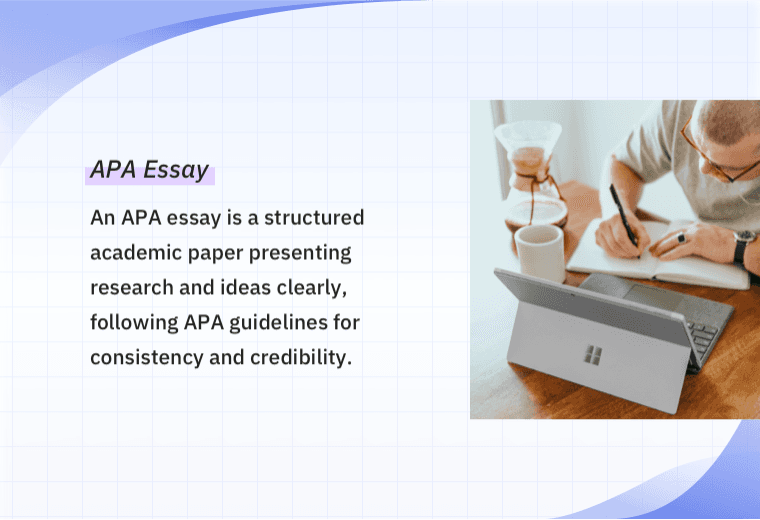
An APA essay is a structured academic paper that presents research and ideas clearly, following the American Psychological Association (APA) guidelines for consistency and credibility. Typically, it includes a title page, abstract (for longer papers), main body with in-text citations, and a reference list.
The primary purpose of the APA format is to standardize academic writing, allowing readers to focus on the content rather than its presentation. Mastering this format ensures your work is professional, credible, and meets scholarly standards.
Common Uses in Academic Writing
APA style is most widely used in the social sciences, including psychology, sociology, and education, but its clear, systematic approach makes it valuable across many disciplines. From literature reviews to case studies and experimental reports, understanding how to write an APA essay is essential for academic success.
Key Components and Formatting of an APA Essay
Writing an APA essay is more than just following rules—it’s about presenting your ideas clearly, professionally, and credibly. To make the process manageable, it helps to break the essay into its main components and understand the formatting and citation rules that go with each.
1. Title Page
The title page is your essay’s first impression. For student papers, it typically includes:
- Paper title
- Your name
- Institutional affiliation
- Course name and number
- Instructor’s name
- Assignment due date
All elements should be centered horizontally and double-spaced. The title goes in bold title case in the upper half of the page. Page numbers appear in the top-right corner, starting with “1” on the title page. For most student papers, a running head is not required unless your instructor specifies otherwise.
2. Abstract
The abstract is a concise summary of your paper, usually one paragraph, up to 250 words. It highlights the research topic, methods, main findings, and conclusions. While optional for shorter essays, it’s essential for longer or research-intensive papers. Tip: write the abstract after finishing the essay—it’s easier once your main points are clear.
3. Main Body
The main body is where your research and analysis take center stage. Its structure typically includes:
- Introduction: Present the problem, its significance, and your thesis statement.
- Body Paragraphs: Each paragraph focuses on a single idea, starts with a topic sentence, and is supported with evidence.
- Headings: Use headings to organize sections (e.g., Introduction, Discussion, Conclusion), depending on your essay type.
Formatting Essentials
- Font: 12-point Times New Roman (or another readable font).
- Spacing: Double-space everything, including headings, quotes, and reference list.
- Margins: 1-inch on all sides.
- Page numbers: Top-right corner on every page.
4. In-Text Citations
Citations give credit to original authors and avoid plagiarism. APA uses an author–date system:
- Basic format:
(Author, Year), e.g.,(Smith, 2020). If the author is part of the sentence:Smith (2020) argued that… - Multiple authors: Two authors use “and” in text and “&” in parentheses:
(Smith & Jones, 2020). Three or more:(Smith et al., 2020). - Multiple sources in one parentheses: Separate with semicolons and alphabetize:
(Adams, 2019; Smith, 2020; Zhao, 2021). - Direct quotes: Require page numbers:
(Smith, 2020, p. 25). Paraphrasing only needs(Author, Year).
5. Reference Page
The reference page lists all sources cited in the essay. Guidelines include:
- Start on a new page, with the centered bold title: References.
- Double-space the entire page.
- List sources alphabetically by the first author’s last name.
- Use hanging indents: first line flush left, subsequent lines indented 0.5 inches.
- Formatting varies by source type (see examples below).
Common reference examples
Journal article:
Author, A. A. (Year). Title of article. Title of Journal, Volume(Issue), Page range. https://doi.org/xxxx

Book:
Author, A. A. (Year). Title of book. Publisher.

Website:
Author, A. A. (Year). Title of page. Site Name. URL
6. Additional Style Tips
- Avoid slang, unnecessary jargon, or personal opinions unless required.
- Use active voice where appropriate.
- Ensure tables and figures are understandable on their own, with clear labels and captions.
By combining a clear understanding of these components with proper formatting and citation rules, your APA essay will not only meet academic standards but also communicate your research professionally and effectively.
Reference list example (visual demo)
- Adams, R. (2019). Research methods in practice. Academic Press.
- Smith, J., & Jones, L. (2020). Effective citation practices. Journal of Academic Writing, 12(3), 45–60. https://doi.org/xx.xxx/yyyy
- Zhao, Y. (2021). Online sources and citation. Research Online. https://example.com/article
Writing Tips for an APA Essay
Crafting a Clear and Purposeful Introduction
An effective APA-style introduction does more than start your paper—it sets the stage for your entire argument. Begin with the broader context of your topic, then narrow down to the specific problem your essay addresses. Clearly state the purpose of the paper and present your thesis in a concise, academically grounded way.
Many APA essays also include a brief “roadmap sentence” to preview the structure of the discussion. This helps readers understand what to expect and reinforces the logical flow APA writing emphasizes.
Building Strong, Evidence-Based Body Paragraphs
Each body paragraph should function as a mini-argument supported by credible evidence. Start with a focused topic sentence that signals the paragraph’s main idea.
Follow with evidence—research findings, data, or scholarly interpretations—properly cited using APA’s author-date system. After presenting evidence, offer your analysis: explain how the evidence supports your argument.
End the paragraph with a linking or transition sentence to maintain smooth flow between ideas. This structure helps you produce paragraphs that are clear, persuasive, and academically sound.
Maintaining Academic Tone and Style
APA writing favors clarity, precision, and objectivity. Use straightforward vocabulary and avoid figurative language, casual phrasing, and rhetorical exaggeration.
Replace subjective statements (“I think,” “I feel”) with evidence-based reasoning. Avoid biased or loaded language by using neutral, respectful wording, especially when discussing groups, populations, or sensitive topics.
When describing research results, rely on accurate reporting verbs such as “found,” “observed,” “indicated,” or “suggested,” which help maintain an academic tone.
Integrating Sources Smoothly and Effectively
Expertly blending sources into your writing is a hallmark of strong APA essays. Instead of dropping citations abruptly, introduce your sources with signal phrases such as “According to Smith (2020)” or “Recent research suggests…”. Follow quotations with brief analysis to clarify relevance.
When paraphrasing, fully rephrase the idea in your own words rather than just replacing a few terms. This demonstrates understanding and helps avoid unintentional plagiarism. Combining paraphrases, summaries, and direct quotes appropriately creates a balanced and authoritative argument.
Strengthening Logic and Coherence Across the Essay
Logical organization is central to the APA writing style. Use transitions to clarify relationships between sections and ensure your arguments develop in a clear, sequential manner. Check that each paragraph contributes to your thesis and that no section feels isolated or repetitive.
Employ APA headings when needed to separate complex ideas and guide readers through the progression of your analysis. Good coherence makes your essay easier to read and significantly strengthens your scholarly credibility.
Revising and Refining Your Draft
Revision is more than proofreading—it’s a complete evaluation of your argument, clarity, and adherence to APA standards. Begin by reviewing the overall structure: Does the introduction clearly state your purpose? Are paragraphs logically ordered? Are claims supported with evidence? Next, refine sentence-level clarity by removing wordiness and ensuring each sentence has a clear subject and verb. Finally, check all APA formatting elements, including headings, citations, and reference accuracy. A polished APA essay results from multiple thoughtful revisions.
Choosing Strong and Credible Academic Sources
A high-quality APA essay relies on scholarly, peer-reviewed sources rather than popular websites or opinion pieces. Use academic databases such as Google Scholar, JSTOR, or your university library to locate journal articles, systematic reviews, and empirical studies. Prioritize recent publications—typically within the last five years—unless you are discussing foundational theories. Evaluating sources for credibility ensures your arguments rest on solid evidence rather than unsupported claims.
APA Format Full Example Template
Sample Title Page
The Impact of Daily Reading on Academic Performance
Name
Department of Psychology, Sunshine University
PSY101: Introduction to Research
Dr. Emily Carter
January 15, 2025
Abstract
Daily reading habits have long been associated with improved cognitive development,
language proficiency, and academic achievement. This study examines the relationship
between consistent reading practices and the academic performance of first-year university
students. Survey data from 120 participants were analyzed to identify patterns in reading
duration, motivation, and grade outcomes. Findings suggest a positive correlation between
daily reading time and GPA, with intrinsic motivation acting as a moderating factor.
Implications for study strategies and academic interventions are discussed.
Main Body
Introduction
Establishing strong reading habits is widely regarded as a foundation for academic success.
Research has shown that students who read regularly tend to demonstrate stronger critical
thinking skills and broader knowledge retention. However, the question remains: does daily
reading still influence academic performance in the digital era? This paper explores the
extent to which first-year university students benefit from consistent reading routines.
Daily Reading and Cognitive Benefits
Extensive studies indicate that reading enhances vocabulary, comprehension, and analytical
processing. Smith (2023) argues that reading for at least 20 minutes per day strengthens
neural pathways associated with sustained attention. For students, these cognitive advantages
translate directly into more effective learning and performance across disciplines.
Study Method
A survey was administered to 120 first-year students. Participants reported their average
reading duration, preferred reading type, and most recent GPA. Additional questions measured
their reading motivation using a standardized motivation scale.
Results and Discussion
The data revealed a positive correlation between reading duration and academic performance.
Students who read 30 minutes or more daily exhibited higher GPAs compared to those reading
less than 10 minutes. Moreover, intrinsic motivation showed a significant moderating effect,
suggesting that the quality of engagement matters as much as the quantity.
Conclusion
The findings support the notion that daily reading remains a valuable habit for academic
success, particularly when students are intrinsically motivated. These insights can guide
educators and institutions in designing effective reading-based interventions.
Reference Page Example
References
Carter, E. (2022). Learning behaviors in first-year students. Academic Press.
Smith, J. (2023). Cognitive benefits of daily reading. Journal of Literacy Research, 45(2), 112–129.
https://doi.org/10.1234/jlr.2023.4512
Williams, A. (2024). Motivation and learning outcomes. Educational Psychology Review, 36(1), 55–72.
Mastering APA format takes practice, but you now have a complete roadmap—from understanding the core structure to formatting every page with precision, citing sources correctly, and avoiding plagiarism with confidence. This guide walked you through title pages, abstracts, in-text citations, reference lists, headings, and even a full sample template to help you visualize what an excellent APA paper looks like in action.
With these tools, you’re equipped to produce clear, credible, and academically sound essays that meet the highest university standards. And if you ever want to simplify the process, speed up formatting, or ensure every citation meets APA 7 rules, EssayPass is here to help. Our AI essay writer can instantly format your paper, check for originality, optimize clarity, and streamline your workflow from draft to final submission.