
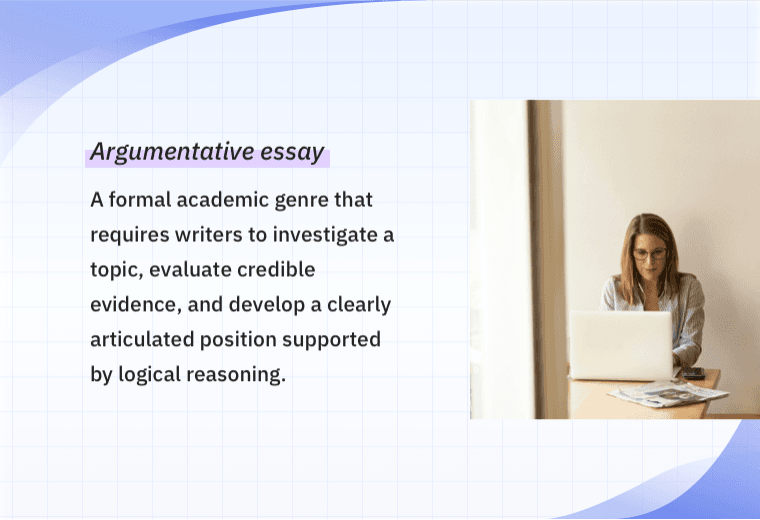
An argumentative essay is a form of academic writing in which you take a clear position on an issue and defend it with logic, evidence, and carefully structured reasoning.It’s about proving a point, persuading your reader, and demonstrating that your stance stands stronger than the alternatives.
Choosing a point of entry, finding evidence, and presenting a compelling argument can be difficult.
This guide will walk you through the techniques, structures, and strategies that turn uncertainty into clarity and transform your ideas into a well-crafted argumentative essay.
Let’s take the first step toward writing with confidence.
What Is an Argumentative Essay?
An argumentative essay is a type of school paper. You study a topic and look at good facts. Then you form a clear opinion, backed by good reasons.
Unlike a simple opinion piece, an argumentative essay follows clear school rules. You must make points that people can argue about. You must use facts that others can check. Your reasons must also follow a strong and clear plan.
An argumentative essay does not just give facts. Instead, it makes a strong school argument. You show that you know other ideas. You also look at what is good and bad about those ideas. Then, you prove why your idea is stronger or has more facts behind it.
Why Argumentative Essays Matter
Argumentative writing is very important in college. It helps students learn to:think carefully about hard topics,
tell the difference between ideas based on facts and ideas without proof,judge the good and bad points of other arguments,
build clear ideas that are well-supported,and explain their ideas clearly and with proof. These skills are important in all school subjects.
For example,you might use them in philosophy to think about right and wrong. You could use them in public health to plan health programs. Or in political science to look at changes in government rules. They are also useful when writing plans for projects in science, technology, engineering, and math (STEM). No matter the subject, being able to argue your point using facts and good reasons is a key skill for school.
How It Differs from Related Essay Types
Because students often confuse argumentative essays with persuasive or expository writing, it is important to differentiate them clearly.
The table below provides a scholarly comparison across key analytical dimensions and will help readers understand how argumentative writing functions within academic contexts.
| Analytical Dimension | Argumentative Essay | Persuasive Essay | Expository Essay / Everyday Argument |
|---|---|---|---|
| Epistemic Purpose | To establish a defensible position through systematic reasoning and empirical validation. | To influence the reader’s attitudes or beliefs primarily through rhetorical and emotional appeal. | To inform, clarify, or explain (Expository); to express personal disagreement or opinion (Everyday argument). |
| Method of Justification | Evidence-based; relies on verifiable data, scholarly sources, and logical inference. | Emotional, ethical, and stylistic appeals; empirical evidence optional. | Expository: objective presentation of facts; Everyday: subjective, experiential reasoning. |
| Thesis Characteristics | Explicit, contestable, and analytically complex; presumes legitimate counterarguments. | Clear position, but may be framed to evoke emotion rather than withstand academic scrutiny. | Expository: neutral, non-debatable claim; Everyday: informal, often implicit. |
| Engagement with Counterarguments | Integral component; evaluates, addresses, and refutes opposing viewpoints. | May acknowledge counterpoints but not required for argumentative rigor. | Expository: presents multiple perspectives without evaluation; Everyday: limited or absent. |
| Use of Rhetorical Appeals | Primarily logos (logical reasoning), supported by ethos (credibility). | Primarily pathos (emotional appeal) and ethos; logos supportive but not dominant. | Expository: logos; Everyday: informal mix of pathos and anecdotal reasoning. |
| Research Demands | High—requires rigorous source evaluation and integration of scholarly research. | Moderate—evidence strengthens argument but is not structurally essential. | Expository: moderate to high research; Everyday: minimal to none. |
| Disciplinary Application | Prevalent across humanities, social sciences, and applied fields requiring critical reasoning. | Common in communication, literature, and public discourse contexts. | Expository used broadly in academic writing; Everyday argument in informal settings. |
Key Components of an Argumentative Essay
An effective argumentative essay relies on several essential components that determine not just what your argument is, but how convincingly you present it. Each component plays a distinct role in building a coherent, evidence-driven, and academically credible argument.
1.Thesis Statement
Rather than simply stating a topic, your thesis must present a claim that requires proof and invites disagreement.
- Indicates the specific position you will defend
- Establishes the analytical direction of the essay
- Reflects awareness of the debate surrounding the issue
This sets the foundation for the reasoning and evidence that will follow.
2. Evidence
While earlier sections introduce the importance of evidence, this component focuses on how to use evidence effectively:
- Select data from credible scholarly or empirical sources
- Prioritize evidence that directly advances your claim
- Address limitations or ambiguities in the data when necessary
The goal is not to accumulate sources, but to strategically employ them.
3. Reasoning
Evidence alone cannot persuade; your reasoning must show why the evidence matters.
- Explains the significance of each piece of evidence
- Demonstrates cause-and-effect or logical relationships
- Avoids logical fallacies by grounding claims in sound analysis
This is where your intellectual contribution becomes visible.
4. Counterarguments
Effective rebuttal requires:
- Identifying the strongest opposing viewpoints
- Acknowledging why they might seem convincing
- Demonstrating their weaknesses using evidence or logic
- Showing why your position remains more persuasive
This deepens the sophistication and credibility of your essay.
5. Rhetorical Appeals
- Logos: logical analysis + structured reasoning
- Ethos: academic credibility; fair treatment of opposing views
- Pathos: controlled emotional resonance used sparingly
Understanding rhetorical appeals helps you persuade without compromising academic integrity.
6. Academic Tone
To maintain credibility, therefor your writing should demonstrate:
- Precision in language
- Objectivity and fairness
- Avoidance of exaggerated, emotional, or biased phrasing
- Consistent use of formal academic style
Tone is part of persuasion, So readers trust arguments delivered with clarity and professionalism.
7. Critical Analysis
Strong argumentative writing goes beyond presenting research:
- Analyze underlying assumptions
- Evaluate strengths and weaknesses in existing arguments
- Identify patterns, implications, or gaps in evidence
- Demonstrate original insight instead of repeating information
This transforms a research-supported paper into a true argumentative essay.
Argumentative Essay Structure
A clear structure helps you write a strong argumentative essay. You present your own ideas. You also talk about different views. So, how you organize your essay is key. It helps readers understand your argument. Below, we show basic and advanced structures. These work for different types and levels of essays.
Basic Structure
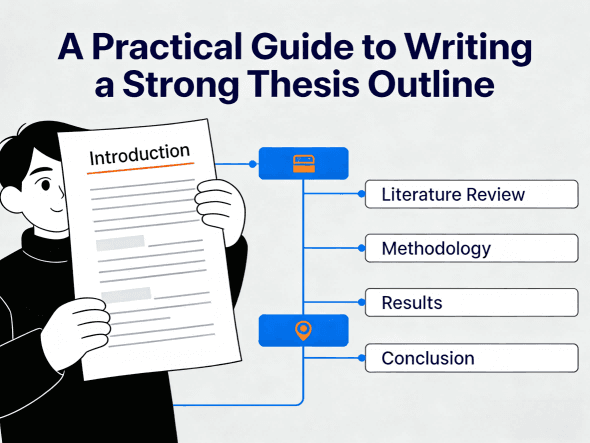
The simplest and most widely used structure for short essays is the five-paragraph format. This works well for timed assignments or essays with a limited scope:
- Introduction: Present your thesis clearly, provide necessary context, and engage the reader.
- Body Paragraphs 1–3: Present your arguments and supporting evidence. Each paragraph can also address and refute an opposing viewpoint.
- Conclusion: Revisit your thesis in light of the evidence and briefly summarize your main points.
This simple structure makes your essay clear and easy to follow. It gives you a strong base to write good arguments.
Advanced Structure
For more complex essays, especially those longer than five paragraphs or involving nuanced arguments, advanced organizational patterns offer flexibility and depth.
Aristotelian (Classic) Structure
Best for: Clear, direct arguments.
The Aristotelian approach builds on the basic five-paragraph model but emphasizes ethos, pathos, and logos:
- Introduce the problem.
- Explain your perspective.
- Present opposing viewpoints and refute them.
- Provide supporting evidence.
- Conclude your argument.
Toulmin Structure
Best for: Complex issues or rebuttals.
The Toulmin method is analytical and logic-driven, ideal for essays that dissect opposing arguments in depth:
- Claim: State your thesis or argument.
- Reasons: Present evidence supporting your claim.
- Warrant: Connect the claim to the evidence, making assumptions explicit.
- Backing: Offer additional supporting evidence.
- Qualifier: Define the limits of your claim.
- Rebuttal: Address counterarguments and criticisms.
Rogerian Structure
Best for: Balanced arguments or mixed audiences.
This method emphasizes mutual understanding and compromise, presenting both sides respectfully:
- Introduce the problem.
- Explain the opposing viewpoint, validating accurate points.
- Present your perspective.
- Find common ground where both viewpoints can coexist.
- Conclude with a balanced summary.
Choosing the right structure depends on your essay’s purpose, length, and audience. Then mastering both basic and advanced frameworks will allow you to craft persuasive, logically coherent, and well-supported argumentative essays.
How to Write an Argumentative Essay
| Step | Technique / Method | Example / Explanation |
|---|---|---|
| 1. Brainstorm Ideas | Generate topics and positions; list pros, cons, controversies | Mind mapping, free writing, or discussion with peers |
| 2. Choose a Topic | Pick a focused, debatable topic | Good: “A carbon tax reduces industrial pollution” Too broad: “Pollution is bad” |
| 3. Conduct Research | Gather credible sources: academic journals, statistics, reports | Government/institutional publications (.gov/.org); avoid blogs or unreliable sites |
| 4. Create an Outline | List introduction (hook + thesis), body, counterarguments, conclusion | Use bullets or numbering for logical flow |
| 5. Write a Thesis Statement | Craft a clear, debatable claim at the end of the introduction | “A carbon tax reduces industrial pollution by incentivizing companies to go green” |
| 6. Write Body Paragraphs | Develop one argument per paragraph using T.E.E.L (Topic → Evidence → Explanation → Link) | “Remote work improves productivity by reducing commuting stress” |
| 7. Address Counterarguments | Anticipate and rebut opposing views | “Although critics say remote work reduces collaboration, surveys show virtual tools maintain team cohesion” |
| 8. Integrate Evidence | Explain relevance, analyze data, connect to thesis | Use journals, statistics, expert quotes; avoid dropping quotes without explanation |
| 9. Ensure Cohesion | Use transitions and logical links between paragraphs | Examples: “Furthermore,” “Conversely,” “As a result” |
| 10. Revise and Edit | Review logic, evidence, clarity, tone, and format | Read aloud to catch awkward phrasing; fix grammar, spelling, word choice |
Strong argumentative writing comes down to a clear thesis, solid evidence, and a logical flow that ties everything together.
With the steps and strategies in this guide, you’re ready to build sharper arguments and write with confidence.
If you want to speed up the process and polish your work with ease, try EssayPass’s AI essay writer. It helps refine your ideas, strengthen structure, and save time—so you can focus on making your argument as strong as possible.
If you still have questions, the following quick FAQ may help.
FAQ
1. How do I pick an interesting and debatable topic?
Choose a topic that genuinely interests you and has clear opposing viewpoints. Look for current issues, controversial subjects, or questions that invite discussion. Make sure it’s narrow enough to explore in depth within your essay length.
2. How do I write a strong thesis?
Your thesis should state a clear position and hint at the main points supporting it. Avoid vague statements or simple observations. A strong thesis is specific, debatable, and defensible, guiding the reader through your argument.
3. What evidence makes my argument convincing?
Use credible sources such as academic journals, books, and reports from reputable organizations. Include facts, statistics, expert quotes, and real-world examples. Always explain how the evidence supports your thesis.
4. How should I handle opposing viewpoints?
Acknowledge counterarguments fairly and refute them with logic, evidence, or by showing a stronger overall perspective. This demonstrates critical thinking and strengthens the credibility of your argument.
5. What tone should I use in my essay?
Maintain an academic, objective, and respectful tone. Avoid emotional or informal language. Your goal is to persuade through reasoning and evidence, not through personal opinion alone.
6. How do I structure my essay for logical flow?
Use a clear introduction with a thesis, body paragraphs that each cover one main point, a section for counterarguments, and a conclusion that reinforces your position. Use transitions to guide the reader smoothly between ideas.
7. How long should paragraphs be, and how many?
Each paragraph should focus on a single idea or argument and provide supporting evidence and analysis. Generally, 3–6 well-developed paragraphs are sufficient for short essays; longer essays may require more body paragraphs.
8. Any tips for brainstorming ideas?
Start with freewriting, mind mapping, or listing questions about the topic. Consider multiple perspectives and jot down possible evidence. Brainstorming helps you clarify your stance and identify supporting points before drafting.
9. How do I write a strong conclusion?
Restate your thesis in the context of your arguments, summarize key points, and leave the reader with a final thought or call to action. Avoid introducing new evidence or ideas in the conclusion.
10. What common mistakes should I avoid?
Avoid vague or weak thesis statements, ignoring counterarguments, relying on unverified sources, and poor paragraph organization. Also, check for logical inconsistencies, grammatical errors, and overly emotional language.