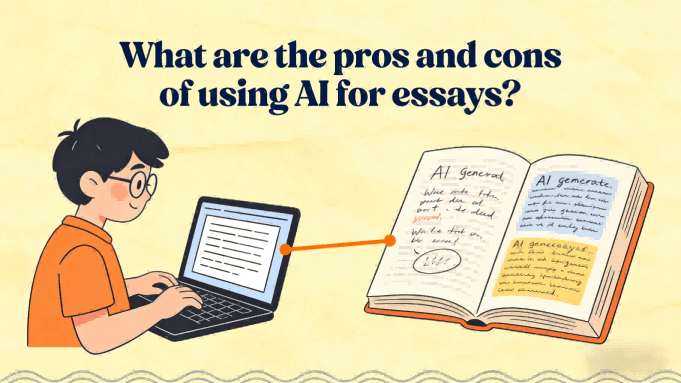

AI tools have become part of everyday student life. From brainstorming ideas to fixing grammar, many students now rely on AI when working on essays. This raises an important question: is it okay to use AI to write essays, and what are the pros and cons of using AI for essays?
In this article, we explore the AI essay generator pros and cons from a student perspective. We look at how AI essay writers work, the benefits of AI writing tools for students, and the risks students should understand before submitting AI-assisted work.
How Do AI Essay Writers Work in Academic Writing?
AI essay writers are built on large language models trained on massive amounts of text. When a student enters a prompt, the system predicts the most likely next words based on patterns it has learned.
How AI essay generators create essays from prompts
Most AI essay generators analyze your topic, assume a basic essay structure, and then generate paragraphs that sound academic. However, this process relies on probability rather than real understanding.
The role of large language models in essay writing
General-purpose tools like ChatGPT are designed for many tasks, not just essays. As a result, the output may be fluent but vague, repetitive, or overly polished.
Student perspective on AI essay writing
From a student perspective on AI essay writing, AI feels helpful because it reduces stress and saves time. Many students turn to AI when deadlines are tight or when they struggle to get started.
What Are the Benefits of Using AI in Academic Writing for Students?
Before focusing on risks, it’s important to understand what are the benefits of using AI in academic writing.
Benefits of AI writing tools for students
The main benefits of AI writing tools for students include speed and convenience. AI can generate outlines, rephrase sentences, and correct grammar within seconds.
AI writing assistance advantages and disadvantages
AI writing assistance advantages and disadvantages often appear together. While AI improves clarity and structure, it frequently lacks depth and original insight.
Can AI improve the quality of an essay?
Many students ask: can AI improve the quality of an essay? AI can improve readability and organization, but overall quality still depends on the student’s thinking, argument development, and revision.
Drawbacks of Using ChatGPT for Essays in Academic Settings
Despite its popularity, ChatGPT has clear limitations when used for academic work.
Drawbacks of using ChatGPT for essays
One major drawback of using ChatGPT for essays is that the content often feels generic. Many AI-written essays share similar sentence patterns, making them easier to identify.
How AI affects essay writing skills
Overreliance on AI can negatively affect essay writing skills. This raises concerns about how AI affects essay writing skills in the long term.
Plagiarism and AI essay writing risks
Plagiarism and AI essay writing risks still exist, even when content is not copied word for word. AI-generated text can be too similar to existing sources.
Will Professors Notice If an Essay Is Written with AI?
For many students, this is the most stressful part of using AI for essays.
What usually makes professors suspicious of AI-written essays
Professors often look for warning signs such as overly broad arguments, unnatural phrasing, or writing styles that differ from a student’s previous work.
How AI detection software for essays is actually used by universities
Many universities now use AI detection software for essays alongside plagiarism tools. These systems analyze sentence predictability, repetition, and language patterns common in AI-generated writing.
Why basic rewriting is often not enough to avoid detection
A common mistake is assuming that small edits or light paraphrasing will avoid detection. In reality, detection focuses on deeper language patterns.
Is It Ethical to Use AI for Academic Writing?
Ethical concerns are just as important as detection risks.
Is it okay to use AI to write essays?
Students frequently ask: is it okay to use AI to write essays? In most academic settings, AI is allowed as a support tool, not a replacement.
Is using AI for essays considered cheating?
Another common question is: is using AI for essays considered cheating? The answer usually depends on whether the student understands and revises the content.
Ethical use of AI in academic writing
The ethical use of AI in academic writing means improving your own draft while maintaining academic integrity and original thought.
EssayPass vs ChatGPT: A Student AI Writing Tool Selection Guide
Students often ask: what are the best AI tools for academic writing? The answer depends on how the tool is used.
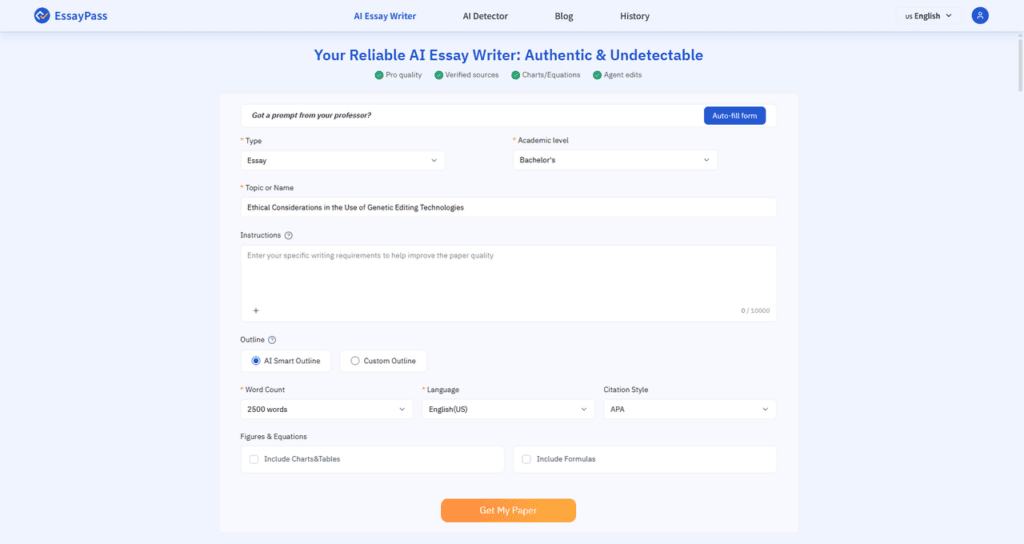
How students should choose an AI essay tool
The table below reflects common student situations when using AI for essay writing.
| Student Situation | ChatGPT | EssayPass |
| Need ideas or brainstorming | ✅ Useful | ⚠️ Not the main focus |
| Already have a draft | ⚠️ Limited help | ✅ Ideal |
| Worried about AI detection | ❌ Higher risk | ✅ Lower risk |
| Need academic tone | ⚠️ Inconsistent | ✅ Optimized |
| Plagiarism concerns | ⚠️ Not controlled | ✅ Designed to reduce risk |
| Ethical academic use | ⚠️ Easy to misuse | ✅ Built for responsible use |
| Planning to submit the essay | ❌ Risky | ✅ Safer option |
Pros and Cons of Using EssayPass for Essays
EssayPass is designed specifically for academic rewriting and paraphrasing rather than full essay generation.
It helps students improve clarity, academic tone, and originality while keeping their own ideas intact.
At the same time, students should understand that EssayPass does not replace thinking or research—it works best when applied to an existing draft.
The Future of AI in Education and Essay Writing
AI will continue to influence education, but many still ask: will AI replace human essay writing?
AI will not replace critical thinking. Instead, it will support students as ethical standards and detection systems evolve.
The future of AI in education essays will likely focus on responsible, transparent use.
Final Thoughts: Using AI for Essays the Smart Way
Using AI for essays involves both benefits and risks. While AI writing tools can save time and improve clarity, they also raise concerns about originality, detection, and ethics.
For students, the real issue is not whether to use AI—but how to use it responsibly.