
You’ve got a paper due tomorrow, and your mind is completely blank. Panic is creeping in, and you’re wondering how you’ll finish on time. You’ve heard AI can “write essays for you,” but the real challenge for most college students isn’t whether to use AI—it’s how to use it responsibly without breaking academic rules or hurting your grades.
Using AI for essay writing doesn’t mean letting a tool do all the work. When used correctly, AI can help you generate ideas, improve sentence clarity, and organize your thoughts, all while keeping your voice and integrity intact. Imagine asking AI to suggest a stronger thesis statement or polish a paragraph—you save time, but the final essay is still yours.
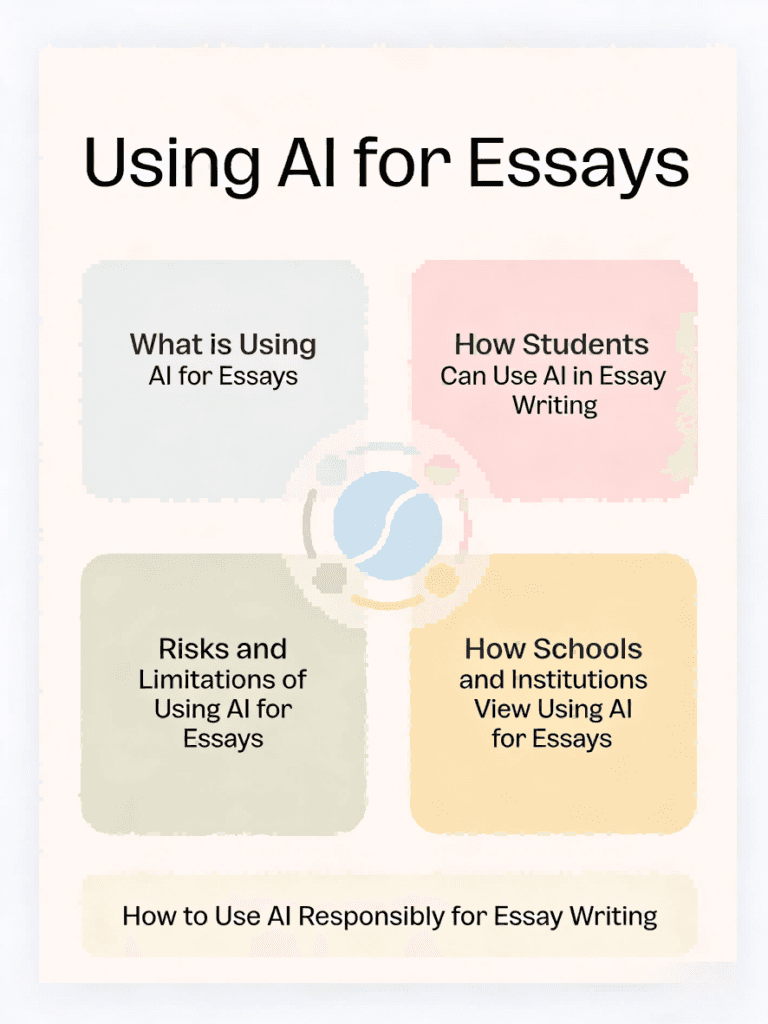
In this guide, we’ll break down what “using AI for essays” really means, how students can leverage AI at every stage of writing, the risks and limitations schools care about, and how to use AI responsibly to write essays that shine.
What is Using AI for Essays?
Using AI for essays means using artificial intelligence tools to assist your writing process without replacing your own thinking. Students can use AI to generate ideas, refine language, or improve structure. Understanding what AI can and cannot do is the first step to using it safely, effectively, and ethically in academic writing.
What AI Can Do in Essay Writing
AI can help brainstorm ideas, suggest alternative phrasing, and improve sentence structure. For example, you can ask an AI tool to generate multiple thesis statements or summarize key points from a paragraph. It can also suggest transitions between sections to improve readability. Treat AI as a helper that enhances your writing rather than producing your ideas for you.
What AI Cannot Do
AI cannot generate truly original arguments or evaluate the depth of course-specific content. It cannot understand your professor’s grading criteria or the nuances of a specific assignment. Relying on AI for these aspects can result in generic or inaccurate essays. Always cross-check AI-generated content and adapt it to reflect your own insights.
Why Understanding the Concept Matters
Knowing what AI can and cannot do helps prevent misuse, reduces anxiety about academic misconduct, and ensures that your work maintains originality. Students who understand AI’s capabilities are more confident and deliberate in integrating AI into their writing process.
How Students Can Use AI in Essay Writing
AI works best when it supports your thinking rather than replacing it. Students can use AI to save time, improve clarity, and explore ideas, but control and ownership of content must remain with the writer.
Brainstorm Ideas, Don’t Let AI Decide Your Argument
Start by asking AI open-ended questions like “What are some angles on renewable energy policies?” Collect multiple suggestions, then evaluate them yourself. Choose the ideas that align with your knowledge and interest, and discard vague or irrelevant ones. This allows AI to spark creativity without dominating your argument.
Build Your Own Outline, Then Let AI Optimize
Manually create your essay outline, listing main points and supporting evidence. Once the structure is clear, you can ask AI to suggest better paragraph order or smoother transitions. For example, AI might recommend combining two short points into one coherent paragraph. Review AI suggestions carefully and adjust to maintain logical flow. Learn more about structuring essays effectively to maximize clarity.
Use AI to Improve Language, Not to Write Your Essay
After drafting your paragraphs, feed them into AI for grammar corrections, clarity improvements, or style enhancements. For instance, you can ask, “Can you make this paragraph more formal and concise?” Avoid letting AI rewrite entire sections, as this can dilute your voice. Example: If your original sentence is “Many people think climate change is bad,” you could ask AI to suggest a more academic phrasing. AI might recommend, “Climate change is widely recognized as a critical global challenge.” You can then review and adjust it slightly to ensure it still sounds like your own writing. This keeps your ideas intact while improving readability and tone.
Final Check: Make Sure the Essay Represents Your Thinking
Read your essay aloud to ensure all arguments are yours and make sense in your voice. Pay attention to phrasing that seems too polished or unnatural—it may be AI-influenced. Adjust sentences where necessary so the final essay reflects your reasoning, style, and understanding.
Risks and Limitations of Using AI for Essays
While AI can be a valuable tool, misuse carries risks. Students must be aware of potential pitfalls, including plagiarism, over-reliance, and misalignment with assignment requirements.
The Risk of Copying AI Outputs Directly
Copying AI-generated text word-for-word can trigger plagiarism detection software and may lead to academic penalties. AI outputs may also lack depth or be too generic. Always rewrite or adapt AI suggestions to ensure originality and authenticity.
Relying on AI for Analysis or Conclusions
Allowing AI to write analytical sections or conclusions can make essays predictable or superficial. Professors can detect reasoning that does not reflect your understanding. Ensure that analysis and final arguments are crafted by you, using AI only as a supporting tool.
Relying on AI Detection Tools Instead of Your Judgment
AI detectors are not fully reliable. Passing a check does not guarantee safety. You are responsible for ensuring that your essay reflects your work. Carefully reviewing and revising content is essential to maintain integrity and originality.
How Schools and Institutions View Using AI for Essays
Academic institutions are still defining policies around AI. Some permit AI-assisted writing, while others restrict it. Understanding your school’s stance is crucial to avoid violating academic standards.
The Gray Area of Allowed vs. Not Allowed
Many schools allow AI for brainstorming, language refinement, or formatting assistance. Direct generation of essays is often prohibited. Always check assignment guidelines and school policies before using AI in your work.
What Professors Actually Care About
Professors prioritize critical thinking, originality, and coherent argumentation. They are less concerned with tools as long as your reasoning and analysis are your own. Focusing on demonstrating understanding ensures that AI use does not negatively impact your grade.
Benefits of Transparent AI Use
Being open about AI assistance can increase trust with instructors and reduce the risk of academic disputes. When used responsibly and disclosed appropriately, AI can enhance your writing without ethical concerns. Learn more about academic integrity in essay writing to stay safe.
How to Use AI Responsibly for Essay Writing
Responsible AI use balances efficiency with academic integrity. Following structured steps ensures that AI enhances rather than replaces your work.
Set Clear Rules for AI Use
Establish boundaries: AI can assist with ideas, language, and structure, but all original arguments and conclusions must come from you. This prevents accidental misuse and maintains academic credibility.
Step-by-Step Guide
-
Brainstorm ideas using AI, then select and refine the ones you understand.
-
Draft your essay outline manually; use AI to suggest improvements in flow or paragraph order.
-
Write your essay draft yourself; employ AI for grammar, style, or clarity.
-
Review the final essay, ensuring arguments, examples, and phrasing reflect your thinking.
Tip: To try these steps immediately, you can start exploring AI writing tools like EssayPass and see how AI can help you structure and polish your essays efficiently.
Common Mistakes to Avoid
-
Copying AI text directly
-
Allowing AI to write analysis or conclusions
-
Over-relying on AI detection tools instead of critical review
Benefits of Using AI Correctly
When used responsibly, AI can enhance clarity, improve logic and structure, save time, and help maintain academic integrity, all while keeping your personal voice intact.
Conclusion
Using AI for essays can be a game-changer when used responsibly. It’s not about letting a tool write your paper—it’s about enhancing your ideas, improving clarity, and organizing your thoughts efficiently. By following the steps in this guide, you can leverage AI at every stage of your essay without risking your grades or academic integrity.
If you’re staring at a blank page or racing against a deadline, EssayPass can help you turn your ideas into structured, polished essays while keeping your voice intact. Start exploring EssayPass today and see how AI can make your writing process smarter, faster, and more manageable.