
Imagine staring at a blank page for hours, knowing your essay is due tomorrow, and feeling that every second wasted makes your grade slip further. You’re not alone—studies show that over 60% of students get stuck at the very first sentence, unable to figure out how to start an essay, even when they know the topic.
This guide will show you exactly how to break writer’s block, craft a focused introduction, and start your essay confidently, whether you’re short on time, overwhelmed by the topic, or unsure how to begin. By following these strategies, you’ll transform that blank page into a structured, academically rigorous, and compelling start—fast.
How to Start an Essay When You Have No Ideas at All
Not having ideas at the beginning of an essay is rarely a creativity problem. It usually stems from cognitive overload: the task is too broad, expectations are unclear, and the writer is trying to solve too many problems at once—topic, structure, argument, and language.
Why “No Ideas” Usually Means the Task Is Underspecified
Students often understand the topic generally but not the specific task. They are unsure whether they need to argue, analyze, or explain. Ideas appear after the task is narrowed, not before.
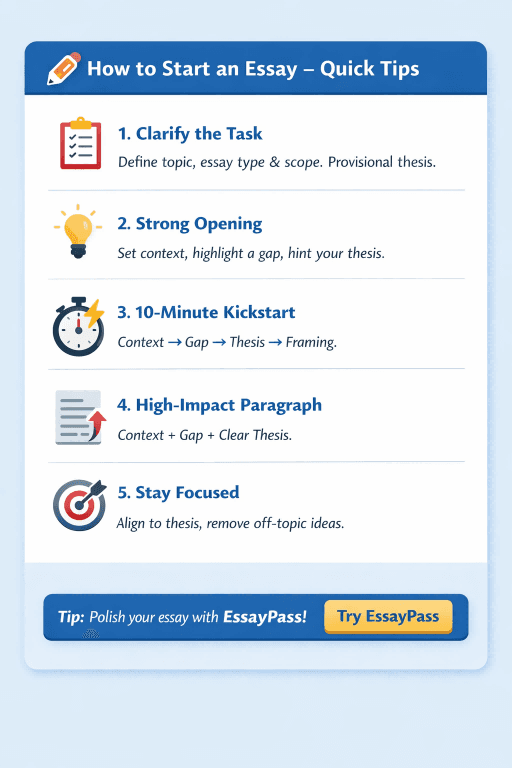
Clarify the Writing Task Before Looking for Ideas
Break the essay prompt into three elements:
-
The subject – What is the essay about?
-
The action – What are you being asked to do?
-
The scope – What are the boundaries of your discussion?
Rewriting prompts like this creates constraints that make idea generation possible.
Start With a Tentative Position, Not a Perfect One
Instead of waiting for the perfect idea, begin with a provisional statement:
-
“This essay will argue that…”
-
“One possible explanation is…”
-
“A key factor influencing this phenomenon may be…”
This allows your mind to ask productive questions and develop arguments.
Example: Moving From Cognitive Block to a Usable Essay Start
Before:
“I know the topic, but I don’t know what to say.”
After:
“This essay argues that online learning has improved access to higher education by reducing financial and geographical barriers.”
Even a rough statement like this unlocks the writing process.
How to Write a Strong Opening Sentence Without Overthinking It (Academic Upgrade)
In academic writing, the opening sentence does more than grab attention—it establishes research context, frames the argument, and positions the study within existing scholarship. A strong opening sentence helps readers immediately understand the subject, research problem, and academic significance.
Functions of a Strong Academic Opening
-
Establish the research field and context
-
Example:“Recent studies in cognitive psychology have examined the role of working memory in complex problem-solving tasks.”
-
-
Identify the research gap or problem
-
Example:“Despite extensive research on online learning platforms, few studies have analyzed their impact on students’ long-term engagement and academic outcomes.”
-
-
Bridge to the thesis and essay structure
-
Example phrases: “This study investigates…”, “The present paper examines…”, “In this context…”
-
Four Types of Academic Opening Sentences
| Type | Purpose | Example |
|---|---|---|
| Background | Introduce field/topic | “Artificial intelligence has become integral to higher education, transforming both teaching and learning practices.” |
| Research Gap | Highlight problem | “Although many studies explore AI in classrooms, limited research addresses its effect on equitable access to resources.” |
| Concept/Definition | Clarify key term | “Academic integrity refers to the ethical standards and practices that govern student work and assessment.” |
| Data/Trend | Provide evidence | “According to a 2023 survey, 72% of universities worldwide have integrated AI tools into their curriculum planning.” |
How to Write a Strong Thesis Statement in 5 Steps – Refine your thesis with expert tips to make your essay stand out.
How to Start an Essay in 10 Minutes (Even on a Deadline) — Professional & Academic
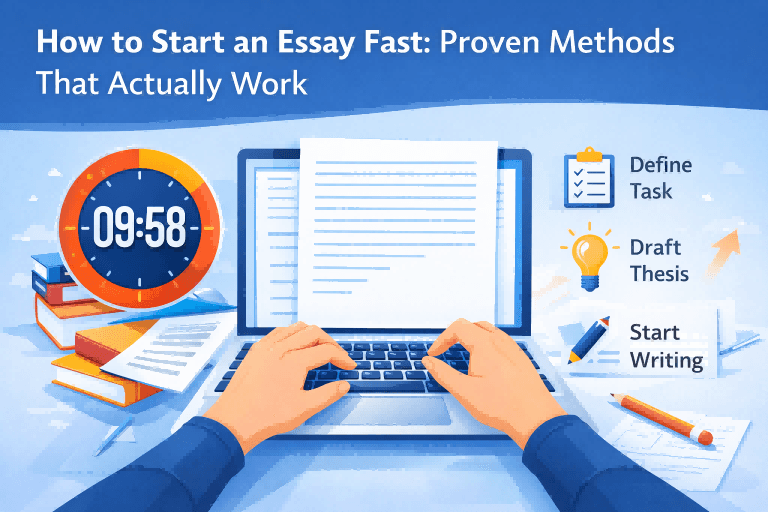
Time pressure is one of the most common obstacles in academic writing, often causing students to freeze in front of a blank page. However, by applying a systematic, research-oriented approach, it is possible to craft a clear, academically rigorous introduction in just 10 minutes—ensuring that your essay starts strong, your argument is logically framed, and your writing immediately signals credibility to the reader.
Step 1: Clarify Essay Type and Task (Minute 1–2)
Identify:
-
Essay type: analytical, argumentative, expository, reflective
-
Assignment goal: explain, argue, evaluate, compare
-
Scope: specific constraints or limits
Example: “The essay requires an argumentative analysis of AI in higher education, focusing on both benefits and challenges.”
Step 2: Draft a Focused Introduction Skeleton (Minute 3–5)
Write three quick sentences:
-
Context / Background – Establish research area
-
Research Problem / Gap – Identify unresolved issues or debates
-
Tentative Thesis Statement – Provisional argument
Example:
“Digital learning platforms have transformed access to higher education. While they create new opportunities, they present challenges regarding equity and student engagement. This essay argues that online education enhances accessibility while mitigating these challenges through strategic institutional support.”
Step 3: Refine Thesis Statement (Minute 6–8)
Ensure your thesis:
-
Directly addresses the prompt
-
Clearly summarizes your argument
-
Connects context and research gap
Example: “This essay argues that integrating renewable energy into urban infrastructure enhances sustainability and economic growth by reducing carbon emissions and generating new employment sectors.”
Step 4: Add Academic Framing and Credibility (Minute 8–10)
-
Introduce key terms or definitions if necessary
-
Include brief statistics, trends, or placeholder citations
-
Ensure logical flow: context → problem → thesis
Example:
“According to UNESCO (2023), over 70% of universities have adopted AI tools for distance learning. While promising, equitable implementation remains a challenge. This essay argues that such integration improves accessibility while addressing disparities through targeted institutional strategies.”
EssayPass AI Editing: Transform Your Drafts Instantly – Start using EssayPass now to perfect your introduction in minutes.
How to Construct a High-Impact First Paragraph in an Academic Essay — Step-by-Step Framework
The first paragraph is arguably the most critical: it establishes research context, frames your argument, and signals academic rigor to your reader. A strong first paragraph guides the reader into your argument logically and convincingly.
Step 1: Introduce the Research Context
-
Situate your topic within a broader academic field or debate.
-
Avoid vague statements; focus on what is already known.
Example:
“The integration of artificial intelligence into higher education has transformed student engagement, instructional design, and access to learning resources.”
Step 2: Identify the Research Gap or Problem
-
Highlight the specific issue, gap, or unresolved question your essay addresses.
Example:
“Despite the benefits of AI-driven platforms, limited research exists on their long-term impact on equitable access and student motivation.”
Step 3: Formulate a Clear, Defensible Thesis
-
Thesis should be specific, arguable, and linked to the research gap.
Example:
“This essay argues that AI integration in higher education enhances learning outcomes by improving accessibility while addressing disparities through targeted institutional strategies.”
Step 4: Ensure Logical Flow and Cohesion
-
Each sentence should lead naturally to the next, creating a coherent argument from context → gap → thesis.
-
Use academic transitions: “In this context…”, “Building on this issue…”, “Consequently…”
Step 5: Optional Academic Framing Enhancements
-
Include key terms, definitions, or brief references
-
Keep it concise—avoid overloading the introduction with too much evidence
Example:
“According to UNESCO (2023), over 70% of universities have adopted AI tools for distance learning. While promising, equitable implementation challenges persist. This essay argues that structured AI integration enhances accessibility and supports personalized instruction.”
How to Maintain Focus in Your Essay Introduction — Avoiding Off-Topic Drift
Drifting off-topic in the introduction is a common challenge, especially under pressure. A well-structured, academically informed introduction ensures that every sentence directly supports the thesis and signals research rigor.
Step 1: Define the Scope and Boundaries
-
Establish what your essay will cover and what it will exclude.
Example:
“This essay focuses on the impact of AI on student engagement and accessibility in higher education, without addressing curriculum design or faculty training strategies.”
Step 2: Align Each Sentence to Your Thesis
-
Apply the “one-question test”:
Does this sentence advance my thesis?
-
Revise or remove sentences that do not.
-
Use academic transitions: “In this context…”, “Consequently…”, “Building on this point…”
Step 3: Use a Structured Framework
-
Context / Background: Situate your essay within the scholarly conversation
-
Research Gap / Problem: Highlight what remains unresolved or underexplored
-
Thesis Statement: Present your central argument clearly and concisely
Example Structure:
“Digital learning platforms have expanded access to higher education. However, equitable participation remains a challenge. This essay argues that targeted institutional strategies can maximize benefits while minimizing disparities.”
Step 4: Introduce Academic Framing Without Overloading
-
Include key definitions, terms, or brief literature references
-
Focus on establishing relevance and framing the thesis, not overloading with evidence
Example:
“According to OECD (2022), students in regions with limited digital infrastructure are disproportionately affected by online learning initiatives. By addressing these disparities, educational institutions can improve both engagement and learning outcomes. This essay explores such strategies in the context of contemporary AI adoption.”
Step 5: Continuous Revision for Focus
-
Review the introduction sentence by sentence
-
Ensure every sentence contributes to thesis clarity, context, or research relevance
-
Tools like EssayPass can highlight off-topic sentences and suggest improvements
Final Thoughts: Start Strong, Finish Strong, and Write with Confidence
Starting an essay is often the most challenging part of academic writing—but it doesn’t have to be. By following these structured steps—clarifying your task, crafting a focused opening sentence, drafting a rapid introduction, building a high-impact first paragraph, and maintaining topic focus—you can overcome writer’s block, frame your argument clearly, and begin your essay with confidence.
Every strong essay begins with a precise, research-backed, and coherent introduction. But even the best strategies are easier to implement when you have tools that help polish clarity, ensure academic rigor, and check grammar instantly. Platforms like EssayPass can refine your writing, highlight off-topic sentences, and suggest improvements in real time, giving you the confidence to meet deadlines without sacrificing quality.Take control of your essay today: start strong, write smart, and let your ideas shine. With structured strategies and intelligent support, finishing your essay with clarity, professionalism, and academic excellence is not just possible—it’s within reach.