
“Good ideas, but the essay doesn’t flow.”If you’ve seen this comment on your paper, your problem isn’t weak content—it’s how your ideas connect.
Your sentences may be grammatically correct and your research solid, yet the argument still feels awkward or hard to follow. That’s because academic writing isn’t judged sentence by sentence; it’s judged by how clearly readers can trace your logic from one point to the next.
This is exactly where transition words for essays matter. When used correctly, they act as logical signals that guide readers through your reasoning, clarify relationships between ideas, and turn disconnected paragraphs into a coherent academic argument. In this guide, you’ll learn how transition words work, how to avoid the most common mistakes, and how to use them strategically to improve clarity, flow, and academic credibility.
Why Transition Words Are Essential for a Smooth Essay Flow
When reading an essay, one of the most noticeable aspects of good writing is how smoothly ideas flow from one sentence or paragraph to the next. Transition words play a crucial role in creating this flow, acting as bridges that guide readers through your arguments. Without them, even the strongest ideas can feel disjointed, making the essay difficult to follow.
What Transition Words Do
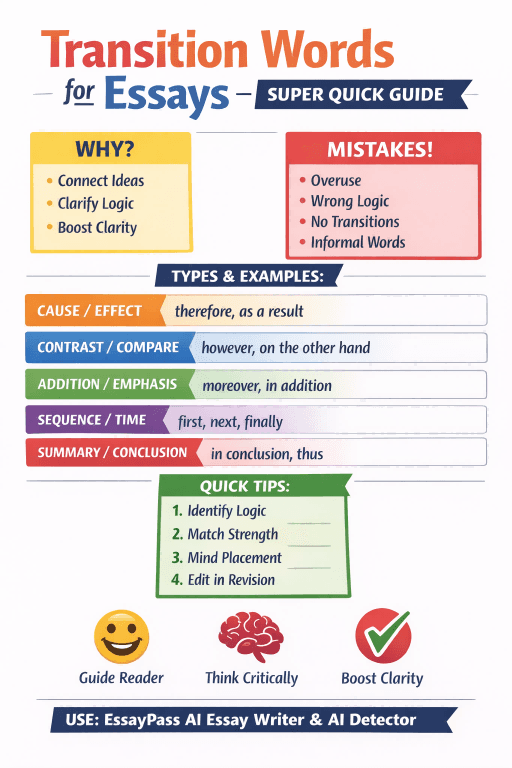
Transition words signal the relationship between ideas. They can indicate cause and effect (therefore, as a result), contrast (however, on the other hand), addition (moreover, in addition), or summary (in conclusion, overall). By explicitly marking these relationships, transition words help readers understand how your arguments connect, which strengthens the overall clarity of your essay.
The Impact of Missing or Misused Transition Words
Essays without proper transitions often read like a series of unrelated statements. For example, a paragraph may jump from presenting evidence to offering an opposing viewpoint without any signal, leaving the reader confused. Misused transition words can be equally harmful. Using therefore to introduce a contrasting idea or however where no contrast exists can make sentences feel forced and interrupt the natural flow.
Why Smooth Flow Matters for Academic Writing
Smooth flow is not just about readability; it affects comprehension and credibility. Professors and reviewers tend to rate essays with clear, logical progression higher because they can easily follow the argument. Transition words, when used thoughtfully, demonstrate your ability to structure ideas logically and professionally. They make your essay feel cohesive, persuasive, and academically strong.
Practical Insight
Even if you have compelling research and strong arguments, neglecting transition words can undermine your effort. Think of them as the invisible thread that weaves your essay together. Incorporating them strategically ensures that your ideas move seamlessly from one point to the next, guiding the reader effortlessly through your reasoning.
Common Mistakes When Using Transition Words in Essays
Transition words are powerful tools, but misusing them can do more harm than good. Students often believe that simply inserting a transition word will automatically improve their essay, yet incorrect usage can disrupt the flow, confuse readers, and weaken arguments. Understanding the most common mistakes is essential for writing essays that are both clear and persuasive.
Overusing a Single Transition Word
Relying on one or two transition words repeatedly—such as however, therefore, or moreover—makes writing predictable and monotonous. Overuse also diminishes the impact of the transition, reducing its ability to guide the reader’s understanding.
Example:
“The study supports the hypothesis. However, the results are not conclusive. However, further research is needed.”
This repetition creates a jarring rhythm and interrupts the natural flow of ideas.
Professional Tip: Rotate between synonyms and contextually appropriate alternatives:
-
Contrast: however, on the other hand, yet
-
Addition: moreover, furthermore, in addition
-
Cause/Effect: therefore, as a result, consequently
Using Transition Words Incorrectly
A transition word must match the logical relationship it intends to convey. Using therefore for contrast or however for addition confuses the reader and undermines credibility.
Example of misuse:
“The experiment failed. Therefore, the hypothesis was supported.”
Here, therefore incorrectly suggests a cause-and-effect relationship, misleading the reader.
Correct usage:
“The experiment failed. However, the methodology was sound.”
Professional Tip: Always identify the relationship between ideas—contrast, cause-effect, addition, or summary—before choosing a transition word.
Neglecting Transitions Entirely
Some essays omit transition words entirely, assuming that strong arguments are self-explanatory. While ideas may be sound, the essay can appear disjointed, making it hard for readers to follow the progression of thoughts.
Why it matters:
-
Academic readers expect a clear logical flow.
-
Without transitions, even well-researched evidence may fail to persuade.
Professional Tip: At a minimum, ensure that each paragraph begins with a linking phrase or sentence that signals the connection to the previous idea.
Using Informal or Overly Simple Transitions
Casual words like so, also, or but can make essays sound unprofessional. Academic writing requires transitions that clearly indicate relationships while maintaining formal tone.
Better alternatives:
-
But → However
-
So → Therefore
-
Also → Moreover / In addition
Using precise, formal transitions improves readability and demonstrates mastery of academic writing conventions.
Ignoring Paragraph and Sentence-Level Coherence
Even when individual transitions are correct, failing to consider the essay at the paragraph level can create abrupt shifts. Transitions should guide the reader both within and between paragraphs, creating a cohesive structure.
Professional Tip:
-
Begin new paragraphs with a sentence that links back to the previous idea.
-
End paragraphs with a summary or bridging sentence that prepares for the next point.
Tools like EssayPass AI Detector can help identify weak or misplaced transitions, ensuring your essay flows smoothly while maintaining professional academic standards.
Different Types of Transition Words and How to Use Them Correctly
Using transition words effectively requires more than just inserting them randomly. Each type of transition word serves a specific purpose, signaling logical relationships between ideas. Understanding these types and how to use them correctly is essential for producing essays that are coherent, persuasive, and academically strong.
Cause and Effect Transitions
These words show the relationship between an action or event and its outcome. They are essential for explaining reasoning, drawing conclusions, or linking evidence to claims.
Common examples: therefore, as a result, consequently, thus, hence
Usage tips:
-
Place cause-effect transitions at the beginning of the sentence that presents the consequence.
-
Ensure the preceding sentence clearly establishes the cause.
Example:
“The data indicates a significant increase in temperature over the past decade. As a result, glacier melting has accelerated in polar regions.”
Cause-effect transitions strengthen argumentation by clearly connecting evidence and conclusions.
Contrast and Comparison Transitions
These words highlight differences or similarities between ideas, helping readers evaluate multiple perspectives.
Common examples: however, on the other hand, in contrast, similarly, likewise
Usage tips:
-
Use contrast transitions (however, on the other hand) to introduce opposing ideas or counterarguments.
-
Use comparison transitions (similarly, likewise) to link ideas that reinforce or mirror each other.
Example:
“Previous studies emphasized the effects of diet on health. In contrast, recent research suggests that exercise plays an equally important role.”
Correct use of contrast and comparison transitions makes arguments nuanced and logical.
Addition and Emphasis Transitions
These words add information or reinforce a point, making your argument more comprehensive and persuasive.
Common examples: moreover, furthermore, in addition, indeed, notably
Usage tips:
-
Use addition transitions to expand on an idea or provide supporting evidence.
-
Avoid overloading a paragraph with multiple consecutive addition transitions, as this can disrupt flow.
Example:
“The study not only examined temperature trends but also analyzed rainfall patterns. Moreover, it evaluated the impact on local agriculture.”
Addition and emphasis transitions create depth by connecting related ideas smoothly.
Sequence and Time Transitions
These words organize events or ideas in chronological or logical order, essential for narrative essays, process descriptions, and methodological sections.
Common examples: first, next, subsequently, finally, meanwhile
Usage tips:
-
Use sequence transitions to guide readers through steps or phases.
-
Combine with clear paragraphing to maintain coherence.
Example:
“First, the participants completed a pre-test. Next, they engaged in a series of training exercises. Finally, their performance was evaluated.”
Proper sequencing ensures the reader can follow complex processes or arguments without confusion.
Summary and Conclusion Transitions
These words help wrap up arguments, synthesize information, and signal closure. They are critical for conclusion paragraphs or the final sentences of sections.
Common examples: in conclusion, overall, to sum up, therefore, thus
Usage tips:
-
Use summary transitions to consolidate main points.
-
Avoid introducing new information immediately after summary transitions.
Example:
“In conclusion, the study demonstrates a clear link between air pollution and respiratory health risks.”
For additional reading on academic writing, see how to write an academic essay.
How to Choose the Right Transition Word for Any Sentence
Knowing transition words is only the first step. The real challenge for most students and researchers is deciding which transition word fits a specific sentence in a specific academic context. Choosing the wrong one can weaken logic, confuse readers, or make writing sound unnatural. To select the right transition word consistently, you need to think in terms of logical relationships, not vocabulary lists.
Identify the Logical Relationship Before Choosing the Word
Every effective transition reflects a clear logical connection between ideas. Before selecting a transition word, ask yourself what relationship you want to express.
Common logical relationships include:
-
Cause and effect (Does one idea lead to another?)
-
Contrast (Are the ideas opposing or challenging each other?)
-
Addition (Are you extending or reinforcing a point?)
-
Sequence or time (Are you describing order or process?)
-
Conclusion or synthesis (Are you summarizing or evaluating?)
Academic habit to build:
Instead of asking “Which transition sounds good?”, ask
👉 “What is the logical function of this sentence?”
This shift alone dramatically improves coherence and academic precision.
Match the Strength of the Transition to the Strength of the Claim
Not all transition words carry the same rhetorical weight. Some imply strong conclusions, while others suggest tentative connections—an important distinction in academic writing.
Examples:
-
Strong conclusion: therefore, thus, consequently
-
Weaker or cautious link: as a result, in this way, to some extent
Example comparison:
“The data supports the hypothesis. Therefore, the theory can be confirmed.”
vs.
“The data supports the hypothesis. In this way, the theory gains preliminary support.”
Choosing transitions that match the confidence level of your evidence helps maintain academic credibility.
Consider Sentence Position and Paragraph Function
Transition words function differently depending on where they appear.
Sentence-level transitions help link individual ideas:
-
Often appear mid-sentence or at the beginning of a sentence
-
Example: however, therefore, moreover
Paragraph-level transitions guide the overall structure:
-
Often appear in topic sentences or concluding sentences
-
Example: in contrast to previous studies, building on this argument
Academic tip:
Strong essays don’t rely on single-word transitions alone. They often use transition phrases or full linking sentences to signal shifts between paragraphs.
Avoid Mechanical or Formulaic Choices
Many students fall into the trap of using the same transition patterns repeatedly (e.g., starting every paragraph with however or moreover). While technically correct, this creates predictable and robotic writing.
Better strategy:
-
Vary transition types across paragraphs
-
Combine transition words with context-specific phrasing
Example:
Instead of:
“However, this view is limited.”
Try:“Despite its widespread acceptance, this view remains limited.”
This approach improves flow and makes writing sound more natural and advanced.
Revise Transitions During Editing, Not Drafting
One of the most overlooked strategies is waiting until revision to refine transitions. During drafting, focus on ideas and structure. During editing, evaluate how smoothly those ideas connect.
Revision checklist:
-
Does each paragraph clearly connect to the previous one?
-
Do transitions reflect the actual logic of the argument?
-
Are any transitions overused or unnecessary?
At this stage, many writers benefit from tools or feedback that highlight weak or mismatched transitions, helping ensure clarity and consistency without rewriting entire sections.
Why This Skill Matters Academically
Choosing the right transition word is not about sounding sophisticated—it’s about making your reasoning transparent. Professors and reviewers don’t just evaluate what you say; they evaluate how clearly your ideas connect. Mastering transitions improves readability, argument strength, and overall academic tone.
How Transition Words Improve Essay Clarity, Grades, and Academic Credibility
Transition words do far more than make an essay “sound smooth.” In academic writing, they directly influence how clearly your argument is understood, how persuasively your evidence is evaluated, and ultimately how your work is graded. Essays with strong transitions don’t just read better—they demonstrate stronger thinking.
Transition Words Make Your Argument Easier to Follow
Academic readers—professors, supervisors, reviewers—do not read essays word by word. They scan for logical structure. Transition words act as signposts, guiding readers through your reasoning.
Without clear transitions:
-
Arguments feel fragmented
-
Readers must infer relationships on their own
-
Key points lose impact
With effective transitions:
-
Claims, evidence, and conclusions connect clearly
-
The logical progression becomes visible
-
Readers stay focused and engaged
In short, transitions reduce cognitive load, allowing readers to focus on what you argue rather than how to interpret it.
Clear Transitions Signal Higher-Level Critical Thinking
In grading rubrics, clarity and coherence are often tied to descriptors like:
-
logical development
-
clear reasoning
-
strong analytical flow
These qualities are not judged solely by ideas, but by how well ideas are connected. Thoughtful transitions show that you understand relationships between concepts—comparison, causation, limitation, synthesis—which is a core marker of academic maturity.
Example:“This result contradicts earlier findings. However, when methodological differences are considered, the discrepancy becomes understandable.”
Here, the transition doesn’t just connect sentences—it reflects analytical judgment.
3. Strong Transitions Improve Paragraph Unity and Structure
Many essays lose marks not because ideas are weak, but because paragraphs feel unfocused. Effective transitions help establish:
-
Clear topic continuity
-
Smooth movement from general claims to specific evidence
-
Logical closure at the end of each paragraph
When transitions are missing or misused, paragraphs can feel like isolated mini-essays rather than parts of a unified argument.
Academic insight:
Well-placed transitions often do the work of explanation, reducing the need for repetitive or overly long sentences.
Transition Quality Affects Perceived Writing Proficiency
Readers often associate fluent transitions with:
-
Advanced language control
-
Academic confidence
-
Professional-level writing
Conversely, awkward or repetitive transitions can make otherwise strong research appear rushed or underdeveloped. This perception matters, especially in:
-
High-stakes coursework
-
Theses and dissertations
-
Journal submissions
Transitions subtly shape how seriously your work is taken.
Conclusion: Make Your Essay Flow Effortlessly
Mastering transition words isn’t just a writing tip—it’s a fast track to clearer, more persuasive essays. Without clear connections, even brilliant ideas can get lost, and reviewers may miss your strongest points.
By strategically choosing and revising your transitions, you ensure every sentence guides the reader smoothly, strengthens your arguments, and demonstrates academic maturity. The difference between a good essay and a great one often comes down to these subtle—but powerful—connections.
Don’t leave clarity to chance. Take a moment now to review your essay: identify weak or repetitive transitions, replace them with precise alternatives, and watch your argument flow effortlessly. Using tools like EssayPass can help you spot overused, misplaced, or weak transitions and suggest the perfect alternatives, making your essay clear, cohesive, and academically strong.
The essays that stand out are the ones where ideas don’t just exist—they connect, convince, and stick. Make your transitions work for you, not against you.