
Imagine staring at a blank screen, a 1500 word essay due tomorrow, and the clock ticking relentlessly. You know the topic, you have your research, but the words just won’t come. Every sentence feels like it carries double weight, and you fear that if you write too little, your grade will suffer — yet if you write too much, your argument will become muddled. This is the challenge every student and researcher faces: how to craft a precise, compelling essay within a strict word limit while maintaining depth and clarity.
A 1500 word essay is not simply about reaching the word count. It’s about organization, depth of argument, and smooth flow, ensuring that every paragraph and sentence contributes meaningfully. Done right, your essay communicates ideas clearly, persuades effectively, and demonstrates your critical thinking. Done poorly, even brilliant ideas can appear scattered, repetitive, or superficial.
In this guide, you’ll learn how to structure your essay, develop strong arguments, refine analysis, and polish language — all while hitting 1500 words with precision. By the end, you’ll understand what a high-quality essay looks like and how to achieve it consistently.
1500 Word Essay Structure: How to Break Down Each Section
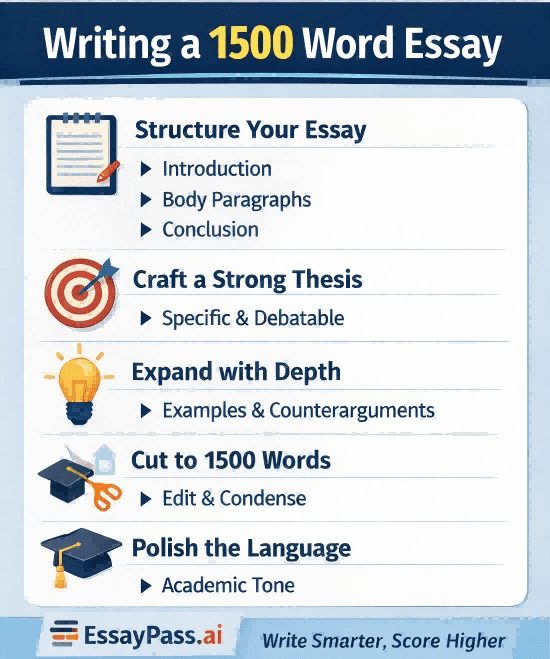
Planning is the foundation of any successful essay. A 1500 word essay is long enough to explore ideas in detail, but short enough that inefficiency or disorganization can ruin it. By dividing your essay into clear sections — introduction, body, and conclusion — you create a roadmap that ensures clarity, focus, and logical progression.
Introduction (150–200 Words)
Your introduction should hook the reader, set context, and present your thesis. Start with a thought-provoking statement, statistic, or scenario to draw readers in. Then, briefly provide context to frame your essay topic. Finally, present a thesis that is specific, arguable, and clearly outlines the scope of your essay.
Example:
“Imagine a coastal city where rising sea levels threaten thousands of homes annually, yet government policies fail to provide adequate support. While adaptation strategies aim to reduce vulnerability, they often disproportionately affect low-income communities. This essay argues that effective climate adaptation must address social equity alongside environmental protection. The following sections explore economic, social, and policy dimensions to illustrate these disparities.”
The introduction sets the tone for your essay. It should establish your credibility, clarify your focus, and give the reader a reason to continue reading.
Body Paragraphs (1000–1100 Words)
Each paragraph should serve as a self-contained argument: a topic sentence, supporting evidence, analysis, and a transition to the next idea. Avoid simply summarizing facts — your analysis is what demonstrates critical thinking.
-
Topic Sentence – Clearly introduces the main point.
-
Evidence – Incorporate statistics, quotes, or examples relevant to your argument.
-
Analysis – Explain the significance of the evidence and how it supports your thesis.
-
Transition – Connect logically to the next paragraph.
Example:
“Low-income communities face unique challenges in climate adaptation because policy costs are disproportionately high relative to available resources. Smith (2021) found that insurance gaps leave households vulnerable to flooding, demonstrating that financial barriers are a critical factor in policy effectiveness.”
Each paragraph should introduce one main idea, supported by evidence and analysis. Avoid tangents; every sentence must contribute to advancing your argument.
Conclusion (150–200 Words)
Your conclusion should synthesize the essay’s key points, reaffirm the thesis in new words, and highlight broader implications. Avoid repeating phrases verbatim from your introduction. Instead, emphasize significance, provide insights, or suggest next steps.
Example:
“In conclusion, climate adaptation strategies are essential, but without addressing economic disparities, they may exacerbate social inequities. Policies must balance environmental goals with support for vulnerable communities to ensure effective and equitable solutions. Recognizing these challenges is critical for developing resilient, inclusive adaptation strategies.”
A strong conclusion leaves the reader with a clear sense of closure and understanding of why your argument matters.
What Does a High-Scoring 1500 Word Essay Look Like?
Meeting the word count alone does not guarantee a high score. A high-scoring 1500 word essay is strategically structured, analytically rigorous, and rhetorically persuasive. It demonstrates that the writer has not only researched the topic but also understood it, synthesized information, and presented a clear, compelling argument. Unlike mediocre essays, which may simply summarize facts or repeat ideas, top-scoring essays guide the reader through a logical progression of thought, anticipate counterarguments, and provide insightful analysis.
At its core, a high-scoring essay achieves clarity, depth, and cohesion. Clarity ensures that each argument is understandable and focused. Depth means that evidence is interpreted, not just presented, and that relationships between ideas are explored thoroughly. Cohesion guarantees smooth transitions between paragraphs, creating a narrative thread that ties all points back to the thesis.
Craft a Strong, Arguable Thesis
The thesis is the backbone of your essay — a weak thesis results in an unfocused essay, while a strong, arguable thesis provides direction and anchors your arguments. To craft a compelling thesis and explore research-based arguments, it can be helpful to refer to guides like How to Write a Research Paper, which provide structured approaches and examples for developing analytical, evidence-backed claims.
A high-scoring essay thesis is:
-
Specific: Narrow enough to be fully addressed in 1500 words.
-
Debatable: Opens room for argument rather than stating an obvious fact.
-
Roadmap-Oriented: Gives the reader a clear sense of the essay’s structure.
Example:
-
Weak: “Technology affects education.”
-
Strong: “Online learning platforms improve access to higher education but risk widening performance gaps among students with limited digital literacy skills, highlighting a need for targeted support measures.”
Practical Tip: Summarize your thesis in one sentence. Ask: Does this allow me to argue, analyze, and provide evidence over 1500 words? If not, refine it.
Develop Analytical Depth
High-scoring essays do more than present evidence — they analyze, interpret, and connect evidence to the thesis. Every piece of data or quotation should serve a purpose: showing a trend, illustrating an argument, or revealing a contradiction.
Example:
-
Weak: “Social media affects teenagers’ mental health.”
-
Strong: “Social media exacerbates adolescent anxiety by promoting social comparison, particularly through curated content that highlights perceived peer success, thereby increasing self-consciousness and stress.”
Techniques to deepen analysis:
-
Ask “Why” and “How”: Why does this matter? How does it connect to the thesis?
-
Compare and contrast: Highlight differences between studies, theories, or perspectives.
-
Link evidence to implication: Show what the findings mean for the broader argument.
Structure Paragraphs Logically
Even excellent analysis can lose impact if paragraphs are disorganized. Each paragraph should contain:
-
Topic Sentence: Introduces the main point.
-
Supporting Evidence: Facts, statistics, or quotes.
-
Analysis/Interpretation: Explains the significance of evidence.
-
Transition: Connects smoothly to the next paragraph.
Example Paragraph Structure:
“Low-income students face unique barriers to digital learning. According to Smith (2020), 42% of students in underfunded schools lack reliable internet access. This disparity demonstrates that while online learning platforms increase accessibility on paper, they can inadvertently reinforce existing educational inequalities. Consequently, policymakers must account for socio-economic factors when implementing digital education strategies.”
Seamless Transitions and Narrative Flow
A hallmark of a high-scoring essay is that ideas flow naturally, guiding the reader from one argument to the next without abrupt jumps. Transitions can be words, phrases, or sentences that explain relationships between points.
Examples:
-
Furthermore — adds supporting evidence
-
In contrast — introduces an opposing perspective
-
Consequently — shows cause-effect relationships
Example:
“While autonomy in online learning can enhance engagement, structured teacher feedback ensures that learning objectives are met, illustrating that freedom and guidance must coexist to maximize educational outcomes.”
Use Evidence Strategically
Evidence should support your argument while being interpreted and analyzed. Use data, case studies, and quotations to strengthen points, but always explain their significance.
Example:
“Smith (2021) reports that students with structured digital guidance outperform peers relying solely on self-directed learning by 15%, demonstrating that autonomy alone is insufficient without targeted support.”
How to Expand a 1500 Word Essay Without Adding Fluff
Many students struggle to reach 1500 words without sounding repetitive. The key is not to pad your essay with empty phrases, but to expand depth, develop analysis, and explore nuances. A high-quality essay grows organically: each paragraph adds insight, supports the thesis, and engages the reader.
Develop Analysis, Not Repetition
Example:
Weak: “Remote work increases productivity.”
Strong: “Remote work increases productivity by allowing employees to align tasks with peak focus periods. Beyond efficiency, this flexibility also enhances intrinsic motivation, fostering engagement and job satisfaction over time (Johnson, 2021).”
Introduce Counterarguments
Example:
“Some argue that remote work reduces collaboration, potentially harming team cohesion. However, structured virtual meetings and collaborative tools maintain connectivity, showing that autonomy and teamwork can coexist effectively.”
Deepen Context and Implications
Example:
“While remote work policies can boost individual productivity, they also transform organizational culture. Moving from strict supervision to output-based evaluation changes employee expectations, impacts managerial roles, and can influence long-term engagement trends.”
Expand Examples and Case Studies
Example:
“In a study of 200 employees, Smith (2020) found that teams with flexible schedules completed projects 18% faster. This was not due solely to autonomy; the success also depended on clear communication channels and regular progress check-ins.”
Refine Language and Add Nuance
Example:
“Autonomy in remote work enhances productivity, yet its benefits are contingent upon employee discipline, managerial oversight, and access to collaborative tools — demonstrating that freedom and structure must coexist to optimize outcomes.”
How to Cut Down to 1500 Words Without Losing Quality
Exceeding the 1500-word limit is a common problem, but trimming your essay isn’t just about deleting sentences. The goal is conciseness without losing argument strength, analysis, or clarity. High-quality reduction involves evaluating each paragraph and sentence for relevance, precision, and necessity.
Step 1: Identify Redundancies
Check your essay for repeated ideas, overlapping evidence, or restated points. Redundant content can often be combined or removed without affecting the argument.
Example:
Original: “Remote work increases productivity because employees can manage their tasks independently. Additionally, autonomy allows employees to schedule work according to their own peak focus times, which also enhances productivity.”
Edited: “Remote work increases productivity as employees can schedule tasks around their peak focus periods, leveraging autonomy effectively.”
Practical Tip: After drafting, highlight repeated concepts in each paragraph. Ask: Does this sentence introduce a new point or support an existing one? Remove it if it doesn’t.
Step 2: Merge and Condense Sentences
Long, wordy sentences can often be shortened without losing meaning. Focus on combining ideas and removing filler words.
Example:
Original: “Due to the fact that employees are given more flexibility in their schedule, they are able to work during times when they feel most focused and alert, which results in higher productivity.”
Edited: “Flexible schedules let employees work during peak focus times, boosting productivity.”
Practical Tip: Look for phrases like “due to the fact that,” “in order to,” or “it is important to note that.” Replace with concise alternatives: “because,” “to,” or simply remove unnecessary lead-ins.
Step 3: Trim Quotes and Paraphrase Effectively
Quotations are powerful, but excessive use can inflate word count. Paraphrase where possible without losing the original meaning, and integrate the analysis alongside the evidence.
Example:
Original: “According to Johnson (2021), remote work allows employees to structure their day according to personal preferences, which increases their motivation and productivity levels.”
Edited: “Johnson (2021) notes that structuring work around personal schedules enhances motivation and productivity.”
Practical Tip: Summarize or combine multiple quotations into a single, concise statement while keeping attribution.
Step 4: Focus on Topic Sentences and Paragraph Unity
Ensure each paragraph contains only one main idea. Extra details or tangential points can often be removed or merged into other paragraphs.
Example:
Original paragraph contains both discussion of remote work benefits and unrelated HR policies. Split or remove the unrelated content to maintain focus.
Practical Tip: After drafting, ask: Does every sentence contribute to this paragraph’s main point? If not, cut or move it.
Step 5: Replace Wordy Phrases with Precise Alternatives
Academic essays often contain wordy expressions that can be simplified.
-
“In the event that” → “If”
-
“At this point in time” → “Now”
-
“Due to the fact that” → “Because”
-
“A large number of” → “Many”
Example:
Original: “In order to maximize productivity, it is necessary for employees to structure their tasks efficiently.”
Edited: “To maximize productivity, employees must structure their tasks efficiently.”
Practical Tip: Scan your essay for long introductory phrases and unnecessary modifiers, then simplify.
Step 6: Read Aloud and Edit for Flow
Reading aloud can help identify awkward phrasing, repetition, or tangential ideas. If a sentence doesn’t sound concise or necessary, revise it.
Practical Tip: During this stage, also check transitions — trimming shouldn’t break the narrative flow. Combine short sentences where appropriate to maintain rhythm and cohesion.
Step 7: Prioritize Analysis Over Description
Cutting word count often requires choosing which evidence or examples are essential. Keep sentences that advance analysis or strengthen the thesis, and remove purely descriptive or peripheral details.
Example:
Remove: “Remote work can include working from home, co-working spaces, or cafés, which gives employees different options for work environments.”
Keep: “Remote work boosts productivity by allowing employees to choose environments that align with their focus and motivation.”
How to Make a 1500 Word Essay Sound More Academic
Reaching 1500 words is only part of the challenge. What truly distinguishes a high-scoring essay from an average one is not length, but academic tone, precision of language, and intellectual control. Many students lose valuable marks not because their ideas are weak, but because their writing sounds conversational, vague, or imprecise.
An academic essay does not simply “state opinions.” It constructs arguments, evaluates evidence, and engages critically with ideas. To make your 1500 word essay sound more scholarly, you must refine how you express your thinking — not just what you say, but how you say it.
Below are the key strategies that elevate writing from informal to academic.
1. Replace Vague Language with Precise Terminology
Academic writing values clarity and specificity. Words like “things,” “a lot,” “very,” or “good/bad” weaken your argument because they lack measurable meaning.
Weak:
“There are a lot of problems with social media.”
Stronger:
“Social media platforms contribute to increased anxiety levels, diminished attention spans, and heightened exposure to misinformation.”
Notice the difference: the second sentence identifies specific mechanisms and consequences. Precision demonstrates subject knowledge and analytical maturity.
When revising your essay, highlight vague words and ask:
-
Can this be more specific?
-
Can I quantify or qualify this claim?
-
Can I replace general language with discipline-specific terminology?
2. Strengthen Analysis, Not Just Description
A common mistake in 1500 word essays is over-describing evidence without analyzing it. Academic writing requires interpretation.
Descriptive:
“A study found that students who study longer get better grades.”
Analytical:
“The study suggests that sustained cognitive engagement improves knowledge retention; however, it also raises questions about diminishing returns and the role of study efficiency versus duration.”
The second version does three important things:
-
Interprets the evidence
-
Explores implications
-
Introduces complexity
Professors reward essays that move beyond “what happened” to explore why it matters and what it implies.
A practical method: after every piece of evidence, add 2–3 sentences answering:
-
Why is this significant?
-
How does this connect to my thesis?
-
Does this evidence have limitations?
3. Use Formal Transitions to Guide Logical Flow
Academic essays should read like a logical progression of ideas rather than disconnected paragraphs. Strategic transitions improve coherence and intellectual authority.
Instead of simple transitions like:
-
“Also”
-
“Another thing”
-
“And”
Use academically appropriate connectors such as:
-
Furthermore
-
In contrast
-
Consequently
-
However
-
Notably
-
From this perspective
-
Taken together
For example:
“However, while technological innovation improves accessibility, it simultaneously introduces ethical dilemmas that require regulatory oversight.”
Transitions do more than link sentences — they clarify relationships between ideas (contrast, cause, addition, qualification).
4. Eliminate Emotional or Overly Personal Language
Unless explicitly allowed (such as reflective essays), avoid:
-
“I believe”
-
“In my opinion”
-
“I feel that”
Instead, let evidence speak.
Weak:
“I think climate change is very serious.”
Academic:
“The accelerating rate of global temperature rise indicates an urgent need for coordinated international intervention.”
The academic version removes personal framing and presents the claim as evidence-based reasoning.
5. Integrate Sources Smoothly
Rather than inserting quotes abruptly, embed them into your analysis.
Basic:
“According to Smith (2022), ‘Remote work improves productivity.’”
Integrated:
“Smith (2022) argues that remote work improves productivity by allowing employees to optimize their work environments, a factor that may explain performance increases in knowledge-based industries.”
Notice how the second version:
-
Introduces the scholar
-
Explains the mechanism
-
Connects directly to analysis
This integration signals academic maturity.
6. Maintain Sentence Variety and Structural Control
A 1500 word essay should demonstrate syntactic flexibility. If every sentence follows the same structure, your writing feels mechanical.
Mix:
-
Short emphasis sentences
-
Complex analytical sentences
-
Conditional statements
-
Comparative constructions
For example:
“While digital platforms expand access to information, they also amplify misinformation. Consequently, educational systems must adapt by strengthening media literacy frameworks.”
Sentence variety improves rhythm and readability — key markers of sophisticated writing.
7. Conduct a Final “Academic Tone Audit”
Before submission, review your essay with these questions:
-
Are any claims unsupported?
-
Are transitions clear between paragraphs?
-
Is my thesis consistently reinforced?
-
Have I avoided informal language?
-
Does every paragraph contain analysis, not just description?
You can also run your draft through a refinement tool such as the EssayPass AI Essay Writer to enhance tone and coherence while preserving your core arguments. After polishing, verifying originality with an AI detection check ensures your essay maintains academic integrity.
Final Thoughts: Achieve Your Best 1500 Word Essay
Writing a 1500 word essay doesn’t have to feel overwhelming. By planning your structure carefully, analyzing evidence deeply, refining your arguments, and maintaining academic tone, you can transform a daunting assignment into a clear, persuasive, and high-scoring essay. Remember: quality always outweighs quantity — each word should serve your thesis, strengthen your analysis, and guide the reader through your ideas.
Yet even the most diligent students can struggle with clarity, flow, and word count simultaneously. This is where EssayPass.ai becomes invaluable. Whether you need to expand your essay without adding fluff, tighten your sentences to meet the word count, or polish your language to sound academically sophisticated, EssayPass.ai provides intelligent, practical support. It helps you save time, reduce stress, and submit essays that reflect both your knowledge and critical thinking.
Take the guesswork out of essay writing. With the right strategy and the right tools, a 1500 word essay can become not just a requirement, but an opportunity to showcase your analytical skills, creativity, and precision. Start refining your essays today, and let every word count toward your best possible grade.