
Staring at your essay like it’s a ticking time bomb? Every missing word feels like a lost point, and every extra paragraph threatens to bury your argument in a wall of text. For college students and researchers, getting the essay length just right is one of the most stressful parts of writing—and yet it can make the difference between an A and a mediocre grade.
In this guide, you’ll discover exactly how to master your college essay length, learn the common traps that derail students, and get practical, step-by-step strategies to balance depth, clarity, and structure—so your ideas stand out, your arguments stay sharp, and your essay hits the perfect word count without hours of frustrating rewrites.
What’s the Perfect College Essay Length and Why It Matters
Knowing the perfect essay length is more than hitting a number—it’s about balancing depth, clarity, and completeness. In academic writing, professors evaluate essays not only for content but also for how effectively ideas are communicated. Staying within the recommended word count ensures that your essay is detailed enough to present a thorough argument, yet concise enough to maintain reader focus. Exceeding or falling short of the ideal range can inadvertently signal a lack of preparation or critical thinking, affecting the overall impression and your grade.
Standard Word Count Ranges for Different Essay Types
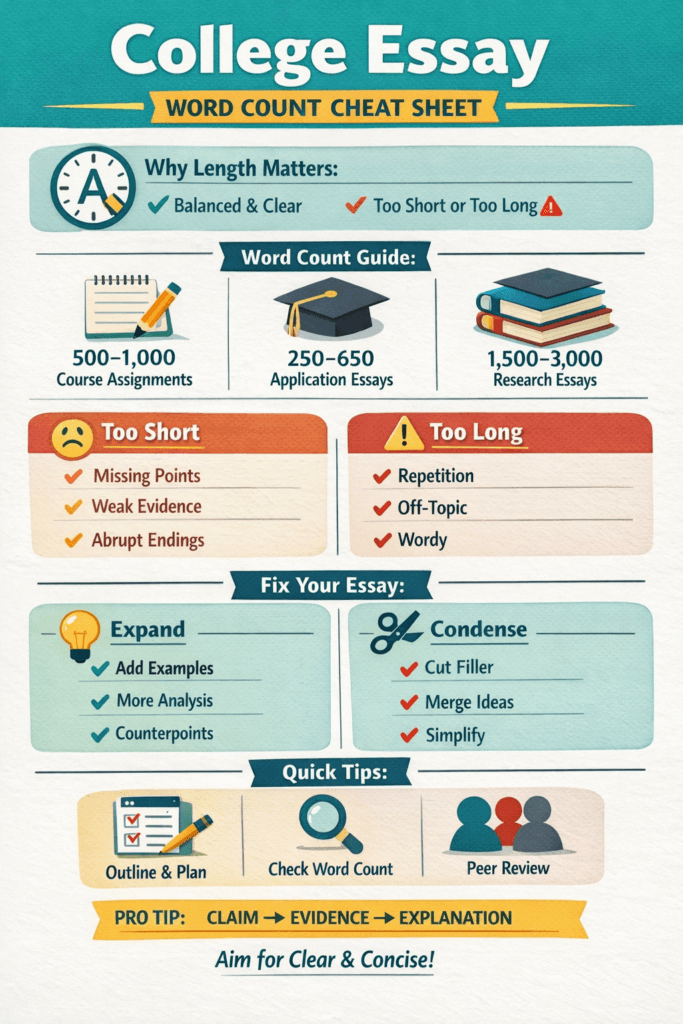
Different essays serve different purposes, reflected in their typical length:
-
Course assignments (500–1,000 words): Focused on demonstrating comprehension, clear argumentation, and analytical reasoning.
-
Application essays (250–650 words, Common App standard): Evaluate clarity, personality, and the ability to communicate complex ideas concisely.
-
Research essays (1,500–3,000 words for upper-level courses): Test the ability to synthesize sources, present detailed evidence, and construct rigorous arguments.
Understanding these ranges allows students to benchmark their work and self-assess whether their essay meets academic expectations before submission. Creating a mini-outline aligned with word count per section can help ensure balanced coverage.
Why Staying Within the Recommended Length Improves Your Grade
Word count matters because it is directly linked to the quality of argumentation and structural clarity. Essays that are too short often lack sufficient analysis, fail to explore counterarguments, or skip critical context. Conversely, excessively long essays may dilute the main argument, introduce tangential points, or create repetitive sections. Maintaining an appropriate length signals to professors that you can convey ideas efficiently, respect assignment guidelines, and understand academic expectations. This not only influences grading but also reflects professional academic habits that professors value.
Common Misconceptions About Essay Length
Many students hold misconceptions:
-
“Longer essays are better.” ❌ Longer essays can introduce redundancy and weaken argument clarity.
-
“Word count doesn’t matter if my essay feels complete.” ❌ Essays outside the recommended range may fail structural or depth expectations, even if content seems sufficient.
Recognizing these misunderstandings allows students to focus on quality over quantity, ensuring that every paragraph serves a clear purpose and contributes to the overall argument. Mastering this balance is crucial for both grades and developing long-term academic writing skills.
Too Short, Too Long, or Just Right? Common Mistakes Students Make
Writing an essay of the right length is a delicate balance between thorough analysis and concise expression. Many students struggle because they either underestimate the depth required or overcompensate with extra content. Both extremes can negatively impact clarity, coherence, and ultimately, grades. Understanding common pitfalls and how they affect your essay is the first step to mastering word count management.
Signs Your Essay Might Be Too Short
An essay that falls below the recommended word count often exhibits subtle but critical issues:
-
Incomplete coverage of the prompt: Key points are missing or superficially addressed, leaving arguments underdeveloped.
-
Limited evidence or examples: Without adequate supporting material, your claims lack credibility and persuasive power.
-
Abrupt transitions: Short essays may feel choppy, with ideas appearing disconnected or underexplored.
Why this matters: Professors assess not only correctness but also analytical depth and argument cohesion. A short essay can inadvertently signal insufficient engagement with the topic, which is reflected in lower scores.
Pro Tip: Conduct a self-check by outlining each prompt requirement and marking where your essay addresses it. Missing or lightly treated points are a sign your essay is too short.
Signs Your Essay Might Be Too Long
Exceeding the recommended word count can also compromise essay quality:
-
Repetition of ideas: Students often restate points unnecessarily, diluting the impact of their argument.
-
Off-topic sections: Additional content may drift away from the main thesis, confusing the reader.
-
Overly complex sentences: Longer essays sometimes include sentences so dense that the central idea is lost.
Why this matters: Lengthy essays may appear unfocused or poorly structured. Graders are trained to spot redundancy and tangential content, which can reduce readability and perceived clarity, lowering the overall grade.
Pro Tip: Break your essay into paragraphs and check each for relevance. If a paragraph doesn’t directly support your thesis, consider condensing it.
How These Mistakes Affect Your Grade
Both extremes—too short or too long—have tangible impacts on academic evaluation:
-
Short essays → Missed analysis, insufficient examples, and incomplete argumentation.
-
Long essays → Loss of focus, diluted arguments, and potential reader fatigue.
Understanding this connection creates urgency to adjust your essay strategically. By identifying signs early, you can implement targeted solutions: expanding underdeveloped sections or condensing repetitive content, ensuring your essay demonstrates critical thinking, clarity, and academic maturity.
How to Fix Your Essay Word Count Without Losing Your Ideas
Adjusting your essay to meet the required word count can be challenging, but it doesn’t have to compromise the quality or clarity of your work. Whether your essay is too short or too long, there are strategic methods to expand or condense content while keeping your main ideas intact. Learning these techniques not only improves the current essay but also develops long-term academic writing skills.
Expanding Your Essay Effectively
If your essay is below the recommended length, the goal is to add depth, not filler. Strategies include:
-
Add supporting examples: Use real-life situations, case studies, or research findings to illustrate your points. If you’re unsure how to analyze texts or sources effectively, check out our guide on how to write a book review for step-by-step strategies..
-
Expand analysis: Explain the “why” and “how” behind your claims. Don’t just state facts—show reasoning.
-
Include counterarguments: Addressing alternative perspectives adds depth and increases word count naturally.
Pro Tip: Break each paragraph into claim → evidence → explanation. This method ensures that expansion is meaningful rather than redundant.
Condensing Your Essay Without Cutting Key Points
If your essay exceeds the word limit, the challenge is to remove redundancy while keeping your argument intact. Effective techniques include:
-
Merge repetitive sentences: Combine ideas without losing their meaning.
-
Eliminate filler words: Words like “very,” “actually,” or phrases that don’t add substance can be removed.
-
Focus each paragraph: Ensure every sentence contributes directly to your thesis; anything off-topic can be trimmed.
Pro Tip: Read each paragraph aloud. If a sentence slows down understanding or feels repetitive, it’s a candidate for removal.
Practical Methods for Continuous Word Count Management
Maintaining an appropriate essay length is easier when you check and adjust continuously rather than leaving all edits to the end.
-
Sectional word count: Track how many words each section has. Ensure introduction, body, and conclusion are balanced.
-
Peer review or self-assessment: Have someone else read your essay to spot areas that feel too short or long.
-
Iterative editing: Expand underdeveloped arguments and trim redundant sections gradually.
Pro Tip: Focus on meaningful adjustments first, exact numbers second. Word count should serve clarity and argument strength, not be the sole goal.
Quick Tips to Stay Within Word Count and Keep Your Essay Strong
Maintaining the right essay length isn’t just about hitting numbers—it’s about writing strategically and efficiently. A well-managed essay length reflects clarity of thought, logical organization, and attention to academic standards. By proactively planning and monitoring your essay, you can prevent last-minute panic and improve overall quality.
Plan Your Essay Structure in Advance
A structured outline is the most effective way to manage word count while keeping content strong:
-
Break your essay into sections: introduction, body paragraphs, and conclusion.
-
Assign target word counts for each section to maintain balance. For instance, introduction ~10–15% of total words, body 70–80%, conclusion 10–15%.
-
Use topic sentences to guide each paragraph and ensure all content contributes to your thesis.
Why it works: Structuring your essay before writing reduces the risk of over-explaining or missing points. It also helps you see where you may need more detail or where content can be trimmed.
Use Concise and Clear Language
Writing concisely is essential for staying within limits without losing impact:
-
Avoid filler words: Phrases like “it is important to note” or “in my opinion” can often be removed without affecting meaning.
-
Prefer simple, direct sentences: Clear writing communicates ideas effectively and reduces unnecessary word count.
-
Focus on precision: Every sentence should serve a purpose—supporting your thesis or adding depth to an argument.
Why it matters: Clear and concise language improves readability and shows professors that you can communicate complex ideas efficiently.
Regularly Check Your Word Count While Writing
Monitoring your word count throughout the writing process prevents last-minute surprises:
-
Check section by section: Ensure each part of your essay aligns with your planned word allocation.
-
Iterative editing: Expand underdeveloped sections and trim redundancy gradually.
-
Self-assessment techniques: Ask yourself if each paragraph answers a question, supports your thesis, or provides valuable context.
Tip: Regular checks allow you to adjust organically instead of making drastic cuts or expansions later. This approach ensures your essay remains strong and balanced throughout.
How Professors Really Evaluate Your Essay Length and Quality
Understanding how professors evaluate essays can transform how you approach writing. Word count alone is not the sole criterion; it interacts with clarity, depth of analysis, structure, and evidence. Students who grasp these evaluation principles can adjust their essays strategically, improving both readability and grades.
What Professors Look For Beyond Word Count
Professors assess essays on several key dimensions:
-
Completeness: Has the essay fully addressed all aspects of the prompt?
-
Logical structure: Are ideas presented in a coherent and progressive order?
-
Supporting evidence: Are arguments backed by credible examples, citations, or data?
-
Clarity and precision: Does each sentence contribute meaningfully to the argument?
Why it matters: An essay that meets word count but fails in these areas will still score poorly. Understanding these criteria helps students focus on writing with purpose, not just length.
Why Essays That Are Too Short or Too Long Lose Points
-
Short essays often leave out analysis, context, or counterarguments, which reduces academic rigor.
-
Long essays can introduce repetition, tangential ideas, or diluted arguments, which confuses readers and weakens your thesis.
Recognizing these patterns allows you to self-evaluate your essay critically and make adjustments before submission, increasing your chances of higher grades.
How Understanding Evaluation Criteria Can Improve Your Writing
By internalizing what professors value, students can approach writing strategically:
-
Prioritize content over exact word count: Ensure each section contributes meaningfully to your argument.
-
Iteratively refine structure: Adjust paragraph lengths to match the depth required for each point.
-
Develop self-check routines: Regularly compare your essay against the grading criteria to identify gaps or redundancies.
Tip: Once you understand the evaluation standards, adjusting essays becomes much more straightforward.
Conclusion
Mastering your college essay length doesn’t have to be a guessing game. By understanding how word count affects clarity, argument strength, and grading, and applying practical strategies to expand or condense your ideas, you can write with confidence and precision.
If you’ve ever spent hours rewriting paragraphs or stressing over whether your essay is too short or too long, there’s a smarter way to make every word count. Tools like EssayPass can help you polish your essay, maintain academic rigor, and check your word count efficiently, so you save time and focus on making your ideas shine.
Take control of your essay today—apply these techniques, review your structure strategically, and make every paragraph work for your argument. With careful planning and smart editing support, perfect essay length becomes less about stress and more about strategy, and you can submit with confidence knowing your essay is clear, concise, and compelling.