
A convince essay is an academic essay that requires writers to persuade a skeptical reader by presenting a clearly defined claim, supported by evidence and logical reasoning, while directly addressing potential counterarguments. Unlike opinion-based writing, a convince essay is judged not on personal belief or writing flair but on how effectively it reduces doubt and justifies a position.
Mastering this type of essay is critical for students. For strategies on structuring essays effectively, guides like how to write an academic essay can help students organize arguments and evidence clearly.
Why Students Struggle with Convince Essays
Many students mistakenly believe that writing confidently is enough to persuade. In a convince essay, the reader starts skeptical, which means fluency or style cannot compensate for weak reasoning. Every claim is tested, and every piece of evidence must serve a purpose.
Students often overlook the importance of logical flow, jumping between ideas without clear connections. Tools on essay transitions provide practical methods to ensure each paragraph builds naturally on the previous one, guiding the reader through the argument.
Convince Essay Requires a Persuasion Mindset
Understanding Skeptical Readers
In a convince essay, every paragraph assumes doubt. Claims need to be precise enough to be tested, not broad enough to sound impressive. Teachers expect writers to limit their scope so reasoning remains sharp. For examples of focused essay structures, references like how to write a college essay show how to keep arguments tight and defensible.
Evidence as Reasoning, Not Decoration
Citing sources is not enough. Persuasion happens when evidence is clearly connected to claims and analyzed for relevance. Students can improve this by reviewing guides like editing and proofreading, which demonstrate how to integrate sources seamlessly.
Anticipating Counterarguments
A strong convince essay acknowledges potential objections. Ignoring counterarguments weakens credibility. For techniques on responding to opposing views logically, see how to write an argumentative essay.
The Most Common Convince Essay Mistakes
Writing Opinions Instead of Defensible Claims
Students often mistake personal belief for a testable claim. Teachers evaluate whether the position can withstand scrutiny, not whether it aligns with the writer’s opinion.
Including Evidence Without Analysis
Many essays list sources without explaining why they support the claim. Persuasion requires reasoning; otherwise, evidence appears decorative. For detailed approaches on research integration, guides like how to write a research paper are useful.
Avoiding Counterarguments
Some students skip acknowledging opposing views, thinking it will make their essay safer. The opposite is true: ignoring objections signals weak reasoning. Students can explore examples of structured argumentation in how to write a discursive essay to learn proper engagement with counterpoints.
Teacher Grading Perspective: What Really Matters
Teachers assess convince essays as a whole argument rather than isolated paragraphs. Key considerations include:
-
Is the central claim clear and defensible?
-
Does each paragraph reduce doubt and build the argument logically?
-
Are opposing views acknowledged and addressed effectively?
Grammar and style are secondary; most low grades result from vague claims, unsupported reasoning, or ignored counterarguments. For additional essay strategies, essay format rules & examples provide templates for coherent, persuasive structures.
Why Generic AI Tools Often Fail
Generic AI writing tools prioritize fluency over persuasion. They generate balanced, neutral content that softens claims, avoids counterarguments, and treats evidence superficially. While readable, such essays rarely convince skeptical readers—exactly what instructors penalize.
Ordinary AI vs EssayPass in Persuasive Writing
| Persuasion Criteria | Ordinary AI Tools | EssayPass |
|---|---|---|
| Thesis Strength | Often vague or over-neutral | Clear, defensible position |
| Argument Logic | General reasoning | Structured persuasive flow |
| Evidence Quality | Generic examples | Real academic sources, downloadable |
| Counterarguments | Commonly ignored | Actively addressed |
| Academic Formats | Limited | Multiple academic formats |
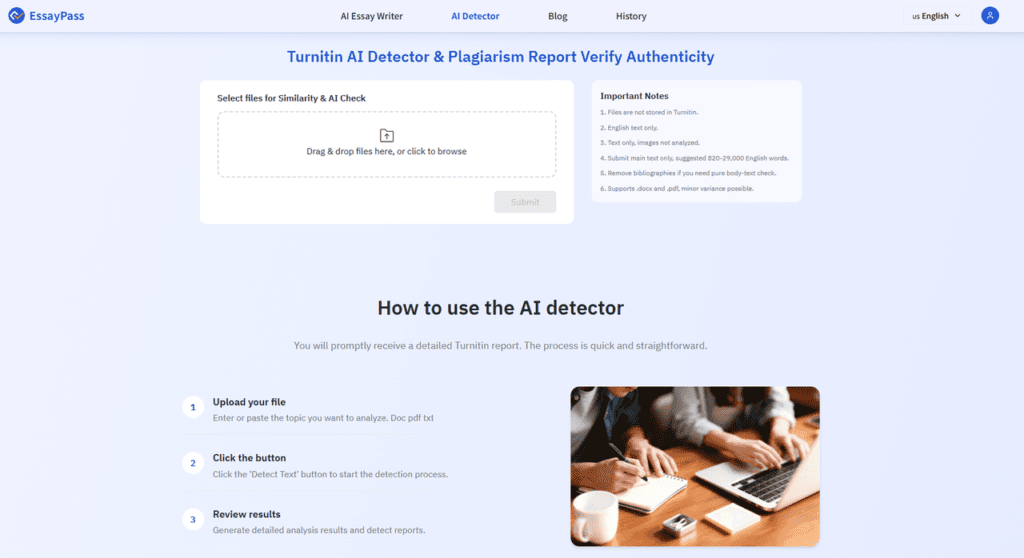
| Detection Safety | High AI-pattern risk | Turnitin-based plagiarism & AI detection |
| Revision Ability | One-time output | AI Agent–driven argument revision |
How EssayPass Supports Real Persuasive Writing
EssayPass focuses on academic argumentation rather than generic text. It allows one-click full essay drafting, supports multiple essay types (including convince essays), and integrates real sources that can be directly downloaded.
Through its AI Agent revision system, students can strengthen claims, improve counterarguments, and refine logical flow—mimicking how high-scoring convince essays are developed. For AI-based plagiarism and content checking, see EssayPass AI Detection.
Final Insight: Convince Essays Reward Control, Not Confidence
A successful convince essay is not about sounding confident—it is about guiding the reader step by step. Strong essays define precise claims, explain evidence clearly, and address counterarguments logically. Mastering this control over reasoning separates persuasive, high-scoring essays from those that merely read well. For inspiration on different essay approaches, you can explore how to write a descriptive essay.