
Don’t Let Simple Grammar Mistakes Cost You Points.Even the clearest ideas and strongest research can lose impact if your essay contains small errors. A misplaced comma, awkward sentence, or inconsistent citation can confuse readers, reduce clarity, and cost you valuable grades—sometimes without you even noticing.
Effective editing and proofreading aren’t just about fixing typos—they transform your draft into a polished, professional, submission-ready essay. In this guide, you’ll learn practical strategies to identify common pitfalls, refine sentence structure, enhance paragraph flow, and verify citations. By following these steps, you can catch mistakes quickly, strengthen your arguments, and submit your best work with confidence.
Whether you’re racing against a tight deadline or preparing a high-stakes submission, mastering these techniques ensures your writing communicates ideas clearly, professionally, and persuasively.
Why Essay Editing and Proofreading Are Essential
Editing and proofreading are critical steps in transforming a rough draft into a polished, professional essay. Many students underestimate this stage, assuming that once the essay is written, it’s ready to submit. However, even the most insightful research or creative arguments can be undermined by grammar mistakes, unclear phrasing, or structural issues. Proper editing enhances clarity, reinforces credibility, and strengthens the impact of your ideas.
Improve Clarity and Readability
Clarity ensures that readers understand your ideas without having to reread sentences. For example, consider the sentence:
“The results of the experiment are indicative of certain outcomes which may be relevant to future studies if considered in appropriate contexts.”
After editing, it could be rewritten as:
“The experiment’s results highlight outcomes that should be considered in future research.”
This shorter, more precise sentence communicates the same idea clearly. Editing also involves removing redundant words, splitting overly long sentences, and making sure each sentence conveys a single idea. Students who skip this step often find that readers struggle to grasp their arguments, even if the research is strong.
Maintain Academic Standards and Professionalism
Academic writing has strict requirements for tone, style, and formatting. Proofreading ensures your essay adheres to these standards, which can influence grading and perception. Inconsistent references, improper heading hierarchy, or switching between formal and casual tone can all reduce perceived professionalism. Editing ensures all citations follow the required style (APA, MLA, Chicago), paragraphs are structured logically, and the academic tone remains consistent from introduction to conclusion.
Prevent Losing Grades on Small Errors
Even minor errors—like misplaced commas, spelling mistakes, or incorrect verb tenses—can cost valuable points. They may make your essay appear careless, distracting from the content itself. A methodical proofreading process helps catch these errors, ensuring your final submission accurately reflects your knowledge and effort.
Common Essay Mistakes That Hurt Your Grade
Even the most brilliant research can lose impact if your essay contains common mistakes that distract readers. Many students focus heavily on content but neglect the small yet crucial errors in grammar, style, and structure. These mistakes not only reduce readability but can also affect grading because professors often consider clarity, consistency, and professionalism as part of the evaluation. Recognizing common pitfalls is the first step toward effective editing and ensures your essay communicates ideas effectively.
Grammar and Spelling Errors
Grammar and spelling mistakes are among the most frequent issues in student essays. Words like “its” vs. “it’s,” or “affect” vs. “effect,” are often misused, which can confuse the reader and reduce credibility. For example, writing “The researcher was able to identify patterns” instead of “The researchers was able to identify patterns” changes the meaning and signals carelessness. Regular proofreading or AI-assisted tools can help catch these errors before submission, ensuring that your essay appears professional and polished.
Poor Sentence Structure and Word Choice
Long, repetitive, or convoluted sentences make essays difficult to read. For instance, a sentence like:
“In this essay, I will discuss the factors affecting climate change, and then I will explain the consequences, and also provide potential solutions.”
is cumbersome and hard to follow. After editing, it could read:
“This essay examines the factors affecting climate change, explores its consequences, and proposes potential solutions.”
This revision is concise, logical, and easier for readers to follow. Word choice is equally important; avoid using vague terms like “things” or “stuff,” and opt for precise academic vocabulary. Well-chosen words enhance clarity and strengthen arguments.
Logical Inconsistencies Between Paragraphs
Even if individual sentences are well-written, poor paragraph transitions can confuse readers. Each paragraph should follow logically from the previous one and support the overall thesis. Abrupt topic changes without proper transitions weaken the essay’s coherence. Using words like “however,” “moreover,” and “as a result” helps guide the reader smoothly through your arguments. Mapping your essay before editing can reveal gaps in logic or flow, making it easier to restructure paragraphs. For more tips on structuring essays and improving clarity, see our step-by-step guide on essay writing, which illustrates clear organization and logical progression.
Improper Citations and Formatting
Citations and formatting are more than formalities—they reflect academic integrity and professionalism. Mistakes such as inconsistent reference styles, missing page numbers, or improperly formatted headings can lower grades or raise plagiarism concerns. Editing ensures that your references follow the required style, whether APA, MLA, or Chicago. Attention to detail in formatting demonstrates care and adherence to academic standards, which can significantly influence grading.
Inconsistent Academic Tone and Style
Switching between formal academic language and casual phrasing can undermine credibility. An essay that reads like a casual conversation will not have the same persuasive impact as one that maintains a consistent, professional tone. Proofreading ensures that your essay keeps a unified voice throughout, reinforcing your authority and making your arguments more compelling.
Step-by-Step Guide to Editing and Proofreading Your Essay
Editing and proofreading can feel overwhelming, especially for long essays or under tight deadlines. However, following a structured step-by-step approach makes the process manageable and ensures your essay reaches a professional standard. By breaking the task into focused steps, you can systematically improve clarity, grammar, structure, and style.
Take a Break Before Editing for Objectivity
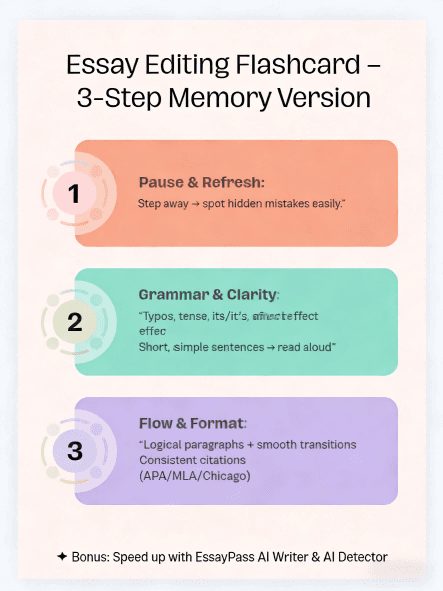
One of the most effective ways to spot errors is to step away from your essay before beginning the editing process. Giving yourself a break—ranging from a few hours to a full day—helps you see the work with fresh eyes. After a break, errors that previously went unnoticed often become obvious. This pause also allows you to read with a critical mindset rather than feeling attached to every sentence. Even a short walk or doing another task for 30–60 minutes can improve your ability to detect mistakes.
Check Grammar and Spelling Thoroughly
Careful grammar and spelling checks are foundational for a polished essay. Manual proofreading helps catch context-sensitive mistakes that automated tools might miss, such as “affect” vs. “effect,” “there” vs. “their,” or verb tense inconsistencies. Reading your essay slowly, line by line, can highlight these errors. Additionally, digital tools can support your work by quickly identifying common mistakes and suggesting corrections. Combining both methods ensures accuracy and efficiency.
Review Sentence Structure and Clarity
Editing for sentence structure means simplifying overly complex sentences and eliminating redundancies. Each sentence should convey a single idea and flow smoothly into the next. For example, instead of writing:
“The researcher conducted the experiment and observed the changes, which were important because they showed some patterns, and these patterns might help in further studies.”
You can revise it to:
“The researcher conducted the experiment and observed significant changes that reveal patterns useful for future studies. Editing also involves removing redundant words, splitting overly long sentences, and making sure each sentence conveys a single idea. For more strategies on refining your writing, check out our comprehensive guide to essay improvement, which covers clarity, conciseness, and flow in detail.”
Examine Paragraph Flow and Logical Progression
Each paragraph should focus on one main idea that supports your thesis. Check that paragraphs begin with a clear topic sentence and follow a logical sequence. Transitions between paragraphs should connect ideas seamlessly. Tools like paragraph mapping or outlining the essay after writing can help visualize the logical progression and highlight sections that need restructuring. This step ensures that readers can follow your argument without confusion.
Verify Formatting, References, and Citations
Proper formatting and accurate citations are crucial for academic credibility. Double-check margins, headings, font consistency, and reference lists. Ensure that in-text citations match the reference list and adhere to the required style (APA, MLA, Chicago). Even minor inconsistencies, like missing italics or punctuation errors, can affect grading. Paying close attention to these details demonstrates professionalism and reinforces the quality of your work.
Read Your Essay Aloud to Spot Hidden Errors
Reading aloud is a simple yet powerful technique to catch awkward phrasing, missing words, or unnatural sentence rhythm. Hearing the essay in your own voice highlights issues that visual reading often misses. Try reading paragraph by paragraph, and pause whenever a sentence feels unclear or clunky. This method not only identifies errors but also helps improve the overall flow and readability of your essay.
⚡ Pro Tip: For students with tight deadlines, AI-powered tools like EssayPass can accelerate these steps. It quickly identifies grammatical errors, suggests sentence restructuring, and checks for style consistency, allowing you to focus on refining ideas rather than hunting for mistakes manually.
How AI Tools Can Help You Perfect Your Paper Fast
Tight deadlines and heavy workloads make essay editing stressful for many students. AI-powered tools have revolutionized this process by offering fast, accurate, and reliable assistance. These tools can handle grammar, style, clarity, and plagiarism detection in minutes, saving hours of manual work. While AI does not replace your ideas, it acts as a supportive partner, helping you refine your writing efficiently and professionally.
Instant Grammar and Spelling Checks
AI can instantly identify grammar and spelling errors that would take hours to find manually. For example, subject-verb disagreements or subtle misused words like “affect” vs. “effect” are highlighted immediately. This ensures your essay is free from distracting mistakes, improving clarity and professionalism.
Smart Sentence Restructuring for Better Readability
AI can suggest ways to simplify long sentences, eliminate redundancy, and reorder clauses for logical flow. For instance, a sentence like:
“The researchers observed several patterns during the experiment, which may have significant implications for the analysis of data, and these patterns could be applied to future research projects in similar fields.”
Can be revised by AI to:
“The researchers observed several patterns during the experiment, which have significant implications for data analysis and may inform future research in similar fields.”
This makes your writing clearer, concise, and easier to read.
Maintain Consistency, Integrity, and Quality with AI
Even small inconsistencies in tone, style, or citations can make an essay feel unpolished and reduce its credibility. AI-assisted tools like EssayPass help maintain a consistent academic tone, highlight passages that may need paraphrasing, and check citations for accuracy—ensuring your work is professional, original, and academically rigorous.
By streamlining grammar, clarity, and formatting checks, EssayPass can save hours of manual proofreading while helping you focus on refining arguments and ideas. Even under tight deadlines, it ensures your essay reads smoothly, avoids common mistakes, and meets academic standards—so you can submit with confidence.
⚡ Pro Tip: Pairing AI-assisted editing with a quick manual review combines efficiency, precision, and control, turning a good essay into a high-quality, submission-ready paper.
Choosing the Right Editing and Proofreading Solution
With multiple editing options available, choosing the right solution depends on your needs, deadlines, and budget. Self-editing, professional services, and AI tools each have strengths and weaknesses. Understanding these differences helps you pick a method that ensures your essay is clear, polished, and professionally presented without unnecessary stress.
Self-Editing – Pros, Cons, and Best Use
Self-editing requires no cost and allows full control over revisions, ensuring your voice is preserved. However, it is time-consuming, and familiarity with your essay makes it easy to overlook errors. Best suited for short essays or early drafts that will later receive external feedback.
Professional Editing Services – Pros, Cons, and Cost
Professional editors offer expert feedback on grammar, style, and structure. Accuracy is high, but cost and turnaround time can be limiting. Best for high-stakes essays, theses, or publications where perfection is essential.
AI Editing Tools (e.g., EssayPass) – Pros, Cons, and Efficiency
AI tools like EssayPass deliver fast, accurate, and consistent editing, helping students improve grammar, clarity, tone, and citation accuracy without compromising their unique voice. While AI cannot provide subjective feedback like a human editor, it dramatically reduces manual proofreading time and ensures technical precision, making it an effective solution for everyday student essays and tight deadlines.
⚡ Pro Tip: Pairing AI editing with a brief manual review combines efficiency, accuracy, and professional quality, giving you the confidence that your essay meets academic standards.
Conclusion – Perfect Your Essays with Confidence and Efficiency
Even the strongest ideas can lose impact if your essay isn’t polished. Grammar mistakes, unclear sentences, or inconsistent citations can distract readers and lower your grade. Careful editing and proofreading—checking grammar, refining sentence structure, ensuring paragraph flow, and verifying citations—transform a good essay into a professional, high-quality submission.
Why this matters: Students who skip thorough editing risk losing points on small errors, weakening their arguments, or submitting papers that appear rushed. Structured editing ensures your work communicates ideas clearly, professionally, and persuasively.
How AI Tools Can Help:
AI-powered tools like EssayPass accelerate this process by detecting grammar mistakes, restructuring sentences, and maintaining a consistent academic tone. They save hours of manual work while allowing you to focus on refining your ideas. Even under tight deadlines, AI-assisted editing ensures your essay is polished, coherent, and ready for submission.
Take Action: Don’t leave your grade to chance. Use EssayPass to streamline your editing, catch subtle errors, and elevate the quality of every essay you submit. By combining intelligent AI support with your own critical review, you can submit work that impresses readers, strengthens your arguments, and maximizes your academic performance.