
Your similarity score is high, but you cannot afford to change the meaning even slightly. If you are looking for the best essay paraphraser, you do not need “fancier synonyms” — you need a rewrite that keeps your claims accurate, your tone academic, and your citations intact.
This guide shows how to reduce similarity the safe way (without meaning drift), what features actually matter in a paraphrasing tool, and a quick checklist to confirm your final draft is both original-sounding and academically correct.
Best Essay Paraphraser: What to Look For
The best essay paraphraser does more than swap synonyms. It keeps your meaning intact, rewrites structure to reduce overlap, and stays citation-safe for academic writing.
When evaluating tools, especially if you are learning how to write an academic essay that meets university standards, use this scoring system (0-2: 0 = no, 1 = partly, 2 = yes). 12+ is strong for academic use.
- Meaning fidelity: preserves claim strength, scope, and logic (no meaning drift)
- Structural rewriting: changes sentence patterns, not just vocabulary
- Term protection: lets you lock key terms (variables, constructs, theory names)
- Citation-safe output: keeps in-text citations and does not distort attribution
- Academic tone control: produces formal, natural phrasing (not robotic or casual)
- Paragraph-level help: can reorganize or reframe ideas for background/literature sections
- Privacy clarity: clearly states whether text is stored or used for training
Fast rule: If a tool cannot rewrite structure and cannot protect key terms, it will rarely reduce similarity in a meaningful way.
Reduce Similarity Without Changing Meaning
Most similarity stays high for one reason: the sentence skeleton is unchanged. Real paraphrasing reduces overlap by rewriting structure while keeping the claim, scope, and evidence identical.
Structural changes that reduce overlap (without meaning drift)
- Reorder clauses (context first vs result first)
- Switch voice when it reads naturally (active/passive)
- Replace wordy noun phrases with precise verbs (“make an evaluation” -> “evaluate”). To ensure your flow remains professional, it’s often helpful to master the use of transition words to connect these new structures seamlessly.
- Split or merge sentences to repackage the logic
- Rewrite topic sentences and reorder supporting points at paragraph level
What should stay stable in academic writing Do not force-rewrite what must remain consistent:
- technical terms and constructs
- theory names and model labels
- instrument names and standardized measures
- proper nouns and official titles
When to Paraphrase vs Quote
Paraphrasing is common and acceptable in academic writing when you cite correctly. Quoting is appropriate when the exact wording matters.
Paraphrase when:
– the idea matters more than the exact phrasing
– you are integrating sources into your own argument
– you want smoother flow and clearer readability
Quote when:
– the wording is definitive or historically important (formal definitions, key claims)
– you are analyzing the language itself
– a policy, legal text, or official guideline must be exact
Do not paraphrase:
– direct quotations (keep them verbatim and in quotation marks)
– statistics, numbers, and units unless you re-check them carefully
– formulas, code, and standardized statements where precision is required
Important: Paraphrasing does not replace citation. If an idea comes from a source, it still needs a reference even after rewriting.
How to Use an Essay Paraphraser
Paraphrasing tools work best as part of a careful revision process. Use this workflow to avoid meaning drift and citation mistakes.
Step 1: Confirm you understand the source
Before you paraphrase, write (in your own words) a one-sentence explanation of:
– the author’s claim
– the reason/evidence
– the limitation or condition (if any)
If you cannot explain it without looking, do not paraphrase yet.
Step 2: Set constraints (so the output stays academic and accurate)
Give clear instructions such as:
– “Keep meaning identical. Keep hedging (may/might). Keep citations. Keep key terms: X, Y, Z.”
– “Rewrite more formally, reduce sentence length, and avoid repetitive phrasing.”
– “Do not strengthen claims. Keep numbers and conditions unchanged.”
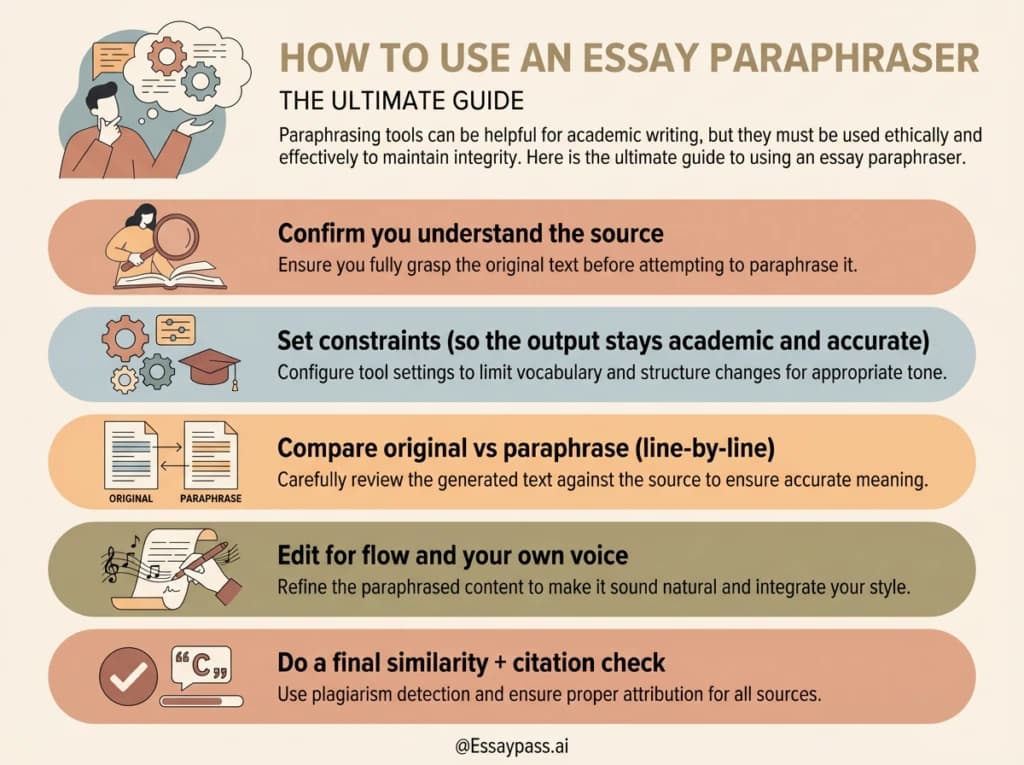
Step 3: Compare original vs paraphrase (line-by-line)
Check the paraphrase against the source for:
– claim strength (suggests vs proves)
– scope (in this sample vs in general)
– logic type (correlation vs causation)
– negation (not / no / does not)
– numbers, units, and timeframes
Step 4: Edit for flow and your own voice
Improve cohesion by:
– adding transitions that match your argument
– ensuring each paragraph has a clear topic sentence
– removing awkward phrases or unnatural word choices
Step 5: Do a final similarity + citation check
A final similarity check is vital, but in the modern academic landscape, you must also ensure your work doesn’t trigger false positives for AI generation. Running your draft through a reliable AI detector can provide that extra layer of security before submission.
Why Your Similarity Is Still High After Paraphrasing
If you paraphrased but similarity remains high, it is usually one of these issues:
1) Structure is still too similar
Fix: rewrite at the clause and paragraph level. Change sentence order, topic sentences, and how you group evidence.
2) You kept high-overlap academic phrases
Phrases like “the results indicate that” are common and not always avoidable, but repeating the same phrasing across your paper can increase pattern overlap.
Fix: vary structure, not just verbs. For example, alternate:
– reporting verb + finding
– finding first + interpretation
– method/context first + result
3) Your literature review follows the source’s sequence
Even with new words, following the same order of points can look too similar.
Fix: reorganize: compare studies by theme, method, or result instead of mirroring one article’s structure.
4) Too much text depends on one source
Fix: synthesize multiple sources in a single paragraph and add your own framing. Paraphrasing works best when your paragraph structure is yours.
5) You paraphrased things that should not be rewritten
If you force-rewrite terminology, names, or definitions, you may create awkward language without reducing meaningful overlap.
Fix: keep key terms stable and rewrite only what surrounds them.
Examples: Bad Paraphrasing vs Good Paraphrasing
Examples show the difference between “synonym swapping” and true restructuring.
Example 1: Synonym swapping (too close)
Original:
The implementation of the policy resulted in a variety of outcomes that were not initially anticipated, particularly in relation to public response and administrative efficiency.Bad paraphrase:
The execution of the policy produced various results that were not first expected, especially regarding public reaction and administrative effectiveness.
Why it fails:
– Sentence structure stays nearly identical
– Only synonyms changed; overlap remains high
Better paraphrase (structure rewritten):
After the policy was introduced, several outcomes emerged that policymakers did not anticipate. The most notable changes involved public response and administrative efficiency.
Why it works:
– Reordered information and split into clearer structure
– Same meaning, different pattern
Example 2: Meaning drift (accuracy risk)
Original:
The findings suggest a relationship between social media use and anxiety, but they do not establish causation.Risky paraphrase:
The findings show that social media use causes anxiety.
What changed (and why it is wrong):
– “suggest” became “show”
– correlation became causation
– the limitation disappeared
Correct paraphrase:
The findings indicate an association between social media use and anxiety, although they do not demonstrate a causal link.
Meaning Fidelity Checklist
Use this quick checklist to confirm your paraphrase keeps the same meaning:
– Claim strength: did you keep “may/suggests” vs “proves” accurate?
– Scope: did you keep population, timeframe, and conditions the same?
– Logic: did you keep correlation vs causation correct?
– Negation: did any “not” get lost or added?
– Numbers: are all statistics, units, and comparisons identical?
– Attribution: is the source still cited correctly?
If any box fails, revise manually before you rely on the paraphrase.
Make Your Paraphrase Sound Academic
Academic tone should be clear, formal, and precise. A good essay paraphraser helps, but final quality depends on your editing.
Practical academic-style upgrades
– Use precise verbs: “analyze,” “evaluate,” “demonstrate,” “indicate,” “argue”
– Remove wordiness: “in order to” -> “to”
– Prefer clarity over complexity: shorter sentences often read more academically
– Keep key terms consistent throughout the essay
Best Essay Paraphraser for Students
Different tasks need different levels of paraphrasing power:
– Quick clarity edits (1-2 sentences): you mainly need readability and grammar support
– Long essays with repetition: you need structural rewriting and tone consistency
– Literature review rewriting: you need paragraph-level restructuring and term protection
– Source integration: you need citation-friendly output and meaning fidelity controls
Where Essaypass Fits
Essaypass is a good fit if you want paraphrasing to be part of a complete academic workflow, not a last-minute rewrite.
- Write faster: Use AI essay writer to generate one-click full drafts with custom or AI-generated outlines, providing a solid structure for further paraphrasing.
- Match requirements: multiple academic formats and essay types
- Revise with guidance: use the AI Agent to apply your teacher’s comments or your own revision plan
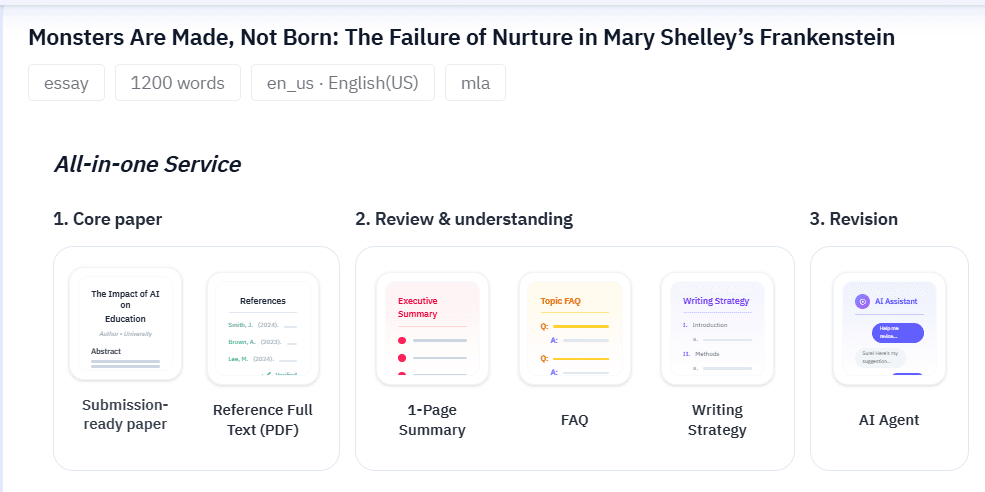
- Validate before submit: Turnitin-based similarity + AI detection for academic expectations
Final Thoughts
The best essay paraphraser helps you reduce similarity while keeping meaning intact. Look for tools that rewrite structure, protect key terms, support academic tone, and preserve citations. Then use a reliable workflow: understand the source, paraphrase with constraints, verify meaning line-by-line, and edit for coherence.
When used responsibly, an essay paraphrasing tool can strengthen clarity and originality without compromising academic integrity.