
An MLA essay is far more than double spacing and parenthetical citations. It is a rigorous framework of scholarly communication designed to ensure clarity, traceability, and intellectual accountability. Professors evaluate MLA essays on analytical depth, structural coherence, and source accuracy. Even insightful interpretations can lose points if formatting, evidence integration, or argumentation are mishandled.
Understanding these standards helps students see MLA not as a set of arbitrary rules, but as a method for professional academic reasoning. Instructors assess essays based on both the quality of ideas and the methodological rigor applied in presenting them.
What Makes an MLA Essay Scholarly
MLA essays are governed by principles that prioritize clarity, credibility, and logical argumentation:
-
Clear Thesis Formation – Every essay should advance a specific, arguable claim. A vague or descriptive thesis often leads to fragmented analysis.
-
Evidence-Based Argumentation – Claims must be supported with credible sources; unsupported assertions weaken credibility.
-
Traceable Sourcing – MLA ensures that readers and evaluators can locate each reference, which underpins academic accountability.
-
Cohesive Structure – Logical sequencing of ideas allows arguments to build progressively rather than appearing as disjointed points.
Example: A student analyzing Hamlet proposed original interpretations, but inconsistent citations made it impossible for the professor to verify sources, resulting in lower grades despite strong insight.
MLA Formatting: The Foundation
Document Layout
-
Font & Size: Times New Roman, 12 pt
-
Margins: 1 inch all around
-
Spacing: Double-spaced throughout
-
Paragraph Indentation: 0.5 inches
-
Alignment: Left-aligned (do not justify)
Academic Logic: Standardized formatting ensures readability and demonstrates professionalism, allowing evaluators to focus on argumentation rather than deciphering presentation errors.
Grading Impact: Incorrect spacing or inconsistent font can lead to minor deductions that accumulate across assignments.
Example: An essay in 11 pt font with 1.5 spacing appeared visually cramped, distracting the evaluator and affecting perceived rigor.
For practical examples, see essay format rules and examples.
Header & Title
-
Header: Last name + page number, top-right corner
-
Title Block: Student name, instructor, course, date, followed by centered essay title
Logic: Provides immediate identification and facilitates tracking for multi-page assignments.
Example: Missing or misformatted headers are common technical deductions even in essays with excellent analysis.
In-Text Citations
MLA citations maintain academic accountability, linking evidence to sources.
Standard Example
“Proper citations demonstrate intellectual accountability” (Smith 45).
If the author is mentioned:
According to Smith, “MLA style ensures source traceability” (45).
Special Cases
-
Two authors: (Smith and Doe 78)
-
More than two authors: (Brown et al. 102)
-
No author: Use shortened title: (“Essay Structure” 22)
Scoring Implication: Mismatched citations and Works Cited entries are a common source of grade loss.
For a detailed guide on improving your citation and writing skills, check how to write an academic essay.
Works Cited Page: Academic Verification
The Works Cited page ensures complete transparency, allowing evaluators to trace each source.
Rules
-
Start on a new page
-
Title: Works Cited, centered
-
Hanging indent: first line flush left, subsequent lines indented 0.5 inches
-
Alphabetize entries by author last name
Examples
Book:
Smith, John. Understanding Literature. Penguin Press, 2020.
Journal Article:
Doe, Jane. “Literary Theory in Practice.” Modern Literary Review, vol. 23, no. 2, 2021, pp. 45–67.
Online Source:
Johnson, Mark. “Digital Humanities Today.” Online Writing Journal, 15 Mar. 2021, www.onlinewritingjournal.com/article. Accessed 20 Apr. 2024.
Academic Logic: Accurate Works Cited entries validate analysis and protect against plagiarism.
Learn more about sourcing and citations in how to write a research paper.
Writing a Strong MLA Essay
Essential Components
-
Defensible Thesis: Clear, arguable claim rather than summary.
-
Structured Paragraphs: Each paragraph presents a claim, supports it with evidence, and analyzes significance.
-
Logical Flow: Ideas transition smoothly to maintain coherence.
-
Critical Interpretation: Evidence is analyzed and linked to the thesis, not merely listed.
Example: A student analyzing The Great Gatsby lost points because quotations were unexamined; insights alone could not compensate for weak integration.
Common MLA Pitfalls and Solutions
-
Missing author names/page numbers → use parenthetical citation correctly
-
Misformatted Works Cited entries → cross-check entries against in-text citations
-
Mixing MLA with APA/Chicago → stick to a single style per assignment
-
Inconsistent italics/quotation marks → follow MLA conventions precisely
Addressing these errors improves readability, demonstrates academic professionalism, and safeguards grades.
How EssayPass Solves MLA Challenges
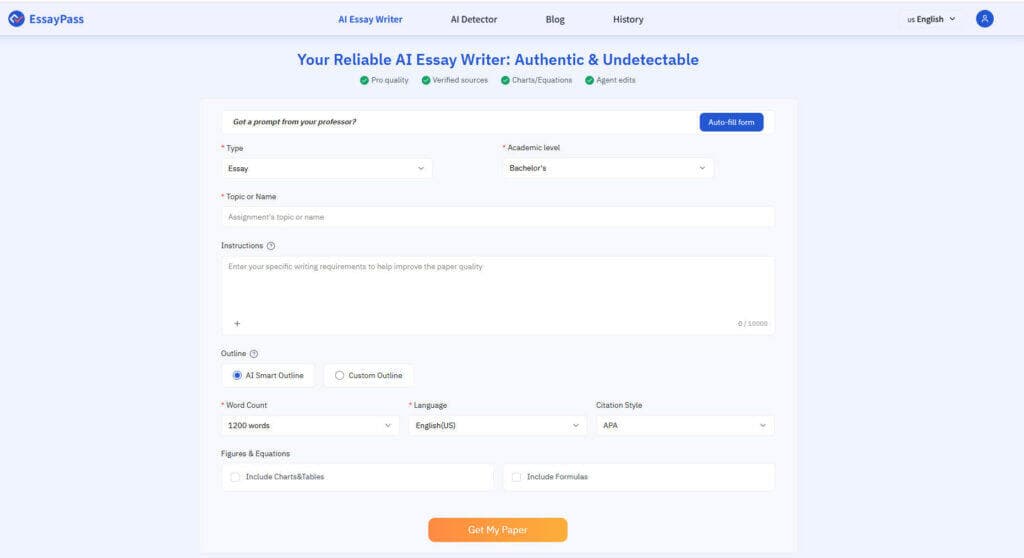
Even knowledgeable students can struggle with MLA formatting, citations, and evidence integration. EssayPass addresses these challenges systematically:
-
Full MLA Compliance – Automates headers, spacing, citations, and Works Cited formatting, eliminating common errors.
-
Authentic References – Provides real, verifiable academic sources, reducing plagiarism risk.
-
AI-Assisted Revision – Refines argumentation, logical flow, and academic tone.
You can explore EssayPass AI essay writer to see how it streamlines MLA essay creation and citation management.
Comparison: Traditional MLA Writing vs EssayPass
| Feature | Manual Writing | EssayPass |
|---|---|---|
| MLA Formatting | Manual adjustments, error-prone | Fully automated |
| In-Text Citation Accuracy | Common mistakes | 100% accurate, verifiable |
| Works Cited | Manual, risk of mismatch | Automatically generated, complete |
| Time Required | Hours per essay | Minutes |
| Argument Refinement | Limited | AI-assisted improvement |
| Plagiarism Risk | Higher | Reduced with authentic sources |
Case Study: A student struggling with MLA citations generated a complete essay with EssayPass, refined the thesis and paragraph transitions with AI guidance, and submitted a polished, fully compliant paper. For AI tool comparisons and evaluations, see the good AI review.
Conclusion
A high-quality MLA essay represents the union of analytical insight and methodological precision. Achieving excellence requires:
-
Correct formatting
-
Accurate citations and Works Cited entries
-
Logical, structured arguments
With EssayPass, students can focus on developing critical arguments while ensuring full MLA compliance, reducing technical errors, and enhancing academic credibility. By integrating scholarly rigor with practical AI assistance, EssayPass enables confident, professional MLA essay writing.