
Writing a college research proposal can feel challenging at first. Simply put, it’s a plan that explains what you want to study, why it matters, and how you will carry out your research—very similar to the thinking process used in academic essay writing. Think of it as a roadmap. It helps both you and your professor clearly see the goals, methods, and expected results.
For instance, I once helped a student in environmental science who wanted to study how urban gardens affect local biodiversity. Their proposal clearly stated the research question, reviewed relevant studies, and explained how they would collect and analyze data. This kind of structure is also common in formal research paper writing, where clarity and planning matter just as much as the final results.
Why a Strong College Research Proposal Matters
A solid college research proposal sets the stage for your entire project. Professors usually check how clear and feasible your plan is.
A good proposal can:
-
Make your ideas easy to follow
-
Show that your research is realistic
-
Demonstrate your ability to use credible sources and proper methods
I’ve seen students who took the time to outline a clear timeline and structure get their proposals approved immediately and end up with high grades for the final paper.
How to Write a College Research Proposal
Writing a college research proposal doesn’t have to be overwhelming if you break it into steps. Many students struggle simply because they try to do everything at once, instead of building the proposal piece by piece.
Choose a Clear Research Topic
Pick a topic that interests you and is relevant to your field. Avoid topics that are too broad. For example, “Climate change” is difficult to manage, while a focused topic like renewable energy adoption is much clearer. If you’re unsure where to begin, reviewing strong argumentative essay topics can help you narrow your focus and identify researchable questions.
Conduct Preliminary Research
Look at existing studies to see what’s already been done. This will help you refine your research question and find gaps. Make sure to use credible journals, books, and databases. Take notes on key findings that relate to your topic.
Define Your Research Question
A clear research question guides your whole project. It tells your reader what you are investigating and why it matters. Strong proposals often rely on analytical thinking similar to what’s required in an analytical essay, where ideas are examined carefully instead of described vaguely.
Outline Your Research Methods
Explain clearly how you’ll collect and analyze data. Include:
-
Tools or surveys you plan to use
-
Sample size or selection criteria
-
How you will analyze the data
For example, if you’re studying plants in urban gardens, describe how many gardens you’ll survey and what statistical analysis you’ll use. This shows your project is realistic.
Include a Timeline
Break your research into phases: literature review, data collection, analysis, and writing. A timeline shows you can finish your project on time and helps your professor see your planning skills.
Cite Relevant Literature
Use credible sources to show your work is grounded in research. Avoid vague or outdated references. A brief review of key studies strengthens your proposal and highlights your understanding of the field. If you’re new to citing sources, exploring essay format rules and examples can be very helpful.
Common Mistakes in College Research Proposals
Even experienced students can make errors. Avoid these common issues when writing a college research proposal:
-
Vague Objectives: Don’t be too general; clearly state what you plan to study.
-
Unrealistic Methods: Make sure your research can be completed in your timeframe.
-
Poor Structure: Messy or illogical proposals are hard to follow. Using proper essay format and headings helps maintain clarity.
-
Weak References: Always rely on credible and recent sources.
I once saw a student propose to study all renewable energy projects worldwide in one semester. The professor rejected it because it was clearly impossible. This shows the importance of realistic planning.
Tips to Make Your College Research Proposal Stand Out
Here are some ways to make your proposal stronger:
-
Be Concise: Stick to the word limit and focus on clarity.
-
Use Simple Language: Clear writing helps readers understand your ideas, and using effective transition words can make your proposal flow more smoothly.
-
Add Visuals: Charts or tables can make your methodology or results clearer.
-
Show Significance: Explain why your research matters. Highlighting relevance makes your proposal more persuasive.
Competitor Analysis and Comparison
Many students use AI tools to help write a college research proposal. Popular options like Grammarly and QuillBot have their benefits, but they also have limitations:
-
Grammarly is excellent for grammar and clarity but can’t generate a full research proposal or provide real references.
-
QuillBot helps with paraphrasing and some essay writing but requires multiple steps for a complete proposal and offers only partial or AI-generated references.
AI Tool Comparison Table
| Feature / Tool | EssayPass | Grammarly | QuillBot |
|---|---|---|---|
| Full Proposal Generation | ✅ One-click full essay writing | ❌ Only suggestions/corrections | ❌ Multiple steps required |
| Academic Formats | ✅ APA, MLA, Chicago, etc. | ❌ Limited | ✅ Some formats |
| Essay Types Supported | ✅ Argumentative, Research, Analytical | ❌ Only editing | ✅ Limited types |
| Real References | ✅ Authentic, downloadable | ❌ None | ❌ Partial/AI-generated |
| Plagiarism & AI Detection | ✅ Turnitin-based | ❌ Limited | ✅ Limited |
| AI Revision Agent | ✅ Refine drafts intelligently | ❌ None | ❌ None |
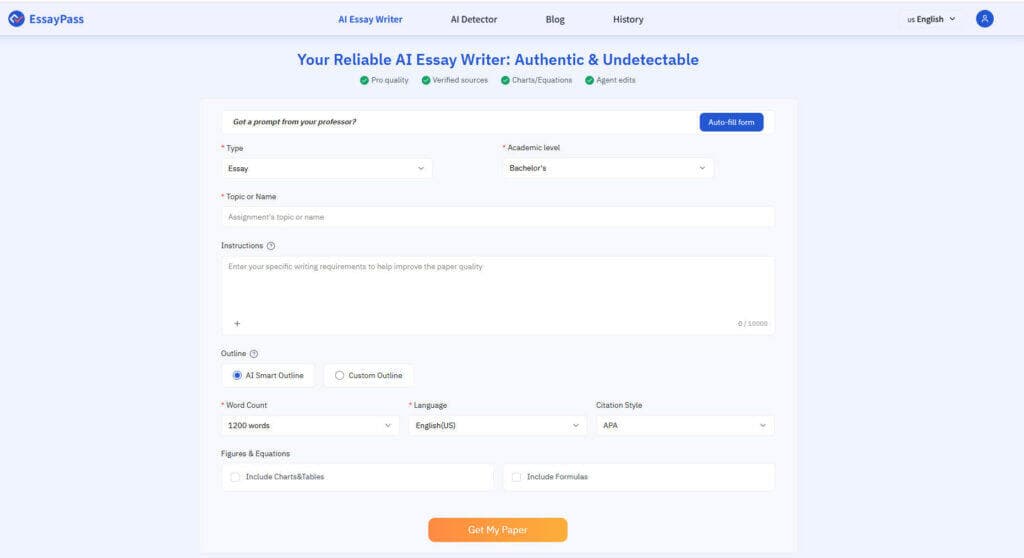
As you can see, while Grammarly and QuillBot offer some help, EssayPass stands out by combining full proposal generation, multiple academic formats, real references, plagiarism detection, and AI-assisted revision. Using EssayPass AI essay writer, you can focus on your research ideas rather than formatting or citations. The result is a polished college research proposal ready to impress your professor, and you can verify originality through EssayPass AI detection.
Conclusion
A strong college research proposal is the foundation for successful research. Choosing a focused topic, defining a clear research question, outlining feasible methods, and citing credible sources can help you create a proposal that earns top grades.
With EssayPass, drafting, formatting, and revising your proposal becomes much easier. By combining careful planning with the right AI tools, writing a winning college research proposal is both achievable and efficient.