
Writing a compare and contrast essay can feel daunting at first. In essence, this essay type asks you to look at two or more subjects and analyze both their similarities and differences. It’s not just about listing facts—it’s about showing why these similarities and differences matter.
Many students struggle because it requires clear organization, logical flow, and analytical thinking. This guide will break it down step by step, show real examples, and even highlight how the right tools can make the process easier and more accurate. For instance, you can check out this guide on how to write an academic essay to see how structure and clarity can transform your writing.
Types of Compare and Contrast Essays
Point-by-Point Method
The point-by-point method examines subjects one aspect at a time, making comparisons clearer.
Example: Comparing online learning vs. traditional classroom learning:
-
Cost and accessibility
-
Interaction with instructors and classmates
-
Flexibility and scheduling
Step-by-step:
-
Pick a comparison point for each paragraph.
-
Start with a clear topic sentence.
-
Discuss both subjects.
-
End with a short conclusion linking back to your thesis.
Why it works: This method is ideal when both subjects share multiple comparable aspects. It keeps your essay structured and easy to follow.
Block Method
The block method discusses one subject entirely before moving to the next.
Example:
-
Paragraph 1–2: Online learning (features, advantages, limitations)
-
Paragraph 3–4: Classroom learning (features, advantages, limitations)
Step-by-step:
-
Present the first subject in detail.
-
Transition clearly to the second.
-
Conclude by comparing or highlighting key differences.
Why it works: Use this when your subjects are very different or need a full picture before comparison. If you’re also curious about writing other types of essays, this narrative essay guide is a good reference for applying similar structuring techniques.
How to Structure a Compare and Contrast Essay
A successful essay has three main parts: introduction, body paragraphs, and conclusion.
Introduction
-
Introduce the subjects and why they matter.
-
End with a thesis statement showing the main argument.
Example thesis:
“Although online learning and classroom learning both aim to educate, they differ significantly in interaction, flexibility, and learning environment.”
Body Paragraphs
-
Focus on one main point per paragraph.
-
Include:
-
Topic sentence
-
Analysis of Subject A
-
Analysis of Subject B
-
Interpretation of significance
-
Transition to the next point
-
Tip: Balance similarities and differences. Start with similarities, then differences, using transitions like similarly, however, in contrast. For more help with transitions, this article on essay transitions can give you practical examples.
Conclusion
-
Summarize key points
-
Reinforce the thesis
-
Highlight why this comparison matters
-
Avoid introducing new arguments
Example:
“Understanding the differences between online and classroom learning helps students choose the method best suited to their goals and lifestyle.”
Case Study: High School vs College Education
Let’s make this concrete.
Similarity: Both aim to develop foundational skills.
Difference: High school provides structured guidance; college requires self-management.
Why it matters: College independence fosters self-discipline, preparing students for professional responsibilities.
Example paragraph:
“Both high school and college aim to educate students effectively. However, college students must manage their own schedules, developing self-discipline and time management skills not emphasized in high school.”
Notice how this paragraph shows analysis rather than just listing differences.
Compare and Contrast Essay Tools: Pros and Cons
Many students turn to tools for help—but not all tools are equal.
-
Generic AI writing assistants: Can produce text fast, but it’s often generic and lacks structure.
-
Grammar checkers: Good for spelling, but don’t help with thesis or logical flow.
-
Essay templates: Rigid and formulaic, risk repetitive content.
You might also want to read our discussion on pros and cons of using AI for essays to understand the limitations of generic AI tools compared to more specialized solutions.
Compare and Contrast Essay Tools Table
| Feature / Tool | Generic AI | Grammar Checker | Templates | EssayPass |
|---|---|---|---|---|
| Structure Guidance | ❌ Limited, may miss logical flow | ❌ None | ⚠ Rigid | ✅ Custom structured essays with intro, body, conclusion. You can see how EssayPass handles other essay types like research papers efficiently. |
| Grammar & Style | ✅ Basic | ✅ Excellent | ⚠ Limited | ✅ Context-aware grammar & style improvements |
| Real Examples & References | ❌ Generic | ❌ None | ⚠ Template-based | ✅ Real references, downloadable. For detailed guidance, check how to write a descriptive essay to see example citations. |
| Originality / Plagiarism | ⚠ Medium | ✅ N/A | ⚠ High similarity risk | ✅ Turnitin-based plagiarism and AI detection. Learn more about EssayPass AI detection. |
| Customizability | ⚠ Low | ❌ | ⚠ Low | ✅ Word count, tone, style; AI Agent edits |
| Ease of Use | ✅ Fast | ✅ Simple | ⚠ Requires editing | ✅ One-click full essay generation. You can also explore EssayPass essay writing page for a step-by-step demo. |
Why EssayPass Stands Out
-
Structured guidance: EssayPass creates a logical flow from intro to conclusion.
-
Authentic examples: Generates paragraphs with real, citable references.
-
Plagiarism-safe: Built-in Turnitin-based checks.
-
Flexible edits: AI Agent allows word count, style, or tone adjustments.
-
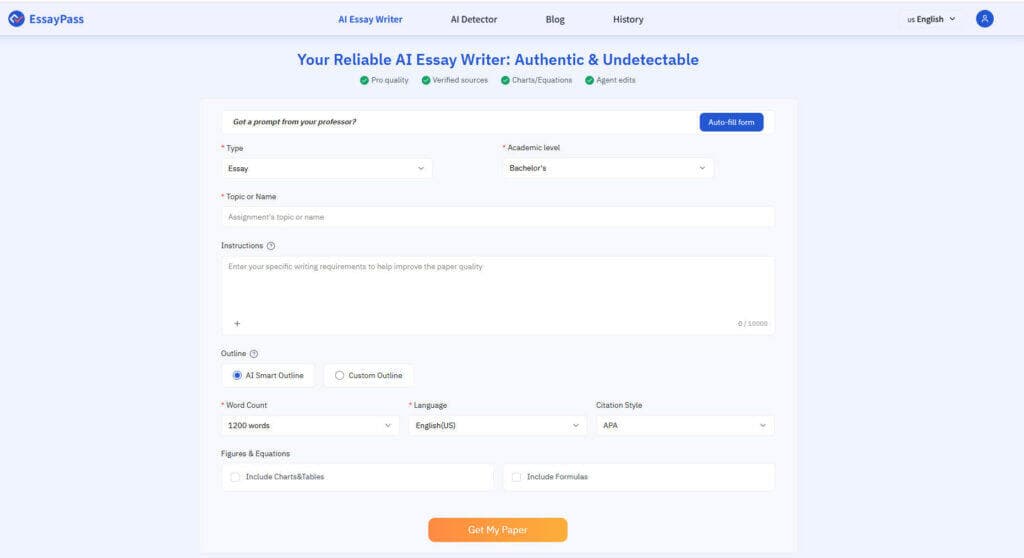
Full essay generation: One click to produce a complete essay, saving time and boosting clarity.
Example: Writing a compare and contrast essay on online vs classroom learning:
-
Input topic and select essay type.
-
Get a full essay with intro, body, conclusion.
-
Download real references.
-
Edit tone, style, or length with AI Agent.
This workflow solves most student pain points and ensures essays are coherent, original, and high-scoring. You can also explore how to write a college essay for more tips on applying these strategies effectively.
Tips for Writing High-Scoring Compare and Contrast Essays
1. Use Clear Criteria
Not all differences are worth mentioning. Focus on points that:
-
Support your thesis
-
Allow meaningful analysis
-
Enable real examples
Example: Interaction, flexibility, cost, learning environment
Tip: Start each paragraph with a clear topic sentence. EssayPass can suggest topic sentences and examples automatically.
2. Balance Similarities and Differences
-
Start with similarities to build a foundation
-
Then explain differences and why they matter
-
Use smooth transitions: similarly, however, in contrast
Example snippet:
“Both online and classroom learning provide structured materials. However, online learning allows self-paced completion, fostering independence.”
EssayPass can suggest transitions and highlight imbalances.
3. Avoid Common Mistakes
-
Listing without analysis: Always explain significance.
-
❌ “Online learning is cheaper.”
-
✅ “Online learning is cheaper, allowing access for students with limited resources, fostering independence.”
-
-
Weak transitions: Connect paragraphs logically.
-
Off-topic points: Every paragraph must support the thesis.
EssayPass flags off-topic points and suggests improved sentences.
Final Thoughts
A high-scoring compare and contrast essay depends on structure, examples, balanced analysis, and smooth transitions. Using EssayPass allows students to focus on thinking and analysis while the tool handles structure, citations, originality checks, and post-writing edits.
For further inspiration, this article on how to write an academic essay and how to write a college essay shows practical examples of applying these principles.