Still ending with “In conclusion… this essay discussed…”? It makes your essay sound like you’re turning in an assignment, not completing an argument.
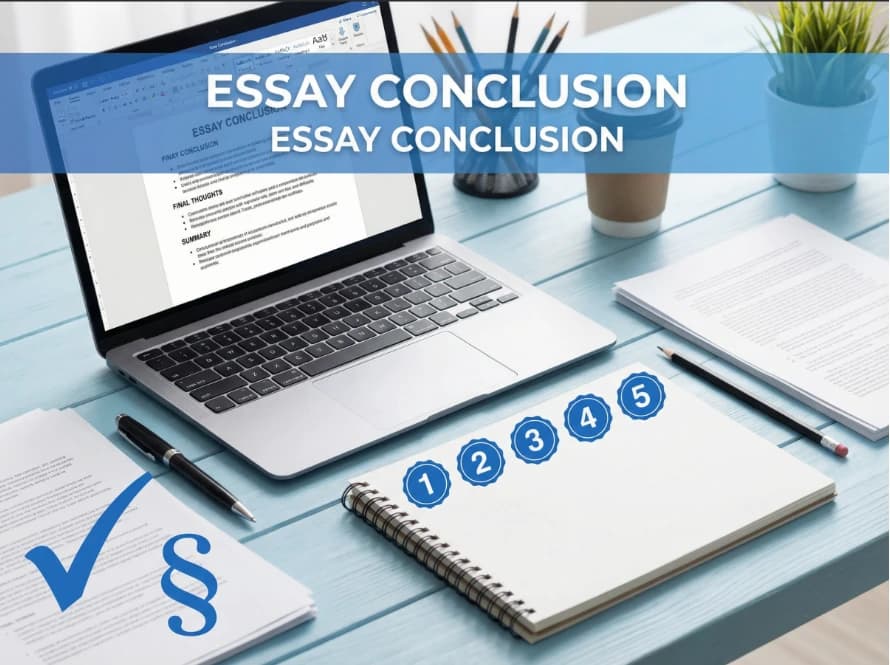
Next, I’ll walk you through a simple 5-step structure, ready-to-use templates, and weak-vs-strong examples to help you write a more powerful ending.
What Makes a Strong Essay Conclusion?
Reconnects to the thesis using fresh language
Synthesizes key ideas instead of listing them
Answers the “so what?” question (significance)
5 Steps to Write an Essay Conclusion
If you need a clear essay conclusion structure or a quick conclusion paragraph outline, this 5-step formula will help you write a stronger ending—without sounding repetitive or generic.
Step 1: Signal the ending (without “In conclusion”)
Instead, use natural transition words like “Overall,” “Ultimately,” or “Taken together” to guide the reader into your final point.
Step 2: Restate the thesis (don’t copy-paste)
A strong conclusion should show you know how to restate a thesis in a conclusion without repeating the introduction word-for-word. Keep the same claim, but sharpen the wording based on what your essay has actually proven.
Step 3: Synthesize your key points (2–3 sentences)
The goal isn’t to recap each body paragraph. It’s to connect your main ideas so the reader sees the logic as a whole—especially if your conclusion currently repeats your body paragraphs or feels like a list.
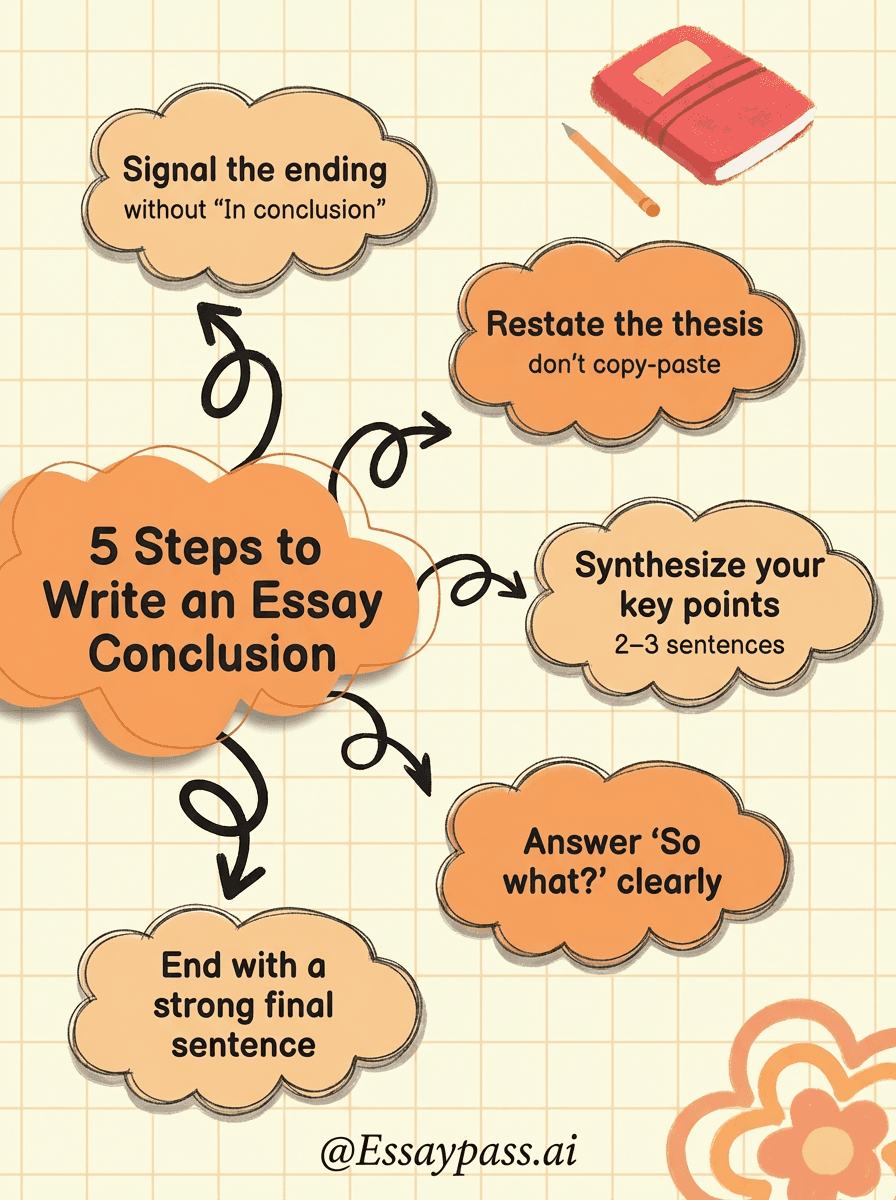
Step 4: Answer “So what?” clearly
This is what separates a weak ending from a high-scoring one. Add one sentence that explains significance: why the argument matters, what it changes, or what the reader should take away after finishing the essay.
Step 5: End with a strong final sentence
If you’re unsure how to write the last sentence of an essay, make it purposeful. A strong final line delivers a takeaway, highlights a broader implication, or offers a forward-looking insight that reinforces your main point.
6 Essay Conclusion Templates & Examples
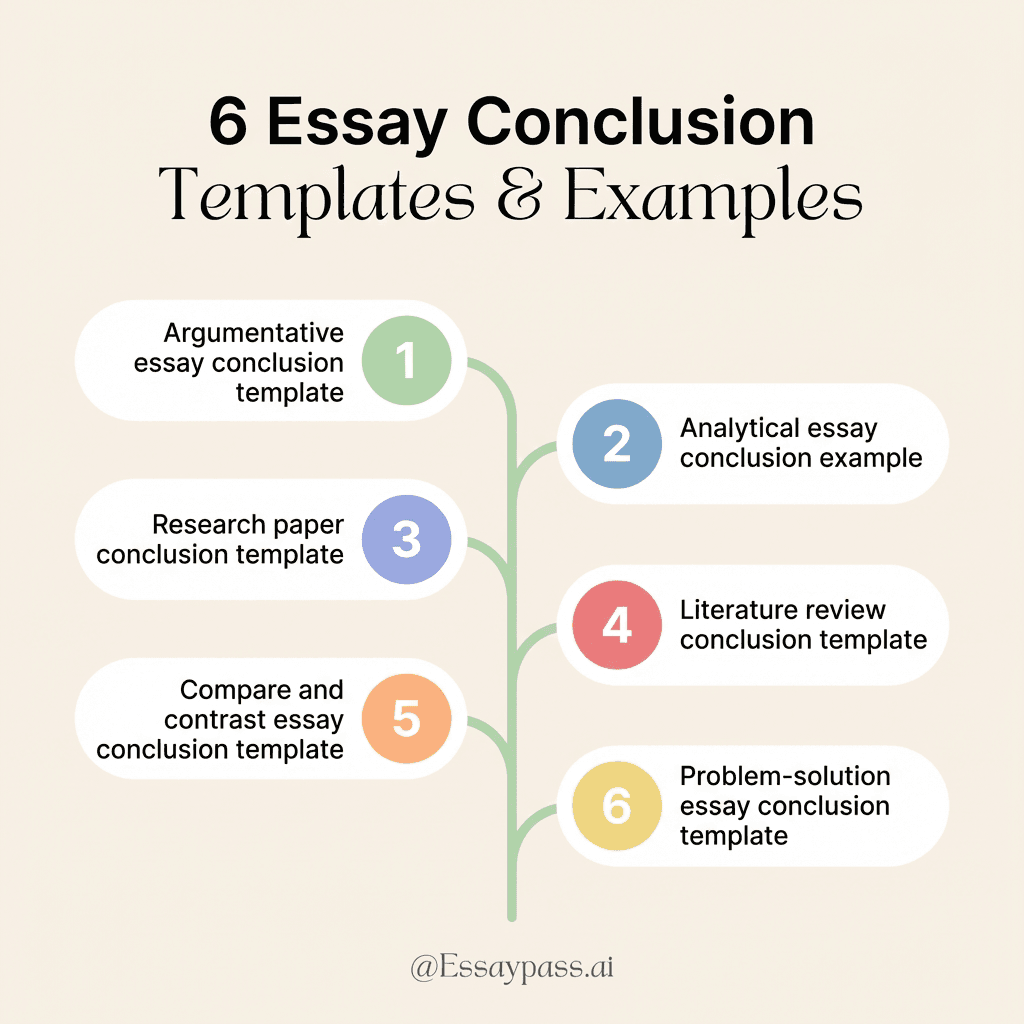
These fill-in-the-blank essay conclusion templates make it easier to write a strong ending fast—without sounding repetitive or generic. Pick the format that matches your assignment (argumentative, analytical, research paper, literature review, compare-and-contrast, or problem-solution), then swap in your own thesis keywords and main points.
Argumentative essay conclusion template
An argumentative essay conclusion should reinforce your position, connect your reasons, and explain why the claim matters beyond the assignment.
Template:
“Ultimately, [restate thesis]. Taken together, [synthesize 2–3 reasons], which shows [broader takeaway]. This matters because [impact / consequence].”Short example (social media & mental health):
“Ultimately, social media can harm mental health by intensifying comparison and constant social pressure. Taken together, its links to anxiety, depression, and self-esteem suggest that the issue is not just personal habit but a broader design problem. Recognizing this matters because it supports more responsible platform choices and healthier digital norms.”
Analytical essay conclusion example
A strong analytical essay conclusion adds interpretation. Instead of repeating observations, it highlights what the pattern means and what readers should understand differently.
Template:
“Rather than simply showing [topic], this analysis reveals [interpretation]. By connecting [patterns/themes], the essay suggests [insight]. Seeing it this way helps readers understand [why it matters].”Short example (symbolism in a novel):
“Rather than simply describing the symbol, this analysis shows how it reflects the character’s shifting identity and fear of change. By linking key scenes and recurring imagery, the essay suggests the symbol functions as a warning against self-deception. Seeing this pattern clarifies how the novel critiques the cost of avoiding truth.”
Research paper conclusion template
A research paper conclusion typically restates the key finding, clarifies the contribution, and acknowledges limitations and future research directions—without introducing new evidence.
Template:
“This study indicates that [main finding]. These results contribute by [contribution], though they are limited by [limitations]. Future research should explore [future direction] to better understand [broader goal].”Short example (study habits & grades):
“This study indicates that spaced review is associated with stronger exam performance than last-minute cramming. These results contribute by clarifying which habits predict more stable learning outcomes, though the findings are limited by self-reported study time and a single-course sample. Future research should test these patterns across disciplines and track behavior with objective learning analytics.”
Literature review conclusion template
A strong literature review conclusion summarizes what’s established, notes where the research disagrees, and clearly states the research gap and future directions.
Template:
“Overall, the literature shows [what is known] but remains divided on [debate]. A key gap is [gap], which limits understanding of [why it matters]. Addressing this gap through [future approach] would strengthen research on [topic].”Short example (remote work productivity):
“Overall, the literature suggests remote work can maintain or improve productivity, but results vary across roles and measurement methods. A key gap is the lack of consistent longitudinal evidence linking remote arrangements to performance over time. Addressing this through multi-industry, long-term studies would strengthen research on how organizations should design flexible work policies.”
Compare and contrast essay conclusion template
A compare and contrast essay conclusion should do more than list similarities and differences. The strongest endings explain what the comparison reveals and why it matters.
Template:
“While [A] and [B] share [similarity], they differ in [key difference]. These differences matter because [why it matters]. Ultimately, comparing both suggests [judgment/insight].”Short example (online vs in-person learning):
“While online and in-person learning both aim to build understanding, they differ most in feedback speed and social accountability. These differences matter because they shape motivation and consistent study habits. Ultimately, the comparison suggests that hybrid learning works best when it protects community support while offering flexibility.”
Problem-solution essay conclusion template
A problem-solution essay conclusion should restate the solution clearly, emphasize feasibility, and end with a recommendation or expected outcome.
Template:
“The problem of [problem] persists because [cause]. However, [solution] offers a practical way forward by [how it helps]. If applied, it could lead to [outcome/impact], making [broader takeaway] possible.”Short example (plastic waste on campus):
“The problem of plastic waste persists because convenience and limited alternatives make disposable items the default choice. However, a campus refill program offers a practical way forward by reducing single-use demand while keeping access easy. If applied, it could cut waste significantly and normalize more sustainable habits without relying on strict bans.”
Word Count for an Essay Conclusion
A short ending can feel rushed, while a long one often turns into repetition. Use the guidelines below to hit a clean, readable essay conclusion word count without overexplaining.
Conclusion length rule of thumb (5%–10% of the essay)
A conclusion typically works best at about 5%–10% of your total word count. This range helps you avoid endings that are too brief to feel complete or too long to stay focused.
Essay conclusion word count guide (1000/1500/2000-word essays)
Here’s a quick word count guide you can follow:
-
1000-word essay: ~60–120 words
-
1500-word essay: ~90–150 words
-
2000-word essay: ~120–200 words
Short vs long conclusion: how to expand or cut
If your conclusion feels too short, add one clear “so what?” sentence and strengthen your final line. If it feels too long, cut repeated details and keep only thesis restatement + synthesis + significance.
Common Essay Conclusion Mistakes
Even strong essays can lose marks in the final paragraph when the conclusion feels repetitive, generic, or unfinished. Use the fixes below to strengthen your ending quickly—without adding new evidence or rewriting the entire paper.
Tip #1: Don’t turn the conclusion into a summary
A conclusion isn’t a recap of each body paragraph. If you repeat topic sentences or list points one by one, the ending will feel flat.
Avoid:
-
Repeating topic sentences
-
Copying phrases from the introduction
-
Listing arguments (“First… Second… Third…”)
Fix: Replace the list with one synthesis sentence that shows how your ideas connect and what they collectively prove.
Tip #2: Can you add new information in a conclusion?
This is a common rule that trips students up.
Avoid: new evidence, new citations, new major arguments.
Okay: implications, recommendations, broader meaning, or (for research writing) limitations and future work.
Tip #3: Avoid vague, generic language
If your conclusion sounds like “many things are important,” it won’t feel convincing. Generic endings often happen when the writer avoids specificity.
Fix: Add one clear takeaway tied to your thesis keywords, and state what the reader should understand after finishing the essay.
Weak vs strong essay conclusion examples
❌ Weak Essay Conclusion Example
“In conclusion, social media affects mental health in many ways. This essay discussed its impact on anxiety, depression, and self-esteem. Social media has both positive and negative effects, and people should be aware of them.”
Why this is weak:
-
Repeats body points without insight
-
Uses generic language
-
Ends without explaining significance
✅ Strong Essay Conclusion Example
“Social media’s influence on mental health reflects broader changes in how people communicate and compare themselves online. By connecting its effects on anxiety, depression, and self-esteem, this essay highlights why mindful digital engagement matters. Understanding these impacts can help individuals and institutions promote healthier online environments rather than treating technology as a simple personal choice.”
Final Thoughts: End Your Essays with Confidence
A strong conclusion is about meaning, not repetition. Use the 5-step structure, choose a template that fits your essay type, and make sure you end with a clear “so what?” takeaway.
If you want extra support during revision, EssayPass—an academic-focused writing tool—can help you rephrase your thesis and improve academic tone.
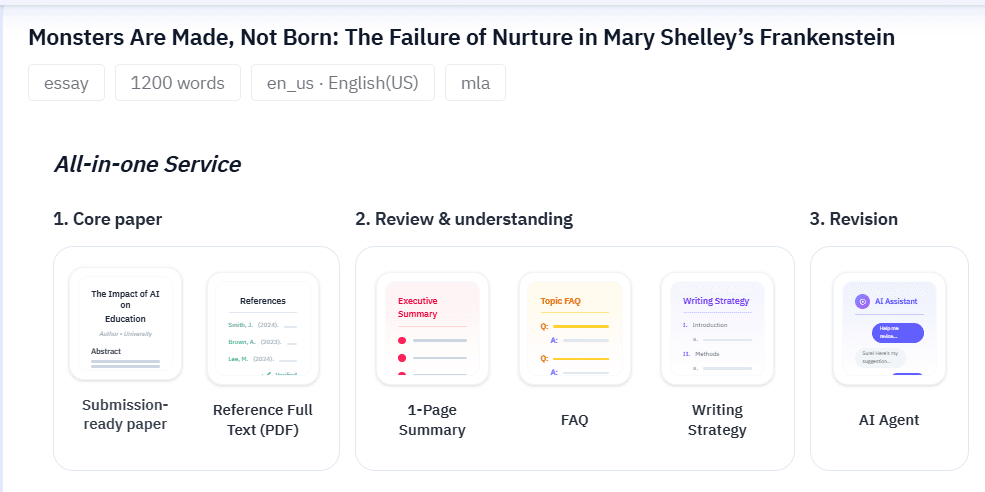
It also makes finishing faster by letting you generate multiple word-count versions, choose the citation style you need (e.g., APA/MLA/Chicago), and work with real, downloadable references. When you’re ready to submit, Turnitin checks can add an extra layer of confidence that your draft is ready.