
Your professor can spot a messy essay in the first 10 seconds—and it usually starts with one problem: an unclear outline. If you keep rewriting your introduction, losing your argument halfway, or wondering “what comes next?”, this guide is for college students who want an outline that’s actually usable—something you can copy, submit (if required), and expand into a strong draft.
Why Writing Without an Outline Feels So Hard
Most writing stress comes from trying to think, organize, and draft at the same time. Without a plan, you’re more likely to:
- struggle to start the introduction
- repeat ideas across paragraphs
- go off-topic mid-essay
- spend hours rearranging sections
- end up with a thesis that doesn’t match your body paragraphs
A good outline prevents these issues before the first sentence is written. It turns drafting into expansion, not improvisation.
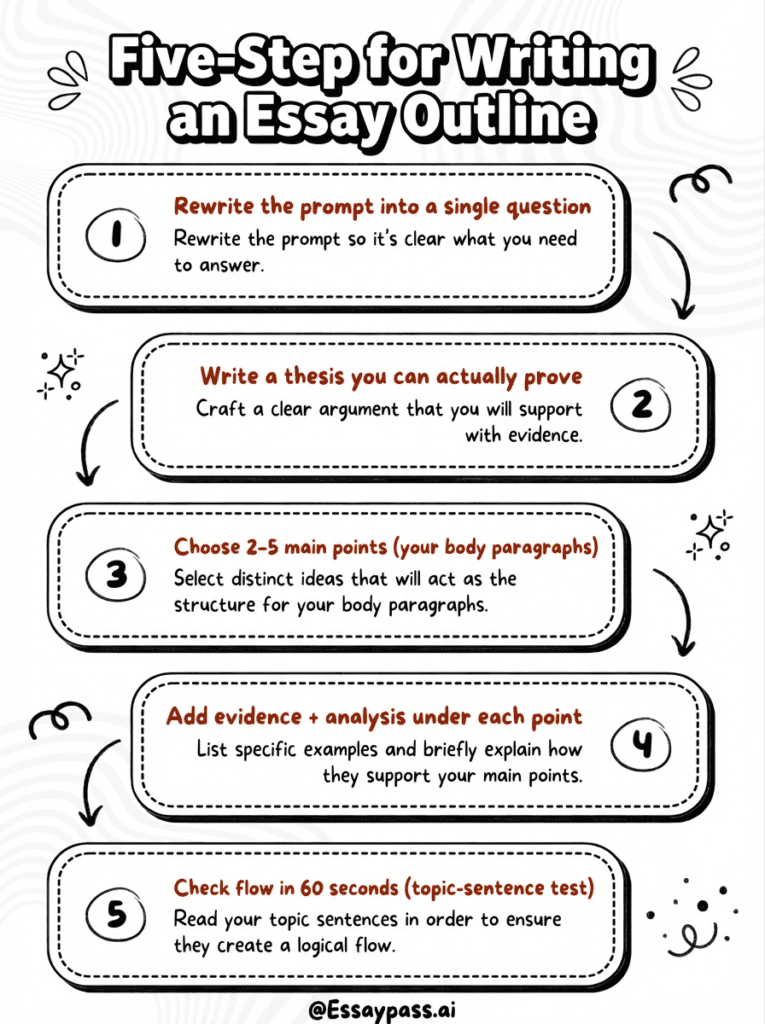
Five-Step for Writing an Essay Outline
Use this workflow for most assignments—especially when you feel stuck.
Step 1: Rewrite the prompt into a single question
Turning the prompt into a question forces clarity.
- Prompt: “Discuss whether social media harms students.”
- Question: “To what extent does social media use reduce academic performance, and why?”
Step 2: Write a thesis you can actually prove
Use this formula:
Thesis: X is true / should happen because A, B, and C.
If A/B/C overlap or sound repetitive, narrow your scope.
Step 3: Choose 2–5 main points (your body paragraphs)
Each body paragraph should prove one distinct reason that supports your thesis.
Quick test: if two paragraphs could swap places without changing meaning, your points are too similar.
Step 4: Add evidence + analysis under each point
Under each main point, write:
- Evidence: research, data, quote, example
- Analysis: what the evidence proves and how it supports the thesis
Step 5: Check flow in 60 seconds (topic-sentence test)
Read only your thesis + topic sentences in order.
If they don’t sound like a logical mini-essay, reorder or rewrite. To make these connections even smoother, consider using specific essay transitions to link your ideas.
Formal vs. Informal Outlines
Use the format that matches your assignment:
- Informal bullet outline = fastest for drafting
- Formal I.A.1 outline = best if you need to submit an outline
Informal Outline
(Bullet Style — Best for Writing Fast)
- Introduction: hook + context + thesis
- Body 1: point + evidence + analysis
- Body 2: point + evidence + analysis
- Body 3: point + evidence + analysis
- Conclusion: restate thesis + synthesize + final insight
Formal Outline
(I.A.1 Style — Best for Submitting)
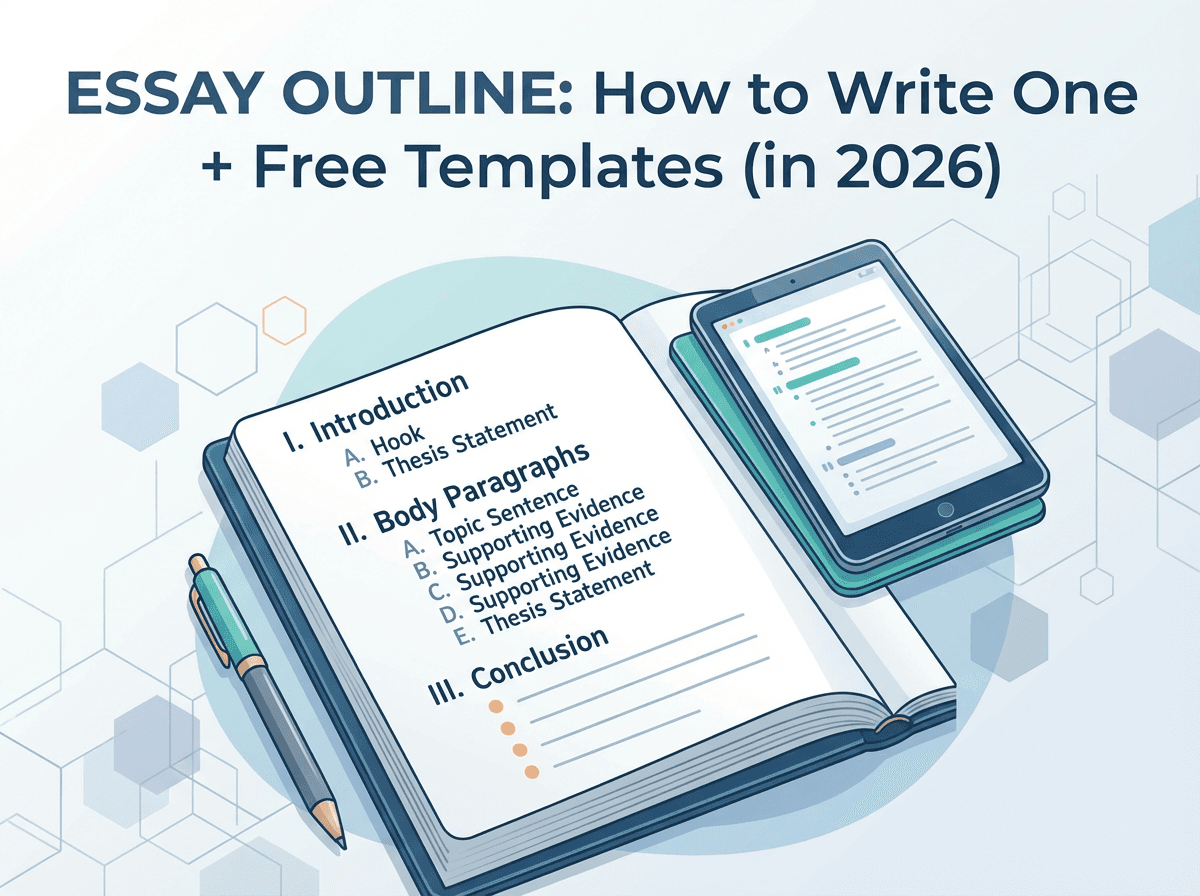
I. Introduction
A. Hook / opening problem
B. Background / context
C. Thesis statement
II. Main Point 1
A. Topic sentence / claim
- Evidence (source/data/example)
- Analysis (why the evidence supports the claim)
B. Transition to next point
III. Main Point 2
A. Claim
- Evidence
- Analysis
B. Transition
IV. Main Point 3 (optional)
A. Claim
- Evidence
- Analysis
V. Conclusion
A. Restate thesis
B. Summarize key points
C. Final insight / implication
Recommended detail level: If you’re submitting, include at least one evidence line under every major point.
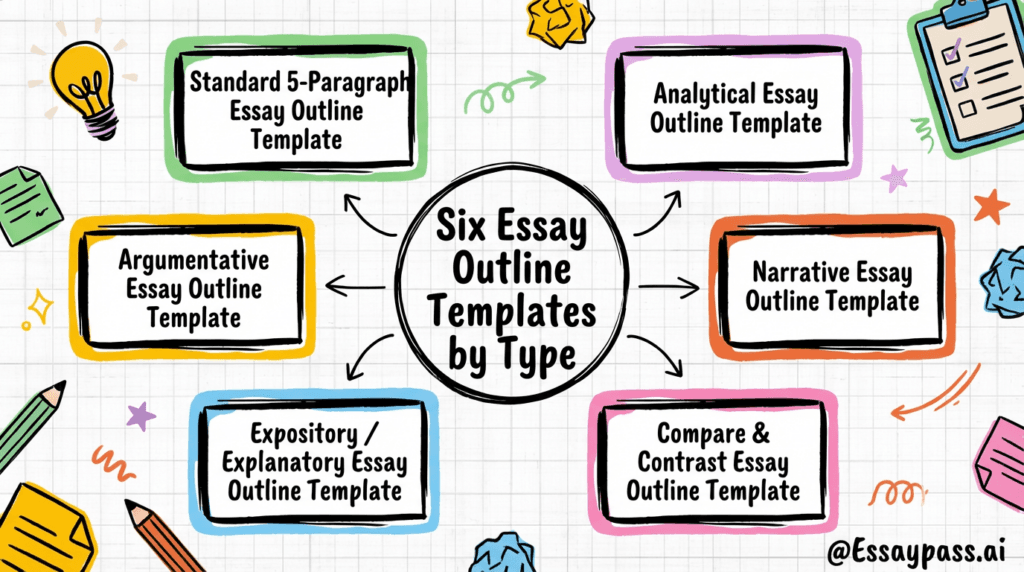
Six-Type Essay Outline Templates
Choose the template that matches your assignment and fill in the brackets.
1) Standard 5-Paragraph Essay Outline Template
Best for: most short college essays, general assignments
If you are just starting your academic journey, it helps to review the basics of how to write a college essay before filling in this structure.
I. Introduction
-
Hook: [question/statistic/problem] (1 sentence that grabs attention—an issue, surprising fact, or debate)
-
Background: [1–3 sentences of context] (define key terms, narrow the scope, give essential context)
-
Thesis: [claim + 2–3 reasons] (one clear position + a preview of your main points: “because A, B, and C”)
II. Body Paragraph 1
-
Point: [reason #1] (one distinct reason supporting the thesis—make it specific)
-
Evidence: [source/example] (1–2 credible supports: study, data, quote, case, real example)
-
Analysis: [how it supports thesis] (explain what the evidence proves and how it connects back to the thesis)
III. Body Paragraph 2
-
Point: [reason #2] (a different reason—avoid repeating Paragraph 1 in new words)
-
Evidence: [source/example] (use fresh evidence, not the same example again)
-
Analysis: [explain] (interpret the evidence—don’t just summarize it)
IV. Body Paragraph 3
-
Point: [reason #3] (third reason or a supporting angle that strengthens your argument)
-
Evidence: [source/example]
-
Analysis: [explain]
V. Conclusion
-
Restate thesis (new words): (same idea, clearer/stronger—don’t copy-paste)
-
Summarize points (1 line each): (mirror your body paragraph order)
-
Final insight: [implication/recommendation] (answer “so what?”—why it matters or what should happen next)
2) Argumentative Essay Outline Template
Best for: persuasive essays, policy debates, ethics topics
I. Introduction
-
Hook + brief context: (1–2 sentences framing the controversy + necessary background)
-
Thesis: [your stance + main reasons] (clear position + 2–3 reasons you’ll prove)
II. Reason #1
-
Claim: (your paragraph’s main argument in one sentence—debatable and specific)
-
Evidence: (1–2 supports: research, statistics, expert view, policy example, real case)
-
Analysis: (explain why the evidence supports the claim, then link the claim back to the thesis)
III. Reason #2
-
Claim: (a distinct reason—not a rewording of Reason #1)
-
Evidence: (new evidence—avoid recycling the same source)
-
Analysis: (walk the reader through the logic: “this shows…, therefore…”)
IV. Counterargument + Rebuttal
-
Opposing view (strong version): (the best form of the other side—no strawman)
-
Why it seems valid: (acknowledge the strongest point or concern)
-
Rebuttal evidence: (data or sources that directly challenge the opposing view)
-
Rebuttal reasoning: (explain why your thesis still holds; clarify limits/conditions if needed)
V. Conclusion
-
Restate thesis + strongest takeaway: (highlight your most convincing reason)
-
Recommendation / implication: (policy suggestion, ethical takeaway, or broader consequence)
Optional: pick a structure
-
Classical: thesis → reasons → counterargument → rebuttal
-
Rogerian: present both sides → build common ground → propose solution
-
Toulmin: claim → evidence → warrant (logic behind the claim) → rebuttal
3) Expository / Explanatory Essay Outline Template
Best for: explaining concepts, processes, causes, definitions
I. Introduction
-
Hook: (a question, surprising fact, or real-world problem that introduces the topic)
-
Thesis: [what you’ll explain + how you’ll organize it] (state what you’ll explain and the “map” you’ll follow: steps/categories/causes)
II. Main Idea A
-
Explanation: (define/describe the concept or step in clear terms)
-
Example: (a concrete example that makes it easy to understand)
-
Why it matters: (one sentence on significance or impact)
III. Main Idea B
-
Explanation:
-
Example:
-
Why it matters:
IV. Main Idea C
-
Explanation:
-
Example:
-
Why it matters:
V. Conclusion
-
Recap main ideas: (briefly restate A/B/C in order)
-
Final takeaway: (what the reader should understand or do now)
4) Analytical Essay Outline Template
Best for: literature/film analysis, theory-based essays, critical analysis
I. Introduction
-
Context of text/topic (1–2 lines): (what you’re analyzing and the key context needed)
-
Thesis (your interpretation, not summary): (your main insight—what it means and why)
II. Insight 1
-
Claim: (your first interpretation point—what you believe the text shows/does)
-
Evidence (quote/scene/data): (specific supporting detail; include where it comes from)
-
Analysis (so what?): (explain what the evidence reveals and how it supports your thesis)
III. Insight 2
-
Claim: (a different interpretive angle)
-
Evidence:
-
Analysis:
IV. Insight 3 (pattern/implication)
-
Claim: (connect earlier insights into a bigger pattern or consequence)
-
Evidence:
-
Analysis:
V. Conclusion
-
Reframe thesis with broader meaning: (return to your interpretation at a higher level)
-
Final implication: (why it matters beyond the text/topic)
5) Narrative Essay Outline Template
Best for: personal narratives, reflective essays, some admissions writing
I. Opening scene (start in action)
-
Moment that matters: (begin with a specific moment, not a summary)
-
Hint of theme/lesson: (subtly signal what this story will reveal)
II. Setup
-
Who/where/goal: (the situation and what you wanted/needed)
-
Why it mattered (stakes): (what you risked or why it was important)
III. Conflict
-
Challenge: (the obstacle or tension)
-
What you tried: (your response/actions)
-
What went wrong: (the complication or turning pressure)
IV. Turning point
-
Decision/realization: (what changed—an insight or key choice)
V. Resolution + reflection
-
Outcome: (what happened next)
-
Reflection: (what you learned and how it changed your perspective)
6) Compare & Contrast Essay Outline Template
Best for: comparing theories, texts, policies, methods
I. Introduction
-
Why comparing matters: [1–2 sentences]
-
Thesis: [main similarity + key differences by criteria]
II. Criterion 1: [criterion name]
-
Subject A: [what A is like on this criterion + evidence/example]
-
Subject B: [what B is like on this criterion + evidence/example]
-
Insight: [what this comparison reveals + why it matters]
III. Criterion 2: [criterion name]
-
Subject A: [A + evidence]
-
Subject B: [B + evidence]
-
Insight: [meaning/implication]
IV. Criterion 3: [criterion name]
-
Subject A: [A + evidence]
-
Subject B: [B + evidence]
-
Insight: [meaning/implication]
V. Conclusion
-
Most important comparison result: [1–2 lines]
-
Recommendation / implication: [so what?]
Tip: Point-by-point is usually clearer than the block method for complex comparisons.
Essay Outline Examples
Example 1: Argumentative Essay Outline
Topic: Should universities make attendance optional?
I. Introduction
- Hook: Attendance policies affect learning, mental health, and equity.
- Context: Universities debate flexibility vs accountability.
- Thesis: Attendance should be optional because adult learners need autonomy, learning should be measured by performance, and rigid policies unfairly penalize students with work/care responsibilities.
II. Body 1 — Autonomy
- Point: Students learn better when treated as responsible adults.
- Evidence: [education theory / policy examples]
- Analysis: Autonomy supports intrinsic motivation, not compliance.
III. Body 2 — Performance-based evaluation
- Point: Grades should reflect mastery, not seat time.
- Evidence: [assessment design research / policy comparisons]
- Analysis: Attendance ≠ learning; assessments measure outcomes.
IV. Body 3 — Equity
- Point: Mandatory attendance disadvantages students with jobs, caregiving, health issues.
- Evidence: [survey data / university reports]
- Analysis: Fairness requires flexible policies.
V. Counterargument + Rebuttal
- Counterargument: Optional attendance reduces participation and community.
- Rebuttal: Engagement can be improved via active learning and assessed participation—not punishment.
VI. Conclusion
- Restate thesis + recommend flexible attendance models with clear performance criteria.
Example 2: Research Essay Outline
Topic: Social media use and academic performance
I. Introduction
- Gap: Studies define “use” differently, causing mixed results.
- RQ: How do passive vs active social media use relate to GPA and study habits?
- Thesis: Passive consumption correlates with worse outcomes, while intentional academic use can support learning under certain conditions.
II. Framework / definitions
- Define passive vs active use
- Source plan: [core study defining categories]
III. Argument 1 — Passive use and distraction
- Claim: Passive scrolling increases task-switching and reduces deep work.
- Evidence: [Source A] + [Source B]
- Analysis: Mechanism = attention fragmentation.
IV. Argument 2 — Active/intentional use
- Claim: Purposeful use (study groups, Q&A communities) can support learning.
- Evidence: [Source C] + [Source D]
- Analysis: Benefits depend on intention + time control.
V. Limitations
- Confounds: self-report bias, prior performance, socioeconomic variables.
- Evidence: [methods critique source]
VI. Conclusion
- Synthesis + implications for students/university policy + future research.
Common Outline Problems
“My paragraphs don’t connect.”
Fix: Add one bridge line between paragraphs: “Because [Point 1], we also need to consider [Point 2].”
“I don’t have enough evidence.”
Fix: For each point, add: (1) one citable source, (2) one concrete example, (3) one sentence of your analysis (not summary).
“My outline feels AI-generic.”
Fix: Add specificity: define key terms, set boundaries (time/place/population), and include at least one unique source or example per paragraph.
From Outline to Draft (Faster, With Less Stress)
Once your outline answers Point → Why it matters → Evidence, drafting becomes a simple task of expansion.
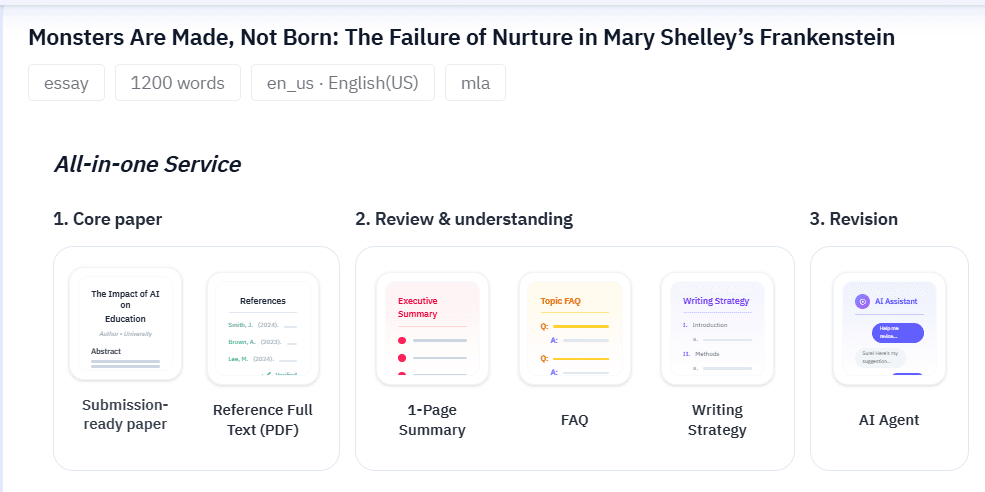
If you want to skip the “blank page” struggle entirely, the Essaypass AI Essay Writer can take your structured outline—or generate a new one for you—and one-click expand it into a full, high-scoring draft.
Whether you need a 5-paragraph argumentative essay or a complex research paper, Essaypass ensures:
-
Total Control: You guide the logic; the AI handles the heavy lifting.
-
Academic Integrity: Optional Turnitin-based originality checks and AI detection to keep your work safe.
-
Real Evidence: Every point is backed by real, verifiable, and downloadable references—no “hallucinations.”
Final Takeaway
A strong Essay Outline is the fastest way to write a clearer essay with fewer revisions. Use our 5-step method to build your plan today.
Ready to turn your outline into a finished paper? Try Essaypass and experience the end-to-end workflow from outline → draft → polished final version in minutes, not days.