
Got feedback like “awkward flow,” “unclear logic,” or “abrupt transitions”? That usually isn’t a content problem—it’s a connection problem. In academic essay writing, weak transitions are one of the primary reasons students lose marks for organization.
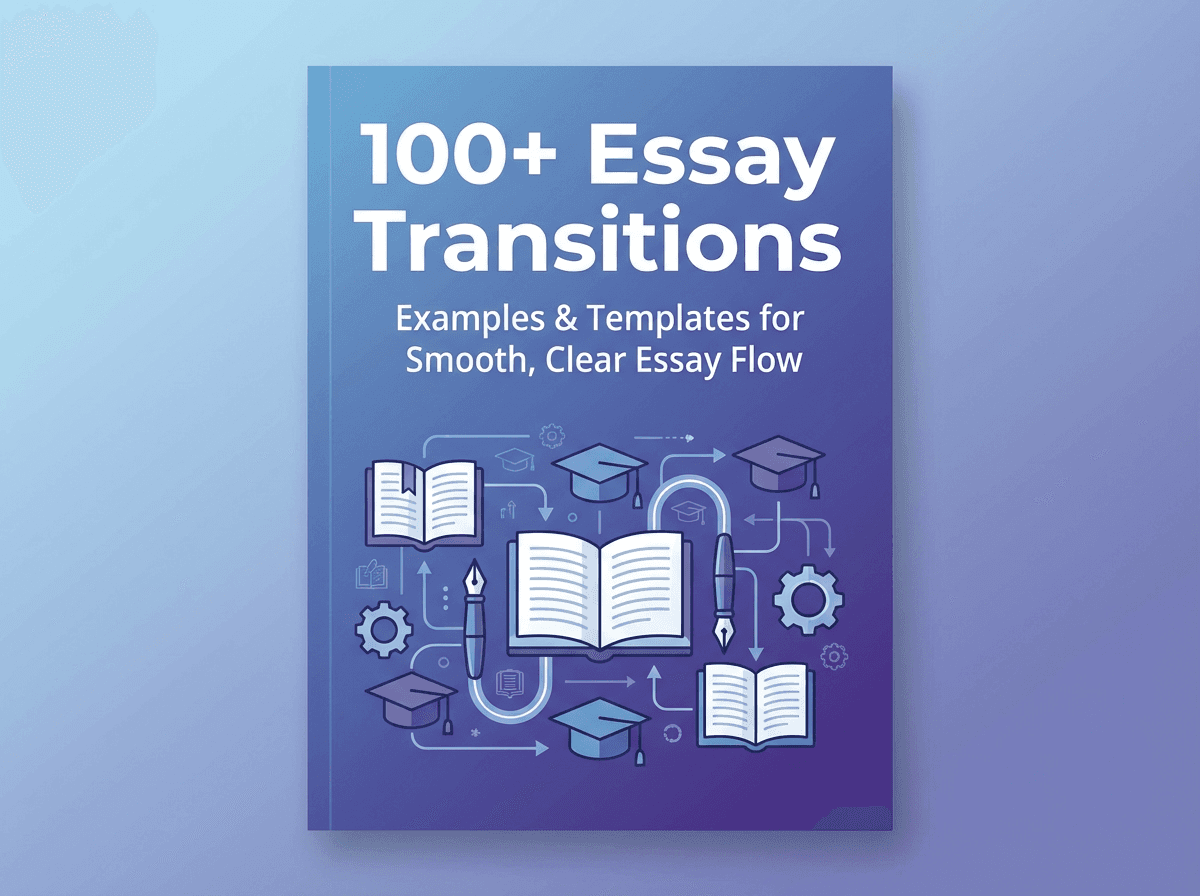
Here are 100+ transition words, phrases, and sentence templates to link your ideas clearly and boost your essay’s coherence.
What Are Essay Transitions
Essay transitions are words, phrases, or full sentences that connect ideas by explaining the relationship between them (contrast, cause-effect, example, conclusion, etc.).
Transitions can work at three levels:
- Sentence-to-sentence (within a paragraph)
- Paragraph-to-paragraph (the “bridge” between two main points)
- Section-to-section (e.g., moving from argument to counterargument)
When transitions are weak, readers must guess your logic—so even good content can look disorganized.
Transition Words vs. Transition Sentences vs. Paragraph Bridges
Many students overuse basic signposts like however, therefore, moreover. These aren’t “wrong”—but a single word often isn’t enough.
Use a transition word when…
The relationship is obvious and the shift is small.
Example: “The policy reduces costs. However, it may increase inequality.”
Use a transition sentence when…
You’re making a bigger move (new point, new paragraph, new claim).
Example: “This cost reduction matters most when budgets are limited, which is why…”
Use a paragraph bridge when…
You’re finishing one main argument and introducing the next.
Example: “Having shown X, it is now necessary to consider Y…”
Rule of thumb:
If a reader could ask, “Wait—how did we get here?” you need more than a single transition word.
The Fast 3-Step Method to Fix Essay Flow
Use this whenever your writing feels disconnected.
Step 1: Name the relationship
Choose the logic: addition, contrast, cause-effect, example, clarification, sequence, conclusion.
Step 2: Repeat one key idea (briefly)
Remind the reader what you just established (5–12 words).
Step 3: Push forward to the next point
Introduce the new idea and explain why it follows.
Template:
“[Repeat key idea]. [Relationship], [new point + purpose].”
Example:
“Remote work improves flexibility for many employees. However, this benefit can be limited by communication barriers, which makes team coordination a crucial next consideration.”
100+ Essay Transitions (Words & Phrases)
Use this table to match your logic—not your habit. (You don’t need to start every sentence with a transition; use them strategically.)
| Purpose (What do you want to do?) | Best Essay Transition Words & Phrases (120+) |
|---|---|
| Add Information (expansion / addition) | additionally, furthermore, moreover, in addition, also, beyond that, not only that, equally important, another key point is that, along the same lines, similarly, in the same way, coupled with, likewise |
| Show Contrast (opposition / difference) | however, nevertheless, nonetheless, in contrast, by contrast, on the other hand, conversely, yet, even so, still, despite this, rather than, on the contrary, alternatively |
| Make a Concession (acknowledge the other side) | although, though, even though, while it is true that, admittedly, granted, despite the fact that, to be sure, even if, regardless of, notwithstanding, albeit |
| Explain Cause (why something happens) | because, since, as, due to, owing to, given that, because of this factor, one reason is that, this stems from, this can be attributed to, in light of, considering that |
| Show Result (effect / outcome) | therefore, thus, as a result, consequently, hence, for this reason, this leads to, this results in, which means that, which explains why, accordingly, thereby |
| Give Examples (introduce evidence) | for example, for instance, to illustrate, specifically, in particular, a clear example is, this can be seen in, evidence of this appears when, one case that demonstrates this is, notably |
| Clarify Ideas (restate / explain) | in other words, put differently, that is to say, to clarify, more precisely, in simpler terms, what this suggests is, this indicates that, this means that, in essence, to rephrase |
| Compare Similarities (comparison / analogy) | similarly, likewise, in the same way, just as, comparable to, in a similar manner, the same pattern appears in, parallels can be drawn between, by the same token |
| Order & Sequence (time / steps) | first, second, next, then, afterward, subsequently, meanwhile, at the same time, finally, ultimately, previously, following this, concurrently |
| Add Emphasis (highlight importance) | notably, importantly, above all, crucially, significantly, it is worth noting that, a key takeaway is, what matters most is, this is especially relevant because, the most compelling point is |
| Add Nuance (qualification / limitation) | in part, to some extent, in many cases, in certain contexts, this depends on, this is not always true when, a limitation is that, this claim holds only if, this is less convincing in situations where |
| Summarize & Synthesize (wrap up / combine ideas) | in conclusion, to conclude, overall, in summary, to sum up, taken together, collectively, these points suggest, in light of this evidence, the broader implication is, this ultimately shows that |
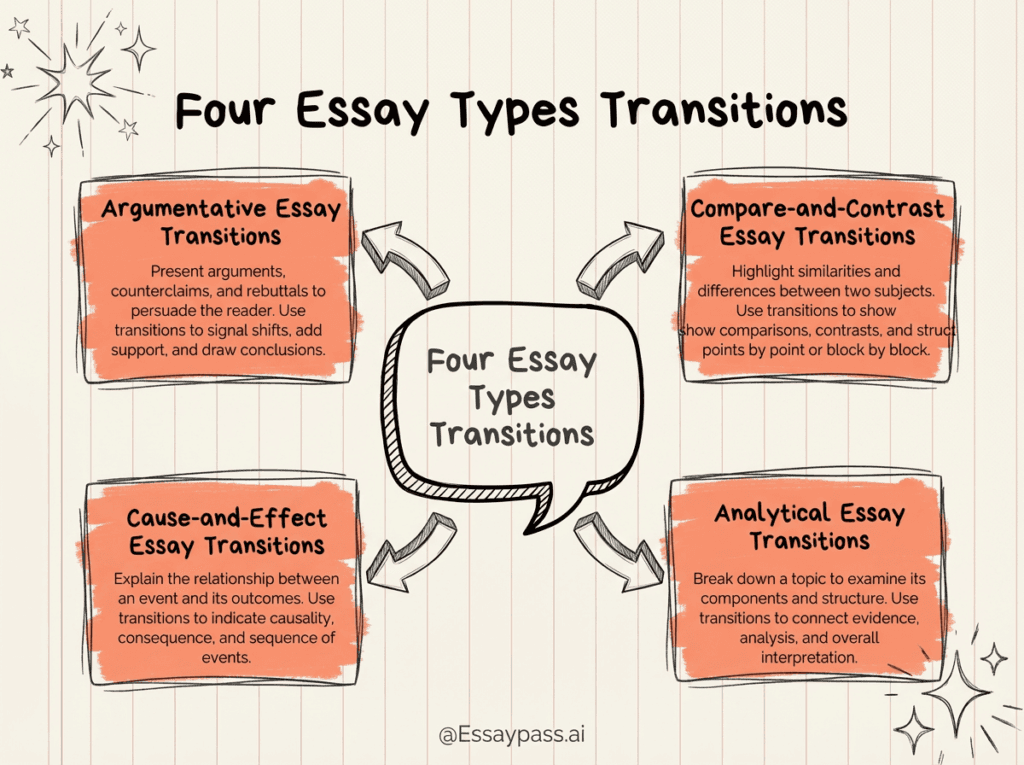
Four Essay Types Transitions
Different essay types require different logical moves. If you’re searching for “essay transitions,” you may actually be looking for transitions that fit your assignment style.
Argumentative Essay Transitions
When learning how to write an argumentative essay, mastering the transition from counterargument to rebuttal is crucial.
- Claim: “One central argument is that…”
- Evidence: “This is supported by…”
- Counterargument: “Admittedly… / A common objection is that…”
- Rebuttal: “However, this view overlooks…”
- Wrap-up: “Taken together…”
Quick bridge template:
“While the previous point shows ____, critics may argue ____. Nevertheless, ____ because ____.”
Compare-and-Contrast Essay Transitions
Go-to moves:
- Similarity: “Likewise… / Both X and Y…”
- Difference: “In contrast… / Whereas…”
- Evaluation: “This difference matters because…”
- Structure: “On the one hand… On the other hand…”
Quick bridge template:
“Although X and Y share ____, they differ in ____, which becomes significant when ____.”
Cause-and-Effect Essay Transitions
Go-to moves:
- Cause: “This stems from… / One reason is…”
- Mechanism: “This occurs when… / In practice…”
- Result: “Consequently… / This leads to…”
- Limitations: “However, this depends on…”
Quick bridge template:
“Because ____, it follows that ____. This is especially true when ____.”
Analytical Essay Transitions
When drafting an analytical essay, transitions should highlight interpretation rather than just facts.
- Interpretation: “This suggests that…”
- Zoom in: “More specifically…”
- Implication: “This matters because…”
- Synthesis: “Taken together…”
Quick bridge template:
“Rather than simply showing ____, this detail reveals ____, which reshapes how we understand ____.”
Copy-Paste Transition Sentence Templates
A) Intro → Thesis templates
- “Although ____ is often seen as ____, a closer look shows that ____.”
- “This issue matters because ____, which is why this essay argues that ____.”
- “To understand ____, it is necessary to examine ____.”
B) Thesis → Body Paragraph (topic sentence transitions)
- “One major reason for ____ is ____.”
- “A more convincing explanation focuses on ____.”
- “To develop this argument, it is useful to consider ____.”
C) Evidence → Analysis templates (where many essays break)
- “This evidence suggests that ____ because ____.”
- “Rather than simply showing ____, this example reveals ____.”
- “What this indicates is not just ____, but also ____.”
- “This matters because ____.”
D) Paragraph-to-paragraph bridge templates
- “Having established ____, the next step is to consider ____.”
- “While the previous point explains ____, it does not fully address ____.”
- “This argument leads to a further question: ____.”
- “A related issue emerges when ____.”
E) Counterargument → Rebuttal templates
- “Admittedly, ____; however, this view overlooks ____.”
- “While it is true that ____, this claim is limited because ____.”
- “This objection is understandable, yet it fails to consider ____.”
F) Conclusion synthesis templates
- “Taken together, these points show that ____.”
- “The evidence indicates that ____—especially when ____.”
- “Ultimately, the broader implication is that ____.”
The Paragraph Bridge Formula Teachers Love
Use this when switching between main points.
- Old (1 short reminder): summarize the previous paragraph’s takeaway
- Link (name relationship): contrast / extend / qualify / cause
- New (preview): introduce the next paragraph’s focus
Example bridge sentence:
“While remote work improves flexibility for employees, it can reduce informal communication, which makes collaboration challenges the next key issue to examine.”
This makes your structure visible—without sounding repetitive.
Before vs After: Real Examples That Turn “Choppy” Writing Into Smooth Flow
Seeing transitions inside real paragraphs is the fastest way to improve your own writing. Here are three common break points—plus a revised version you can model.
Example 1: Sentence-to-Sentence Flow (Within One Paragraph)
Before (choppy):
“Social media use has increased in recent years. Therefore, mental health problems have increased. Therefore, students should limit screen time.”After (smooth and logical):
“Social media use has increased in recent years, and this shift matters because constant comparison and information overload can intensify anxiety. As a result, many students experience reduced focus and wellbeing, which is why limiting screen time can be a practical step toward healthier routines.”
Why it works: The revision explains the reasoning instead of repeating “therefore.”
Example 2: Paragraph-to-Paragraph Bridge (Main Point 1 → Main Point 2)
Before (abrupt shift):
“Remote work improves flexibility and reduces commuting time.
Remote work also creates communication problems.”After (clear bridge):
“Remote work improves flexibility and reduces commuting time, which can raise productivity for many employees. However, these benefits often depend on effective collaboration, making it necessary to examine how fully virtual teams handle communication, coordination, and trust.”
Why it works: One bridge sentence connects the takeaway (benefits) to the next focus (challenges).
Example 3: Evidence → Analysis (The Most Common Weak Spot)
Before (evidence with no reasoning):
“A study found that students who sleep eight hours perform better on exams. This shows sleep is important.”After (evidence + analysis that flows):
“A study found that students who sleep eight hours perform better on exams. This evidence suggests that sleep improves learning not only by restoring attention, but also by strengthening memory consolidation. In other words, sleep supports the cognitive processes that exams actually measure.”
Why it works: It moves from evidence to interpretation and explains why the evidence matters.
Common Transition Mistakes
Mistake 1: Starting every sentence with a transition word
Fix: Use transitions only at key shifts. Mix sentence structure.
Mistake 2: Using the wrong logic word
“Therefore” (result) is not the same as “However” (contrast).
Fix: Identify the relationship first (addition vs contrast vs result).
Mistake 3: “Fake flow” (signposting without explanation)
Bad: “However, X.” (no reason why it conflicts)
Fix: Add the why: “However, X because …”
Mistake 4: Repeating the same three words
Fix: Rotate phrases and use sentence-level bridges.
Improve Your Essay Transitions Faster
Strong transitions usually don’t fail because students lack ideas—they fail because revision time is limited. When you’re juggling research, citations, formatting, and deadlines, it’s easy to miss the exact sentence where your logic “jumps.”
EssayPass saves your time and simplifies your logic in three easy steps:
-
Draft with Precision: Use AI essay writer to input your requirements and generate a structured, coherent draft instantly.
-
Additional deliverables: Receive your essay complete with academic sources (available for download), logical outlines, and insightful FAQs.
-
Refine with AI Agents: Use specialized AI Agents to perform iterative edits, fine-tuning your transitions and tone to meet your specific needs.
Stop guessing which words fit. Elevate your academic tone, fix broken paragraph bridges, and submit a cohesive, professional essay with confidence.