
Why some students spend half the time writing but get twice the grade? The secret isn’t ‘better English’—it’s a structural framework that forces your reader to agree with you.
If you’re tired of feedback like ‘too descriptive’ or ‘lacks flow,’ this 2026 guide is your roadmap to turning messy thoughts into a persuasive masterpiece in minutes.”
The Core Essay Structure
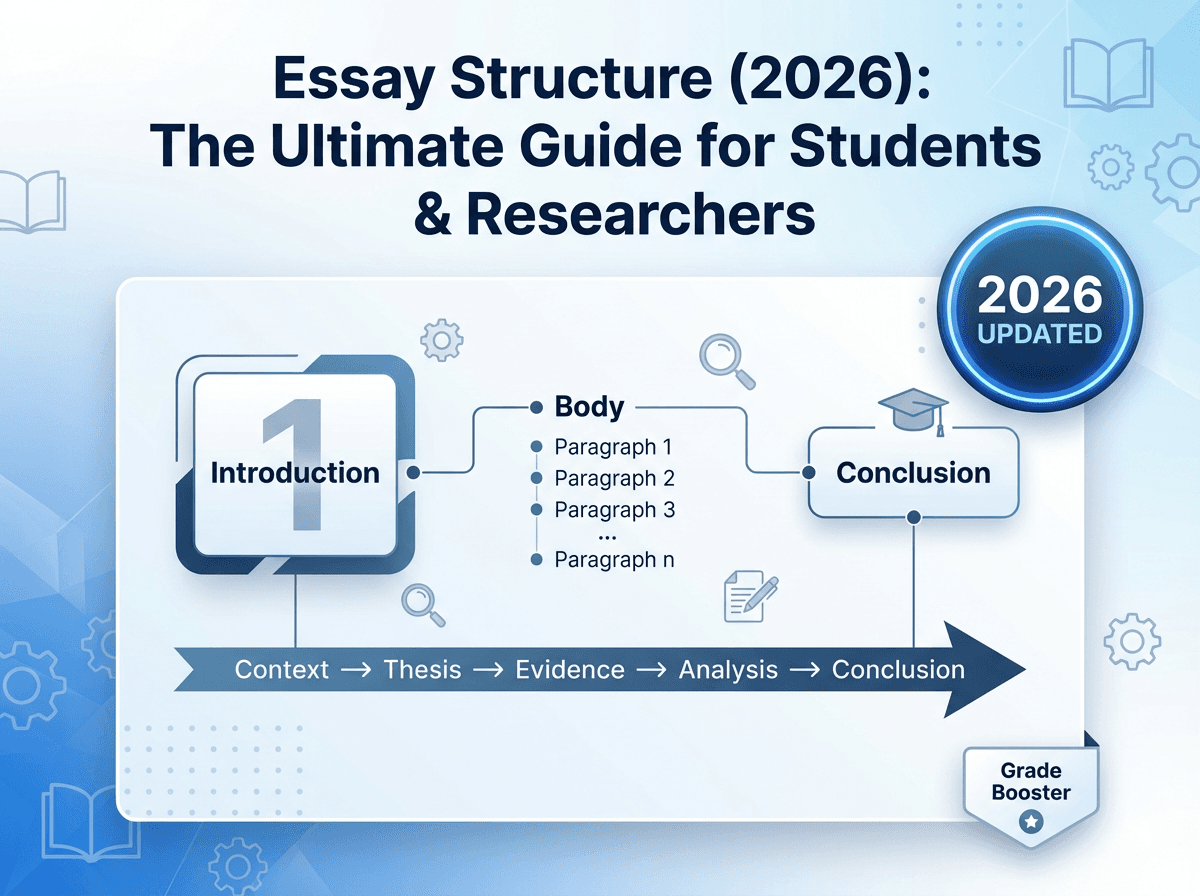
Most academic essays—across disciplines—use the same core framework. The difference between average and excellent writing is how well each part performs its job.
-
Introduction: Set the Direction
A strong introduction usually includes:
-
Context (1–3 sentences)
-
A clear thesis statement (your main argument)
-
(Optional) a brief roadmap of main points
Mini example (weak vs strong) Weak: This essay is about social media. Strong: This essay argues that while social media increases connectivity among college students, it also increases anxiety by intensifying social comparison and weakening offline support systems.
-
Body: Build the Argument
Each body paragraph should focus on one main idea that supports the thesis.
Rule of thumb: One paragraph = one purpose. If a paragraph contains multiple main ideas, the argument becomes harder to follow.
-
Conclusion: Reinforce (Don’t Expand)
A strong conclusion should:
-
Restate the thesis in new wording
-
Summarize the key moves (briefly)
-
End with an implication or final insight
Avoid adding brand-new evidence or arguments in the conclusion—this is a common reason students lose marks.
For more detailed advice, check out these essay conclusion tips to ensure you end on a high note.
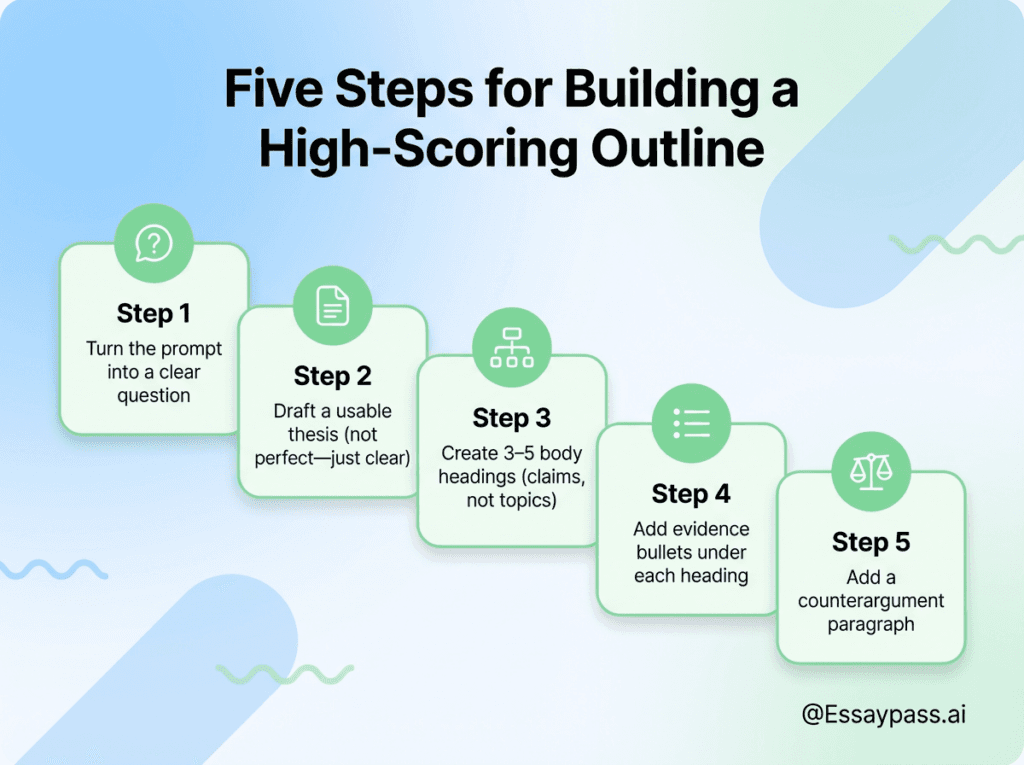
Five Steps for Building a High-Scoring Outline
If you don’t know where to start, don’t start by writing full paragraphs. Start with a structure you can trust.
Step 1: Turn the prompt into a clear question
Examples:
-
“Discuss X” → “What is my position on X, and why?”
-
“To what extent…” → “How far do I agree, and what evidence supports it?”
Step 2: Draft a usable thesis (not perfect—just clear)
Use one of these formats:
-
Position + reasons X is true because A, B, and C.
-
Although X, Y because… Although X seems convincing, Y is more accurate because…
-
Problem → cause → solution X is a problem caused by A and B; therefore C is the best solution.
Step 3: Create 3–5 body headings (claims, not topics)
Write headings as claims:
-
Topic: “Remote work”
-
Claim: “Remote work increases productivity by reducing commuting fatigue”
Step 4: Add evidence bullets under each heading
Under each paragraph heading, add 2–4 bullets:
-
Study/data/quote/example
-
One line explaining what it shows
Step 5: Add a counterargument paragraph
For argumentative essays:
-
Counterargument → rebuttal → return to thesis
Mini example: Outline you can actually write from
Prompt: Should universities require attendance? Thesis: Universities should not require attendance because it disadvantages working students, encourages passive learning, and can be replaced by performance-based assessment.Body 1 (Claim): Attendance rules disadvantage working students
If you’re stuck at the outline stage, the EssayPass AI Essay Writer can generate a clean, logical outline and essay draft from your prompt and requirements—so you can edit the draft instead of writing form a blank page.
The Best Body Paragraph Structure
Most “weak essays” have the same issue: they include information but not enough reasoning. Use the TEAL (Topic sentence, Evidence, Analysis, Link) structure to maintain flow.
To make your transitions seamless, you can use specific essay transitions that guide the reader from one piece of evidence to the next.
Use TEAL (or PEEL)
-
Topic sentence: the paragraph’s main claim
-
Evidence: research, data, textual proof, or example
-
Analysis: explain how evidence supports your claim and thesis
-
Link: connect to the next paragraph
Evidence vs Analysis (The #1 Grade Booster)
-
Evidence = what the source shows
-
Analysis = what it means and how it proves your point
If a paragraph is mostly quotes/facts with little explanation, it reads like a summary—not an argument.
Mini example: TEAL paragraph (short but realistic)
Topic sentence: Mandatory attendance policies disadvantage working students and reduce educational equity. Evidence: Many students work part-time or full-time to support tuition and living costs, making fixed attendance rules difficult to meet consistently. Analysis: When attendance is graded, the policy rewards schedule flexibility rather than learning—so students with jobs are penalized even if their assignments and exam performance demonstrate mastery. This shifts assessment away from academic outcomes and toward circumstances outside a student’s control, which weakens fairness. Link: For the same reason, policies focused on participation and performance are more equitable than seat-time requirements.
“Analysis prompts” to deepen your reasoning
After evidence, ask:
-
So what? What does this show?
-
Why does it matter? How does it support the thesis?
-
Compared to what? Are there limitations or counterexamples?
Four Types Essay Structure
Different assignments reward different structures. Use the framework that matches your task.
Argumentative Essay Structure
-
Introduction + thesis
-
Reason 1 (TEAL)
-
Reason 2 (TEAL)
-
Reason 3 (TEAL)
-
Counterargument → rebuttal
-
Conclusion
Compare & Contrast Structure
Option A: Block method
-
Discuss all points about A → then all points about B Best for shorter essays.
Option B: Point-by-point (recommended)
-
Compare one dimension per paragraph (cost, effectiveness, ethics, etc.) Best for clarity and smoother flow.
Problem–Solution Structure
-
Define the problem + significance
-
Explain causes (1–3 paragraphs)
-
Present solution(s) + evidence
-
Evaluate feasibility/limitations
-
Conclusion
Research-Based / Literature-Based Writing (For Researchers)
Research-heavy essays often work best as theme-driven structure, not “one study per paragraph.”
Theme-based structure:
-
Theme 1: main debate + evidence + your synthesis
-
Theme 2: main debate + evidence + your synthesis
-
Theme 3: gap/limitation + your interpretation
-
Conclusion: implications + future direction
Key rule: Don’t write a list of studies. Write a map of ideas.
Structure by Word Count (500–5000+)
A common question is: How many paragraphs should my essay have? There is no single correct number, but you can use these ranges.
500–800 words
-
Intro (1) + Body (2–3) + Conclusion (1)
1000–1500 words
-
Intro (1) + Body (3–4) + Conclusion (1)
-
Optional: 1 counterargument paragraph
2000–3000 words
-
Intro (1) + Body (4–6) + Conclusion (1)
-
Consider headings if allowed
5000+ words (research-heavy)
-
Section-based structure often works better than “pure paragraphs”
-
Use headings like: Background, Themes/Arguments, Discussion, Implications
Rule of thumb: Paragraph count is less important than paragraph function. Each paragraph should do one clear job.
Fix a Messy Draft: The 60-Second Structure Check
Already wrote a draft but it feels unclear? Do this quick check before polishing language.
-
One-sentence summary test
Write one sentence summarizing each paragraph’s main claim.
-
If you can’t summarize it, the paragraph is unfocused.
-
If two summaries are basically the same, you’re repeating yourself.
-
Thesis alignment test
Ask: How does this paragraph prove my thesis? If you can’t answer, it’s off-topic or needs a clearer topic sentence.
-
Order test (rearrange for logic)
List your paragraph summaries like an outline. Reorder until the logic flows.
-
Conclusion test
Remove:
-
New evidence
-
New arguments
-
New sources If the conclusion introduces something new, move it into the body.
Tip: Use an AI Agent to handle the heavy lifting of structural editing. EssayPass can help identify off-topic content and weak transitions while simultaneously generating a full essay draft from your initial ideas to help you finish faster.
Literature Review Structure (2026)
If you’re a researcher (or writing a research-based paper), the biggest structure mistake is writing a “summary parade” of sources.
Step 1: Group sources into themes
Instead of listing papers one by one, cluster them by:
-
agreement vs disagreement
-
method differences
-
definitions or theoretical frameworks
-
contexts (countries, populations, time periods)
Step 2: Build each theme paragraph like an argument
Each theme section should answer:
-
What do scholars agree on?
-
Where do they disagree, and why?
-
What does the evidence suggest overall?
-
What is your synthesis (your academic “take”)?
Step 3: Use synthesis sentence starters (copy/paste)
-
Taken together, these studies suggest that…
-
However, findings diverge when…
-
A key limitation across this literature is…
-
This debate highlights the need to…
-
In contrast to earlier work, recent evidence indicates…
-
One explanation for these mixed results is…
This structure instantly makes your writing sound more “research-level” because you’re synthesizing, not listing.
Leveraging Smart Tools to Build Structure
Structure is hard because you’re trying to think, organize, and write at the same time. EssayPass, an essay writing tool, can help you separate these steps.
Scenario 1: Prompt → Outline in minutes
Input your topic, word count, and requirements; get a clear structure.
Scenario 2: Thesis alignment (stay on-topic)
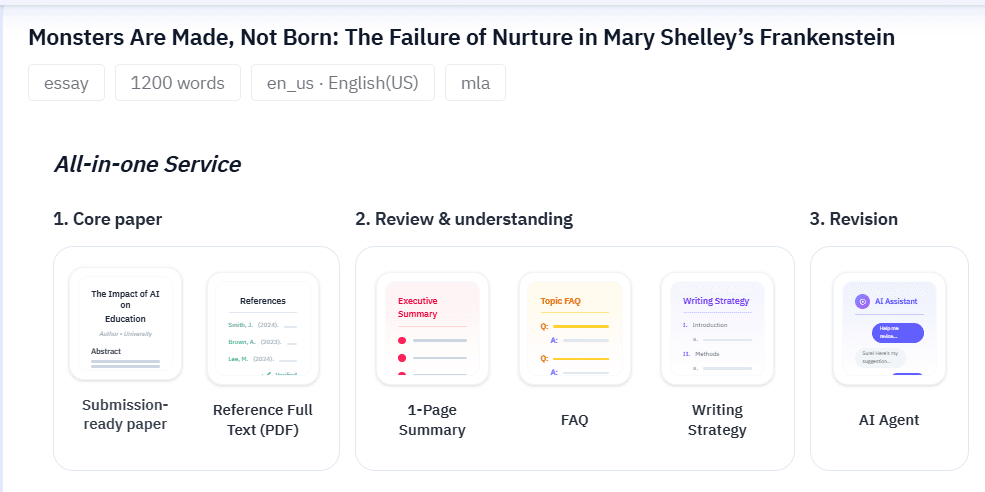
Transform a vague concept into a comprehensive first draft, complete with a logical paragraph plan, strategic writing insights, and downloadable reference lists to ground your research.
Scenario 3: Fix flow in an existing draft
Refine your work with a dedicated AI Writing Agent. By automating the ‘heavy lifting’ of structural revision, you can focus your energy on critical thinking and the nuances of your argument.
Final Checklist (Before You Submit)
-
My thesis is one clear, arguable sentence
-
Every paragraph supports the thesis (one idea per paragraph)
-
I include evidence and analysis (not summary-only writing)
-
Paragraphs connect logically with transitions
-
The conclusion reinforces the argument without adding new points
Strong essay structure makes your ideas work together instead of competing for attention. Once structure is clear, writing becomes faster, less stressful, and much easier to score highly.