Pride and Prejudice is often read as a classic love story, but its lasting power comes from Jane Austen’s precise and sophisticated narrative structure. For university students, understanding this structure is the key to moving beyond plot summary and writing high-level literary analysis.
This article provides a clear, essay-ready structural analysis of the novel, examining its narrative arc, Freytag’s Pyramid, parallel plots, and key techniques such as Free Indirect Discourse and the strategic use of letters.
Pride and Prejudice Structure: Quick Overview
-
Narrative model: Classical five-part structure (Freytag’s Pyramid)
-
Structural climax: Darcy’s first proposal (Chapter 34)
-
Key techniques: Free Indirect Discourse, epistolary interventions
-
Parallel plots: Three contrasting marriages as moral foils
-
Central concern: Moral growth through the correction of pride and prejudice
This balanced structure allows Austen to combine romance, satire, and moral education within a single narrative framework. Understanding these elements is crucial when learning how to write an academic essay on literature.
The Three-Volume Architecture of the Novel
When Pride and Prejudice was published in 1813, it appeared as a three-volume novel, a format that strongly influences its pacing and structural rhythm.
Volume I: Establishing Conflict
The first volume introduces:
-
The social world of Longbourn
-
The economic pressure surrounding marriage
-
The arrival of Bingley and Darcy as the inciting incident
Misunderstandings take root through Darcy’s apparent arrogance and Wickham’s misleading narrative. The volume ends with unresolved tension and social instability.
Volume II: Structural Crisis
The second volume complicates relationships through separation and emotional distance. It culminates in Darcy’s failed first proposal, the moment of maximum structural tension and moral confrontation.
Volume III: Resolution and Moral Repair
The final volume addresses the consequences of earlier misunderstandings. Lydia’s elopement introduces a serious social crisis, which is ultimately resolved through Darcy’s reformed conduct and the restoration of social harmony.
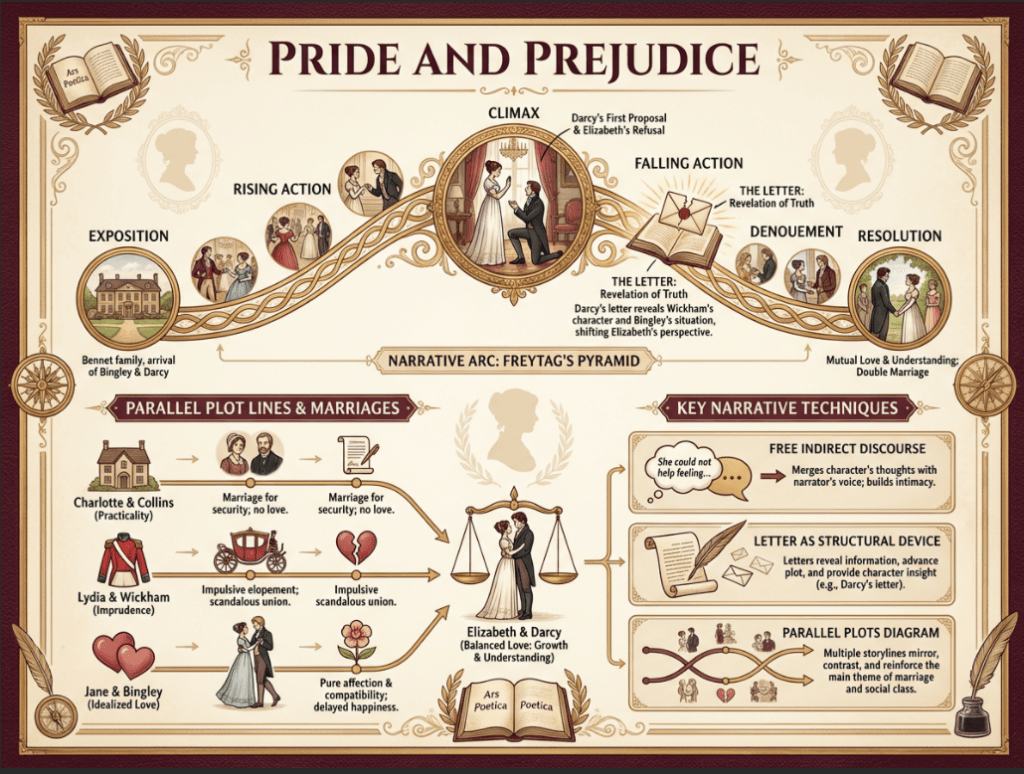
Plot Structure: Freytag’s Pyramid in Pride and Prejudice
Exposition
The novel opens by establishing the social and economic realities of Regency England. While the story is engaging, analyzing it requires distinguishing between simple storytelling and structural analysis—a skill detailed in our guide on how to write a narrative essay.
Rising Action
The rising action develops through a series of misunderstandings and obstacles:
-
Darcy’s pride alienates Elizabeth
-
Wickham manipulates public opinion against Darcy
-
Jane and Bingley’s relationship is quietly disrupted
-
Mr. Collins’s proposal foregrounds marriage as economic necessity
Each episode reinforces Elizabeth’s prejudice and delays emotional resolution.
Structural Climax: Darcy’s First Proposal
The true structural climax of Pride and Prejudice occurs in Chapter 34, at Hunsford Parsonage.
During this confrontation:
-
Darcy proposes with unexamined pride
-
Elizabeth rejects him with moral intensity
-
Long-suppressed accusations are openly voiced
This moment represents the turning point of the novel. Darcy’s subsequent letter dismantles false narratives and initiates genuine self-reflection for both protagonists. Importantly, the reader’s understanding shifts alongside Elizabeth’s.
Falling Action: Crisis and Reassessment
Following the climax:
-
Elizabeth reevaluates Darcy’s character
-
The visit to Pemberley reshapes her emotional perspective
-
Darcy acts with humility rather than social superiority
The narrative then introduces its major crisis: Lydia’s elopement with Wickham, which threatens the Bennet family’s reputation and appears to make Elizabeth’s happiness impossible.
Dénouement: Resolution
The resolution restores moral and social order:
-
Darcy discreetly resolves the Wickham scandal
-
Bingley returns to propose to Jane
-
Darcy proposes again, now with humility and respect
The conclusion succeeds not simply as romance, but as a logically earned moral resolution.
Parallel Plots and Character Foils
Austen strengthens the main narrative by arranging parallel marriages that function as structural and moral contrasts.
| Couple | Type of Marriage | Structural Purpose |
| Charlotte & Collins | Purely Economic | Represents the “prudent” social reality. A marriage without love, but with security. |
| Lydia & Wickham | Purely Passionate | Represents unchecked impulse. A marriage based on lust and appearance, leading to ruin. |
| Jane & Bingley | Passive / Ideal | Represents a good marriage, but lacks the intellectual depth and challenge of the protagonists. |
| Elizabeth & Darcy | The Synthesis | The “Perfect Union.” It combines passion (Lydia), security (Charlotte), and virtue (Jane), added to intellectual equality. |
These relationships clarify what distinguishes Elizabeth and Darcy’s union: a balance of affection, judgment, and moral growth.
Key Narrative Techniques Shaping the Structure
Free Indirect Discourse
Austen’s use of Free Indirect Discourse blends third-person narration with Elizabeth Bennet’s internal judgments.
Structurally, this technique:
-
Aligns the reader’s perception with Elizabeth’s
-
Makes the climax effective by correcting both character and reader simultaneously
As a result, the novel’s turning point is intellectually transformative, not merely emotional.
Letters as Structural Devices
Although Pride and Prejudice is not an epistolary novel, letters play a crucial structural role.
-
Darcy’s letter revises the narrative truth
-
Lydia’s letter triggers the central crisis of the falling action
-
Mr. Collins’s letters provide satire and social commentary
Letters function as moments where private truth disrupts public misunderstanding.
Common University Essay Approaches to Structure
Students frequently build successful essays around the following structural angles:
-
Structural Climax vs. Romantic Climax: Analyzing why the first proposal matters more structurally than the second.
-
Spatial Structure: Exploring how movement between Longbourn, Kent, London, and Derbyshire reflects psychological development.
-
Marriage as Narrative Framework: Examining how different marriages organize the novel’s moral argument.
If you are struggling to find a unique angle, browsing our list of argumentative essay topics might spark further inspiration.
Turning Structural Insight into a Strong Essay
Many university students understand Pride and Prejudice at the level of plot but struggle to organize structural analysis into a clear academic argument. You might have the ideas, but mapping them onto a blank page is the hardest part.
Essaypass is an advanced AI essay writing tool designed to solve this exact problem. It goes beyond simple spell-checking to help you build your essay from the ground up:
-
Smart Structuring: Develop a logical, coherent outline based specifically on your prompt requirements.
-
One-Click First Draft: Instantly generate a complete first draft to overcome writer’s block and get your ideas flowing.
-
Comprehensive Study Suite: Every essay comes with 5 additional resource packs, including:
-
Summaries
-
Topic FAQs
-
Step-by-step Writing Strategies
-
Downloadable References
-
A dedicated AI Agent for follow-up editing
-
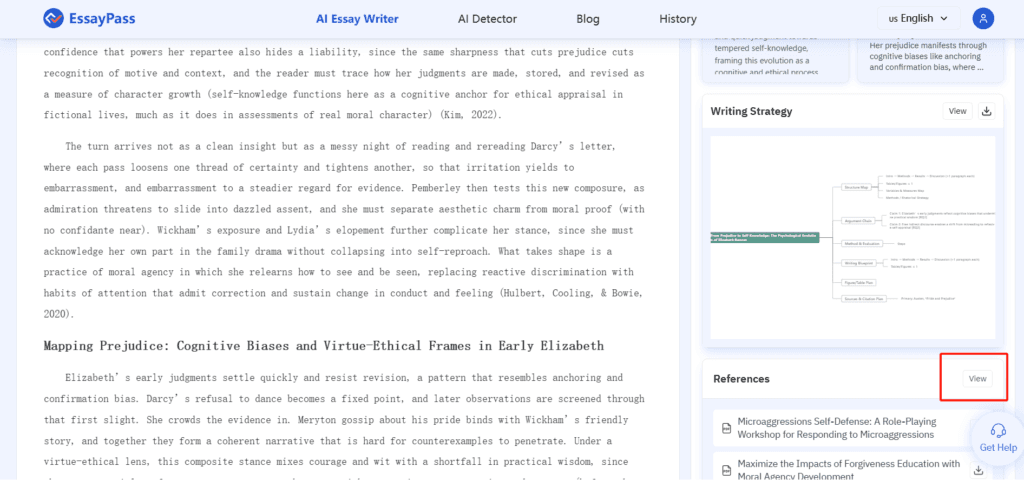
Instead of starting from a blank page, you begin with a structure that already works.
Try Essaypass and turn your literary insights into a high-scoring essay today.