
A college thesis represents the pinnacle of a student’s academic journey, demonstrating mastery of research, critical thinking, and scholarly communication. Producing a standout college thesis project requires clear research questions, rigorous methodology, and the ability to contribute original insights. Unlike ordinary essays, this research project demands structure, evidence, and analytical depth. For students aiming to strengthen foundational academic writing skills, exploring resources on how to write an academic essay can be highly beneficial.
Introduction: Writing Your Research Project
Situating Your Study in the Field
A college thesis should clearly define its place within the academic discipline. Students must demonstrate knowledge of existing scholarship while identifying gaps their work can address. For instance, a history student examining 19th-century labor movements might highlight the underrepresented role of women in industrial strikes, offering fresh insight into social and economic transformations. To learn how to formulate research questions effectively.
Defining the Research Problem
A clearly defined research problem guides the study from start to finish. Articulating precise objectives and a research question ensures the research project addresses meaningful gaps while maintaining focus and coherence throughout.
Reference:
Turabian, K. L. (2018). A Manual for Writers of Research Papers, Theses, and Dissertations (9th ed.). University of Chicago Press.
Literature Review for Your Study
Synthesizing Prior Research
A strong literature review critically evaluates existing studies and positions the research within ongoing academic debates. For example, studies on digital learning highlight engagement trends but often overlook inequities in access. Students looking to improve analytical evaluation skills may consult how to write an analysis essay for guidance on structuring critical assessments.
Identifying Research Gaps
Highlighting gaps in prior research demonstrates originality and relevance. Ensuring that your research contributes new knowledge rather than reiterating established findings is key. For maintaining clear flow between sections, reviewing techniques from essay transitions is recommended.
Methodology and Design
Designing a Rigorous Study
The methodology section details how the research question will be investigated. For example, a psychology study on study habits might combine surveys of 200 students with follow-up interviews, using both quantitative and qualitative methods for robust results. Students can also refer to how to write a descriptive essay for tips on presenting detailed observations clearly.
Ensuring Validity and Reproducibility
Transparent documentation of methods, sampling, and analysis strengthens credibility and allows other scholars to replicate the study. For guidance on enhancing clarity and precision, see editing and proofreading.
Analyzing Results
Presenting Findings Clearly
Results should be concise and directly tied to the research question. Visual aids like tables or figures help clarify complex data. For guidance on structured academic presentation, students may explore how to write a college essay.
Interpreting Findings in Context
The discussion interprets results within theoretical and empirical frameworks, explaining implications and limitations. A strong study considers both expected and unexpected outcomes, demonstrating analytical depth. For insights into structured argumentative discussion.
Conclusion: Summarizing Your Study
Highlighting Key Insights
The conclusion restates the research problem, summarizes key findings, and emphasizes the study’s significance. For example, a sociology study on social media engagement could link individual behaviors to broader societal patterns. Students looking to refine their conclusions can refer to essay conclusion tips.
Demonstrating Scholarly Impact
A strong conclusion shows how a college thesis advances knowledge, fills research gaps, and informs future studies. By emphasizing originality and rigor, it leaves a lasting impression on evaluators.
Enhancing Your College Thesis with EssayPass
Limitations of Conventional Tools
AI tools like ChatGPT, Grammarly, and QuillBot assist students but have limitations. ChatGPT generates text efficiently but lacks academic formatting and verified citations. Grammarly improves grammar but cannot produce full-length theses. QuillBot assists with paraphrasing but may generate generic content that lacks depth.
Advantages of EssayPass
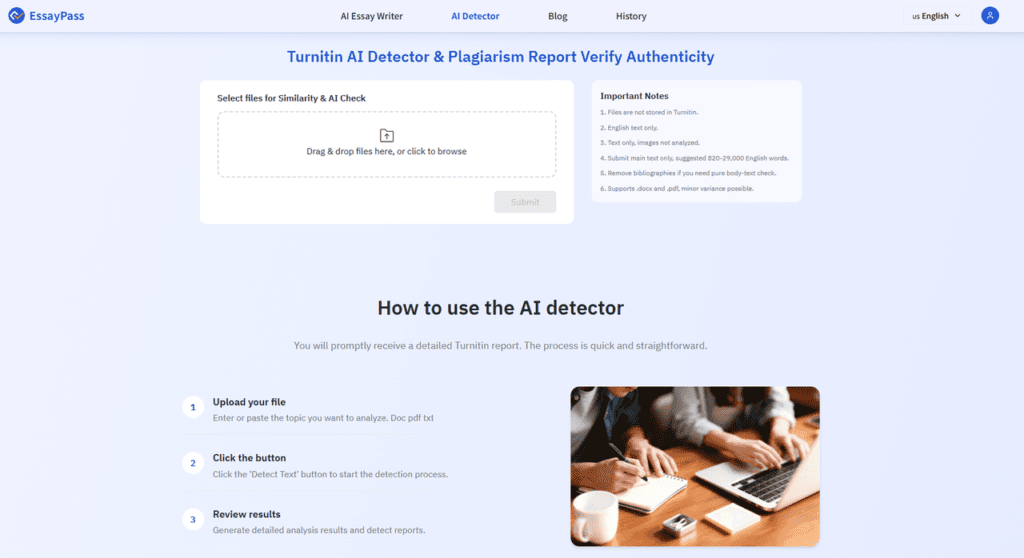
EssayPass is specifically designed for high-quality academic writing. It supports one-click full-length thesis generation, multiple academic formats (APA, MLA, Chicago), real citable references, and Turnitin-based plagiarism & AI detection. Its AI Agent enables iterative improvement for clarity, structure, and argumentation. Learn more about its AI detection capabilities on EssayPass AI detector.
Product Comparison Table:
| Feature | ChatGPT | Grammarly | QuillBot | EssayPass |
|---|---|---|---|---|
| Full-length thesis generation | ❌ Limited | ❌ No | ❌ Limited | ✅ One-click full thesis |
| Academic formatting | ❌ No | 🔸 Partial | ❌ No | ✅ Multiple formats |
| Diverse essay types | ❌ Limited | ❌ No | ❌ Limited | ✅ Analytical, argumentative, etc. |
| Plagiarism & AI detection | ❌ No | ❌ No | ❌ Basic | ✅ Turnitin + AI |
| Real, citable sources | ❌ No | ❌ No | ❌ Limited | ✅ Verified, downloadable |
| AI-assisted revisions | ❌ Minimal | 🔸 Basic | 🔸 Paraphrasing | ✅ Full AI Agent support |
Leveraging EssayPass
By overcoming the limitations of conventional tools, EssayPass empowers students to produce college theses that are methodologically rigorous, analytically compelling, and academically credible. It streamlines research and writing, allowing focus on originality and critical thinking. For additional guidance on research writing, students may also explore how to write a research paper.