
Jane Eyre is a paradox. It is a romance that warns against blinding passion, a religious novel that challenges traditional piety, and a Victorian text that radically demands gender equality. This complexity makes Charlotte Brontë’s novel endlessly fascinating—but also notoriously difficult to reduce to a single, focused thesis statement.
If you are staring at a blank page wondering how to turn this dense novel into a clear argument, you are not alone.
This guide offers over 20 college-level Jane Eyre thesis statement examples, paired with key quotes and scenes, to help you write a clear, defensible, and high-scoring literary analysis essay.
-
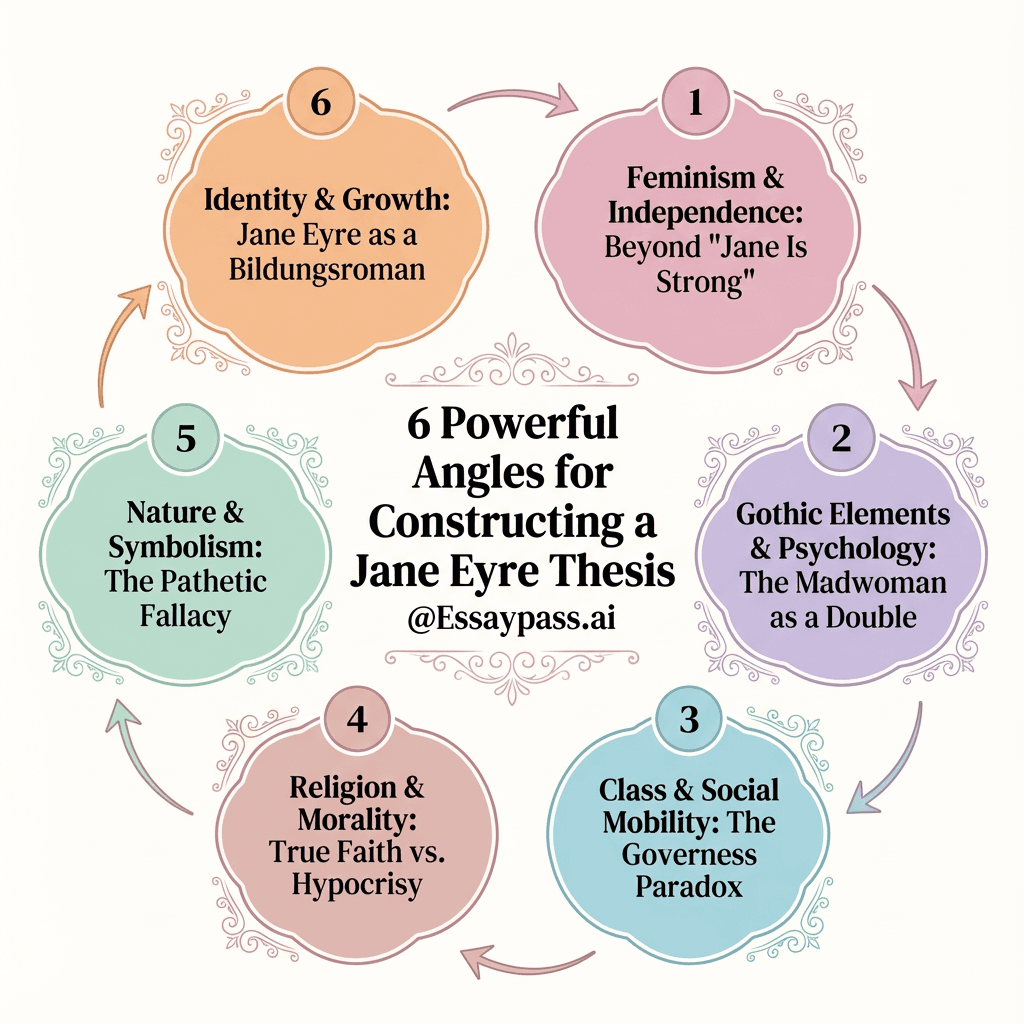
Feminism & Independence: Beyond “Jane Is Strong”
Feminist readings of Jane Eyre are common, but successful essays go beyond simply stating that Jane is independent. Strong arguments analyze how Brontë defines female independence within a patriarchal society.
Thesis Statement Examples
-
Emotional vs. Economic Freedom: Through Jane’s refusal to become Rochester’s mistress or St. John’s missionary wife, Brontë argues that true female independence requires emotional equality rather than mere financial security.
-
Self-Respect as Survival: Brontë critiques Victorian domestic ideals by portraying Jane’s resistance to male authority not as rebellion, but as a mechanism essential to her moral survival.
-
Marriage on Jane’s Terms: Although the novel concludes with marriage, Jane Eyre remains a feminist text because Jane only enters the union after establishing both economic independence and personal autonomy.
-
The Male Gaze Reversed: Unlike typical Victorian heroines who are objects of beauty, Jane asserts power by observing rather than being observed; her narrative voice reclaims the “gaze,” stripping power from the male figures who attempt to objectify her.
-
Sisterhood as Salvation: While romantic love is central, Brontë posits that female intellectual companionship—represented by Diana and Mary Rivers—is the critical foundation that allows Jane to reconstruct her identity before returning to Rochester.
Key Quote for Evidence
“I am no bird; and no net ensnares me; I am a free human being with an independent will.”— Jane to Rochester (Chapter 23)
-
Gothic Elements & Psychology: The Madwoman as a Double
The Gothic features of Jane Eyre—the Red Room, eerie laughter, and supernatural imagery—serve more than atmospheric purposes. They reflect psychological repression, trauma, and forbidden emotion.
(If you are interested in comparing Brontë’s use of Gothic tropes with other Victorian classics, our Frankenstein essay outline offers a great framework for analyzing similar themes of isolation and monstrosity.)
Thesis Statement Examples
-
The Dark Double: Bertha Mason operates as Jane’s psychological double, embodying the rage and unrestrained passion that Jane must suppress to survive within polite Victorian society.
-
Trauma Externalized: Brontë uses Gothic spaces such as the Red Room and Thornfield’s attic to externalize Jane’s internal conflicts and the lingering scars of childhood trauma.
-
Repressed Truth: By confining Bertha to the attic, Rochester attempts to repress the consequences of his past, mirroring the Victorian society’s impulse to conceal moral transgression behind a facade of respectability.
-
Dreams as Prophecy: Jane’s recurring dreams of children and ruined landscapes serve not merely as foreshadowing, but as manifestations of her deep-seated anxiety regarding motherhood and the loss of self.
Key Scene for Evidence
The mirror scene in Chapter 25, where Bertha tears Jane’s wedding veil, symbolically destroys the “angel in the house” ideal—an identity Jane instinctively resists but feels pressured to adopt.
-
Class & Social Mobility: The Governess Paradox
Jane Eyre occupies a liminal social position: educated but poor, a servant yet socially refined. This unstable status allows Brontë to critique rigid Victorian class hierarchies.
Thesis Statement Examples
-
Liminal Identity: Jane’s role as a governess places her in a “liminal” (threshold) social position, enabling Brontë to expose the artificiality and fragility of Victorian class distinctions.
-
Moral Worth over Wealth: The novel challenges aristocratic privilege by asserting that moral integrity, rather than wealth or lineage, determines a human being’s true social value.
-
Economic Reality of Equality: Jane’s unexpected inheritance reveals Brontë’s pragmatic acknowledgment that equality within marriage was socially attainable only when women possessed financial leverage.
-
Artificiality of the Elite: Through the character of Blanche Ingram, Brontë satirizes the aristocracy, contrasting Blanche’s performative beauty with Jane’s authentic, albeit plain, substance to critique the superficiality of the upper class.
Key Quote for Evidence
“Do you think, because I am poor, obscure, plain, and little, I am soulless and heartless? You think wrong! — I have as much soul as you — and full as much heart!”— Jane to Rochester (Chapter 23)
-
Religion & Morality: True Faith vs. Hypocrisy
Jane Eyre is deeply concerned with the spirit. Brontë contrasts different forms of religious practice to define a morality that champions individual conscience over institutional dogma.
Thesis Statement Examples
-
Hypocrisy of Institutions: Through the character of Mr. Brocklehurst, Brontë condemns the weaponization of Christianity to oppress the poor, contrasting his punitive Calvinism with Helen Burns’s doctrine of universal forgiveness.
-
Ambition vs. Vocation: St. John Rivers represents a perversion of religious duty, where spiritual ambition suppresses human emotion; Brontë rejects his cold asceticism in favor of a faith that embraces earthly love.
-
God as a Personal Guide: Jane’s morality is defined not by church doctrine but by a personal relationship with the divine, suggesting that true spirituality empowers the individual to defy unjust authority.
-
Redemption through Suffering: Rochester’s physical maiming is not mere punishment, but a necessary purgatorial cleansing that aligns with Brontë’s theme of spiritual redemption through humility.
Key Quote for Evidence
“Laws and principles are not for the times when there is no temptation… They are for such moments as this, when body and soul rise in mutiny against their rigour.”— Jane (Chapter 27)
-
Nature & Symbolism: The Pathetic Fallacy
Brontë frequently uses nature not just as a setting, but as an active participant in the narrative, mirroring Jane’s internal emotional states (a technique known as pathetic fallacy).
Thesis Statement Examples
-
The Split Chestnut Tree: The lightning-struck chestnut tree at Thornfield symbolizes the rupture of Jane and Rochester’s relationship—ominously foretelling that their union can only survive if they are first broken and then healed.
-
The Moon as Mother: Throughout the novel, the moon appears as a maternal, guiding feminine force, appearing in critical moments of decision to offer the guidance Jane never received from her biological mother.
-
Weather as Emotion: Brontë employs pathetic fallacy to link the frozen landscape of Lowood to Jane’s emotional stagnation, suggesting that environment dictates internal states until the self creates its own warmth.
-
Fire and Ice: The elemental contrast between Rochester (Fire/Passion) and St. John (Ice/Reason) creates a dialectic structure where Jane must find a temperate middle ground to survive.
-
Identity & Growth: Jane Eyre as a Bildungsroman
As a classic Bildungsroman (coming-of-age novel), Jane Eyre traces its heroine’s psychological and moral development through a series of symbolic environments.
Thesis Statement Examples
-
Settings as Developmental Stages: The novel’s major locations—Gateshead (oppression), Lowood (deprivation), Thornfield (passion), Moor House (asceticism), and Ferndean (resolution)—represent successive stages in Jane’s psychological integration.
-
Balancing Passion and Reason: Jane’s maturation depends entirely on her ability to reconcile her fiery nature (passion) with her strict moral code (reason), a balance she achieves only after rejecting both Rochester’s immorality and St. John’s coldness.
-
Maturity through Mutual Vulnerability: Jane’s return to a blinded, dependent Rochester signifies the completion of her development, arguing that true adult love is possible only through mutual vulnerability rather than dominance.
Key Scene for Evidence
Jane’s flight from Thornfield marks the novel’s decisive moment where conscience triumphs over desire, confirming her transition from a dependent girl to a morally autonomous woman.
Quick Jane Eyre Thesis List (Keywords for Brainstorming)
-
Jane Eyre feminist thesis statement
-
Jane Eyre Gothic symbolism essay
-
Jane Eyre Bertha Mason analysis
-
Jane Eyre class and social mobility essay
-
Jane Eyre Bildungsroman thesis
-
Religion and hypocrisy in Jane Eyre
-
Fire and Ice symbolism in Jane Eyre
How to Turn a Thesis into an A-Level College Essay
Use the Thesis Formula
Specific Topic + Analytical Verb + Interpretive Claim
Example:“In Jane Eyre, Brontë uses Bertha Mason to symbolize the dangers of unrestrained passion, positioning her as a cautionary mirror for Jane herself.”
Refine Language Without Weakening Analysis
Many students understand the ideas but struggle to express them in academic prose. Using outlining tools or revision-focused writing assistants can help clarify structure and polish phrasing without replacing original analysis. These tools are most effective when used for organization and language refinement—not content generation.
Defend Your Claim Consistently
Each body paragraph should explicitly reinforce your thesis. Because you are essentially persuading the reader of your interpretation, treating your paper like an argumentative essay will help you ensure that every piece of evidence directly supports your central claim. For instance, if your essay addresses class, do not merely describe Thornfield’s social gatherings—analyze how Blanche Ingram’s behavior highlights Jane’s moral superiority despite her lower status.
From Outline to Outstanding: The Final Step
Crafting a thesis statement that honors the complexity of Jane Eyre is a significant achievement, but it is only the first step. The real challenge often lies in the execution: weaving those Gothic elements, feminist critiques, and Victorian social observations into a cohesive, flowing narrative without getting lost in the dense text.
If you find yourself staring at a perfect thesis but struggling to build the paragraphs around it, you don’t have to struggle alone.
Meet Your New Writing Partner: EssayPass
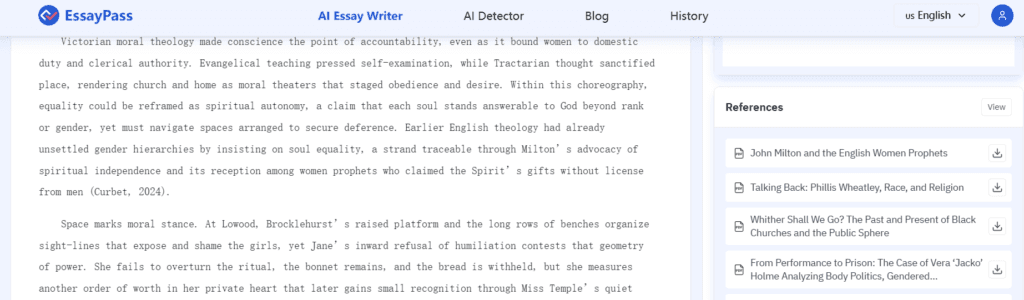
EssayPass is an AI essay writer designed specifically to help students bridge the gap between complex ideas and polished academic prose. Whether you are tangled in the threads of Brontë’s symbolism or struggling to organize your arguments about social mobility, EssayPass offers a comprehensive solution.
EssayPass assists you with:
-
Brainstorming & Outlining: Turn your rough notes on the “Red Room” into a structured essay plan.
-
Overcoming Writer’s Block: Generate ideas to get past the daunting blank page when you’re stuck.
-
Refining Your Tone: Elevate the language to match the academic rigor required for college-level literary analysis.
-
The Full Package: Unlike simple grammar checkers, EssayPass is designed to deliver a complete essay draft along with 5 essential deliverables.

Ready to turn your Jane Eyre analysis into a high-scoring paper?
Ready to turn your Jane Eyre analysis into a high-scoring paper? Try EssayPass today and focus on your analysis. Let EssayPass handle the structure, delivering a complete essay and 5 professional deliverables to help you cross the finish line with confidence.