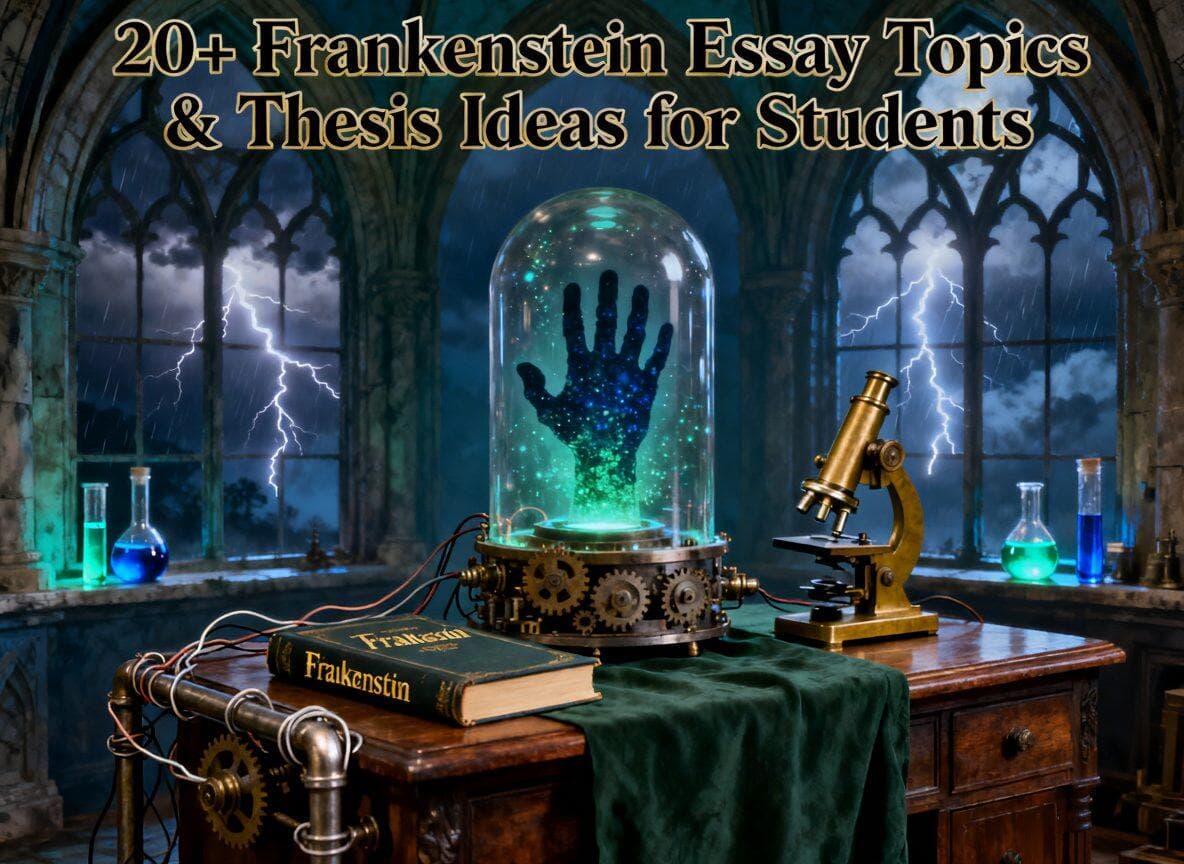

Frankenstein Essay Topics are specific thematic prompts and research questions designed to inspire fresh, creative analysis of Mary Shelley’s novel through various literary and philosophical lenses.
Writing a paper is like Victor’s experiment; without a strong logic “spark,” you’re just stitching together cold, dead sentences that nobody wants to read. Stop wasting time and find your perfect topic below
Who Is the Real Monster?
Victor Frankenstein and his creature share the role of the antagonist. While the creature commits horrific murders, Victor is often viewed as the true monster because he abandons his creation. The novel explores how Victor’s lack of responsibility and scientific hubris lead to the tragedy.
- Victor’s Moral Accountability: Was Victor fully responsible for the actions of his creation?
- The Creature’s Descent: Analyze how the monster turned from benevolent to wicked due to societal rejection.
- Prejudice and Appearance: Discuss how society judges the creature based on the “Uncanny” effect rather than his soul.
The Modern Prometheus: Science vs. Nature
Shelley subtitled her novel “The Modern Prometheus” to highlight the dangers of overstepping human limits. Just as Prometheus stole fire from the gods, Victor takes the power to create life away from the divine. Both figures suffer eternal torment for their transgressions.
- Divine Boundaries: Does the novel suggest that only a god should have the power to grant life?
- The “Vital Spark”: Compare Victor’s use of electricity to Prometheus’s gift of fire.
Gender, Isolation, and Social Upheaval
Isolation acts as both a cause and a result of the tragedy in Frankenstein. Victor isolates himself to pursue forbidden knowledge, while the creature is forced into loneliness by a society that judges his appearance. This shared alienation eventually drives both characters toward self-destruction.
- The Passive Female: Analyze the role of women like Elizabeth and Justine as victims of masculine ambition.
- Masculine Creation: Explore Victor’s attempt to create life without a woman and the “erasure of the feminine.”,
- The Need for Companionship: Why does the creature beg for a mate, and why does Victor destroy her?,
- A Warning for the 21st Century: How Shelley’s critique of “bad science” relates to modern AI and gene editing.
How to Write an A+ Frankenstein Essay Without the Stress
Writing an essay is tough. We get it. If you mess up the structure, your grades suffer. But you don’t have to do it alone. EssayPass helps you organize your thoughts instantly so you can focus on the content.
- Bypassing AI Detection: How to use an undetectable AI writer to maintain academic integrity while staying efficient.
- Authentic Citations in One Click: Why you should stop wasting time on manual formatting and let AI handle your analytical essay bibliography.
- Structuring Your Argument: Using a logical argumentative essay outline to ensure your Frankenstein thesis ideas hold up under scrutiny.
20 Frankenstein essay topics
The Psychology of the Creator and the Created
Victor Frankenstein and his creature share the role of the antagonist. While the creature commits horrific murders, Victor is often viewed as the true monster because he abandons his creation. The novel explores how Victor’s lack of responsibility and scientific hubris lead to the tragedy.
- Parental Malpractice: Analyze Victor’s failure to nurture his creation as a critique of “bad parenting” and its ethical consequences.
- The Eloquence of Horror: How does the monster’s ability to speak transform him from a nightmare into a tragic, sympathetic figure?.
- Nature vs. Nurture: Was the creature born with a wicked heart, or did societal rejection turn him into a fiend?.
- The Weight of Isolation: Compare how loneliness drives both Victor and the creature toward self-destruction.
- Appearance vs. Reality: Discuss how the “Uncanny” effect of the creature’s appearance prevents humans from seeing his inner benevolence.
Scientific Hubris and The Modern Prometheus
Shelley subtitled her novel “The Modern Prometheus” to highlight the dangers of overstepping human limits. Just as Prometheus stole fire from the gods, Victor takes the power to create life away from the divine. Both figures suffer eternal torment for their transgressions.
- The Lightning Thief: Analyze the “vital spark” of electricity as a modern parallel to the Promethean gift of fire.
- Playing God: Explore the religious taboos Victor breaks when he appropriates the role of the Creator.
- Science Without Soul: Does the novel suggest that scientific advancement is dangerous when divorced from moral values?.
- CRISPR and Frankenstein: How does Shelley’s 19th-century warning relate to modern genetic editing and AI ethics?.
- The Domination of Nature: Use the Frankfurt School’s critique to argue that Victor’s attempt to “penetrate nature” is an act of aggression.
Literary Allusions and Structure
Shelley’s novel is a “mise-en-abyme”—a story within a story—narrated by three different men. This complex structure forces readers to question the reliability of each narrator.
- Paradise Lost Connections: Compare the monster to both the Biblical Adam and the fallen angel, Satan.
- The Unreliable Narrator: How do the biased perspectives of Walton, Victor, and the monster shape our understanding of the truth?.
- Gothic vs. Romantic: Discuss how the novel balances dark, eerie scenes with the “sublime ecstasy” of the natural world.
- The Rime of the Ancient Mariner: Trace the influence of Coleridge’s poetry on Robert Walton’s arctic journey.
- The Identity of the Nameless: Why did Shelley refuse to give the creature a name, and how does this affect his humanity?.
Social Structures and Feminist Ideals
Mary Shelley depicts women like Elizabeth and Justine as passive victims. This reflects the gender inequality of her era, but some argue she used these deaths to critique the static role of women.
- Masculine Creation: Analyze Victor’s attempt to create life without a woman and the “erasure of the feminine” that follows.
- Safie’s Letters: How does the character of Safie embody the feminist ideals of Mary Wollstonecraft?.
- Social Contract Theory: Discuss how the monster’s exclusion from society’s “contract” justifies his rebellion.
- Justice and Injustice: Examine the trial of Justine Moritz as a critique of legal systems that value reputation over truth.
- Mary Shelley’s Grief: How did the author’s personal experiences with death and loss shape the novel’s dark themes?.
If these frankenstein essay topics inspired you but you still feel stuck, try a best AI essay writer to help organize your Frankenstein thesis ideas. Stop wasting time on citations and generate them instantly with EssayPass! Also, if you need more inspiration for your next assignment, check our list of argumentative essay topics.