
Writing an academic paper is hard enough without worrying about complex formatting rules. If you are a student in History, Literature, or the Arts, you will likely encounter the Chicago Style Essay format. Unlike MLA or APA, Chicago style has very specific rules—especially regarding footnotes—that can easily trip up even the best students.
Many students search online for a “Chicago style paper example,” only to find conflicting information. To help you secure a better grade, we have prepared the 5 most common mistakes students make when writing essays in Chicago style, complete with real-world examples and how to fix them.
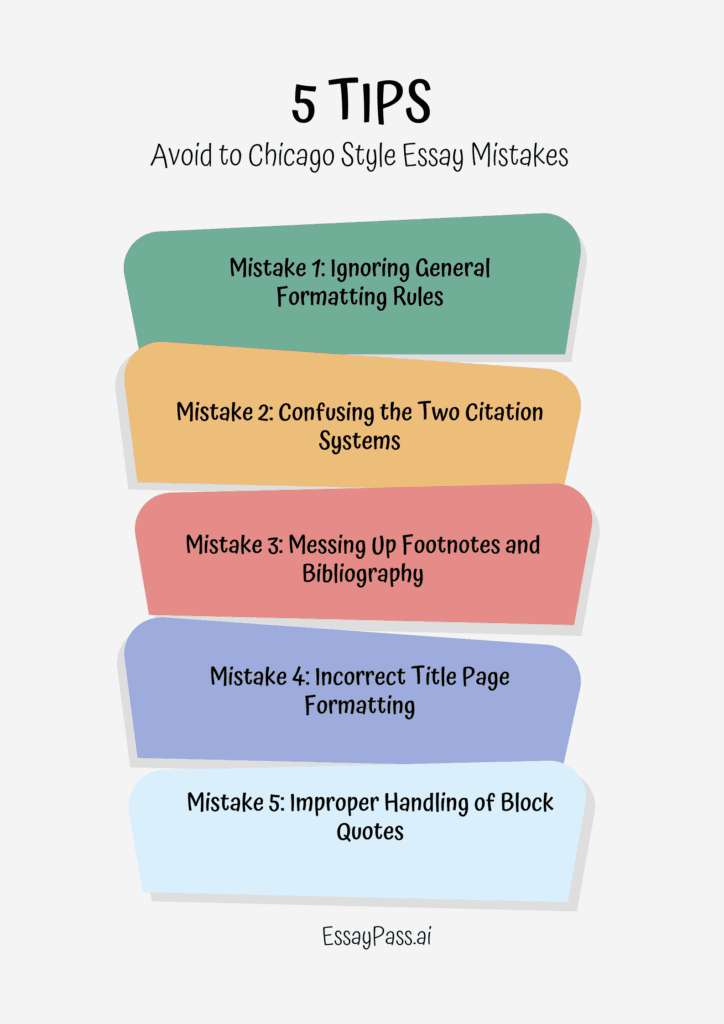
Mistake 1: Ignoring General Formatting Rules
The foundation of any good paper is how it looks on the page. A common error is assuming that “default settings” in Word or Google Docs are correct. They usually aren’t.
If you want to learn how to format Chicago style essay papers correctly, you must adhere to these specific settings:
-
Margins: Do not use default settings if they aren’t standard. You need 1 inch on all sides.
-
Font: 12-point Times New Roman (or another readable serif font if permitted by your instructor).
-
Indentation: Indent the first line of every new paragraph by 0.5 inches (use the “Tab” key).
The “Justified Text” Error
-
The Mistake: Many students use “Full Justify” alignment to make the text look like a book block.
-
The Fix: Text should be Left-justified (ragged right edge).
Example:
❌ Incorrect: The text is stretched across the page to touch both the left and right margins, creating uneven gaps between words.
✅ Correct: The text aligns perfectly on the left side, but the right side is uneven (ragged).
Mistake 2: Confusing the Two Citation Systems
Did you know Chicago style implies two different systems? Using the wrong one is a major red flag.
-
Notes-Bibliography (N-B): This uses numbered footnotes or endnotes. This is the standard Chicago style research paper format for Humanities (History, Arts)
-
Author-Date (A-D): This uses parentheses in the text, like (Smith 2023, 15). This is for Social Sciences.
Tip: In practice, when history professors ask for a ‘Chicago Style Essay,’ they almost always expect the Notes-Bibliography system. (If you are unsure about the nuances of different assignments, check out our guide on how to write an assignment for more clarity.)
Example:
Notes-Bibliography (Footnote style):
Author-Date (In-text citation & Reference list style):
(In-text): (Dittmar and Schemske 2023, 471)(Reference Entry): Dittmar, Emily L., and Douglas W. Schemske. 2023. “Temporal Variation in Selection Influences Microgeographic Local Adaptation.” American Naturalist 202 (4): 471–85. https://doi.org/10.1086/725865.
(Note: Both examples above refer to journal articles.)
Mistake 3: Messing Up Footnotes and Bibliography
The most distinct feature of this format is the use of footnotes. Many students struggle with the Chicago footnotes and bibliography essay requirements because the formatting for a footnote is slightly different from the bibliography entry. This is particularly important if you are learning how to write a book review, where accurate book citations are crucial.
Real Example: Book Citation in Notes and Bibliography Format
Notice the difference in punctuation and name order below.
-
The Footnote (Used at the bottom of the page):
You must use a superscript number in the text.
❌ Mistake: Binder. Amy J. and Kidder. Jeffrey L, The Channels of Student Activism: How the Left and Right Are Winning (and Losing) in Campus Politics Today (University of Chicago Press, 2022), 117–18.✅ Correct: Amy J. Binder and Jeffrey L. Kidder, The Channels of Student Activism: How the Left and Right Are Winning (and Losing) in Campus Politics Today (University of Chicago Press, 2022), 117–18.(Note: First name first, commas are used, publication info is in parentheses.)
-
The Bibliography (Used at the end of the paper):
❌ Mistake: 1. John Smith, The History of Chicago (Chicago: University Press, 2020), 45.✅ Correct: Smith, John. The History of Chicago. Chicago: University Press, 2020.(Note: Last name first, periods are used, no parentheses, hanging indent applies.)
For a perfect Chicago style citation essay example, always check if you need a comma or a period!
Mistake 4: Incorrect Title Page Formatting
First impressions matter. Chicago style essay title page requirements differ from MLA (which often doesn’t use one).
The Mistake: Putting page numbers on the title page or bolding the title.
The Fix:
-
Title: Centered, about one-third down the page. Do not bold it.
-
Details: Several lines down, center your Name, Course Number, Instructor Name, and Date.
-
Page Numbers: Do NOT number the title page. Page numbering starts on the first page of the text (Top Right).
-
Title page: The title page should not have a page number, but should be included in the page count—in other words, the page numbering starts on page 2.
Mistake 5: Improper Handling of Block Quotes
When quoting a source, length matters. If you are quoting 5 or more lines of prose, you must use a Block Quotation.
Example Case:You are quoting a long speech by Abraham Lincoln.❌ Incorrect: You put the whole paragraph in quotation marks “…” and keep it double-spaced like the rest of the text.✅ Correct: You remove the quotation marks. You start a new line, indent the entire block 0.5 inches, and single-space the text.
Struggling with Your Chicago Style Essay? Let EssayPass Help
Mastering these rules takes time and attention to detail. This is where EssayPass comes in.
If you find yourself searching for “Chicago style essay guidelines” at 2 AM, you are not alone. Mastering the intricacies of footnotes and hanging indents can be overwhelming. Why spend hours fighting with an essay when you can have a perfect draft in minutes?
EssayPass is the all-in-one AI essay writer designed to solve academic writing-related problems.
Whether you are writing a complex history paper or a literature review, EssayPass offers features that generic tools simply cannot match:
-
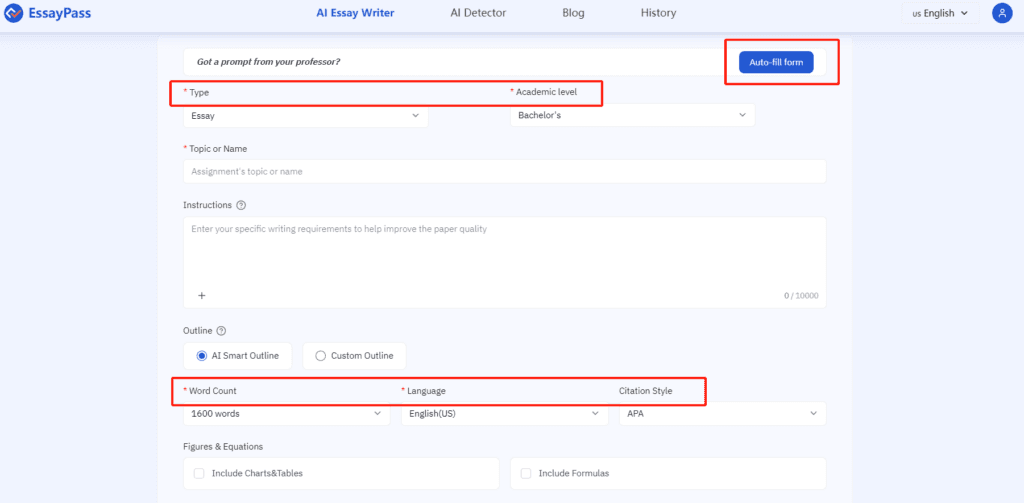
One-Click Full Essay Generation: With just one click, EssayPass generates a complete, logically structured essay from start to finish. It handles the introduction, body paragraphs, and conclusion seamlessly.
-
Real, Downloadable References Accuracy is everything. EssayPass cites real academic sources. The best part? You can directly download the PDF files of the cited literature to verify them yourself.
-
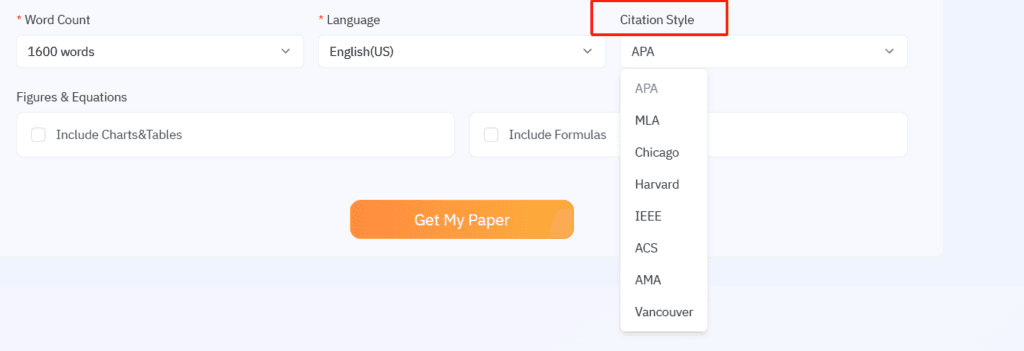
Multi-Format Mastery (Including Chicago Style) EssayPass is an expert in academic formatting. It supports all major citation styles, including APA, MLA, Harvard, and the difficult Chicago.
-
Turnitin-Based Plagiarism & AI Detection Submit with confidence. EssayPass offers optional “AI Detection & Plagiarism Check” powered by Turnitin technology. It ensures your paper is original and safe to submit to university portals.
-
Supports Various Essay Types No matter the assignment, we have you covered. EssayPass supports a wide range of academic writing types, including Argumentative Essays, Case Studies, Theses, and more.
-
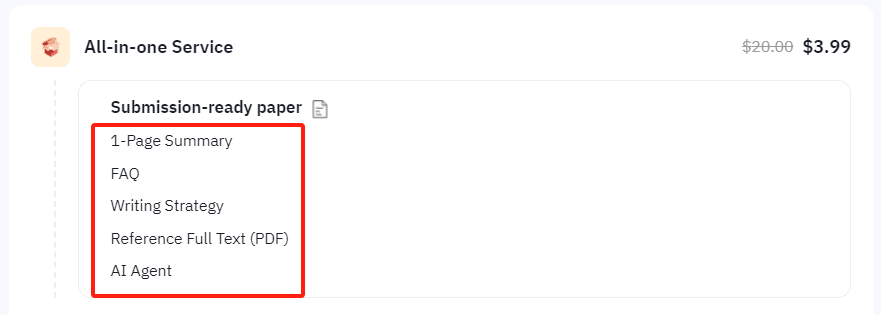
5 Free Deliverables Included When you use EssayPass, you get more than just the text. Every essay comes with a complete submission package, including:
-
A summary
-
About 10 FAQs
-
A step-by-step writing strategy
-
Downloadable reference PDFs
- An AI agent for follow-up editing and proofreading.
-
So don’t let formatting stress affect your GPA. Visit EssayPass Now to Get a Chicago Style Essay.