
You have exactly three seconds to prove your work is worth the time in academic writing. A weak start means a forgotten paper. But what if you could grab their attention instantly? Whether it’s a shocking statistic or a bold provocative statement, mastering the essay hook is the ultimate secret weapon to elevate your writing from average to unforgettable. Let’s dive in.
Understanding Essay Hooks and Functions
Hook Definition
An essay hook is the opening sentence—or group of sentences—designed to capture a reader’s undivided attention within the first 30 seconds. It functions as a “storefront window,” enticing the audience to “step inside” and explore your subject. For example, a vivid description like “The hallway smelled like old textbooks and panic” immediately immerses the reader in a scene. Without an effective hook, even well-researched papers risk losing readers before the main argument.
The Three Vital Functions of an Essay Hook
Capturing Attention and Sparking Curiosity
The primary function of a hook is to manage the reader’s “attention economy”. Research indicates that readers decide within the first 30 seconds whether to continue engaging with a text, making the opening line a critical “storefront window” for your subject. By using surprising statistics or provocative questions, a hook creates an “information gap,” triggering a cognitive need for resolution that compels the reader to seek answers in the subsequent paragraphs. For example, a startling fact about how most people never finish the books they start immediately piques curiosity about the reasons behind this behavior.
Establishing Tone and Professional Ethos
A well-crafted hook acts as a “rhetorical handshake,” establishing the writer’s ethos and signaling a high level of professional competence. It sets the foundational tone and writing style—whether persuasive, reflective, or authoritative—which shapes how the reader experiences your perspective. This is particularly essential in academic writing, where a confident opening demonstrates that the author is in control of the discourse. For instance, a bold declaration about educational reform immediately projects an authoritative stance.
Framing Context and Bridging to the Thesis
Beyond merely grabbing attention, a hook must serve as a functional bridge between the reader’s world and the specific intellectual landscape of the essay. It provides the initial context and leads the audience on a natural, logical path toward the thesis statement. This ensures the introduction follows a “funnel technique,” moving smoothly from general interest to a specific argument. Without this connective function, the opening becomes a “floating hook”—an engaging but irrelevant statement that fails to support the overall claim.
Funnel Technique Logic
The funnel technique moves logically from a broad, engaging statement to a focused thesis. This structure prevents a “floating hook”—an opening with no logical relationship to the topic—by narrowing the scope through specific background information. For example, a writer might start with a general fact about “modern communication” before narrowing the discussion to “social media’s impact on teen anxiety,” ensuring the creative opening supports the eventual research claim.
Why Your Opening Sentence Matters
Capture Attention with Statistic Hooks
Research proves readers decide within 30 seconds whether to stay or bail. Therefore, you must capture their attention immediately to manage their “attention economy”. Start now. A surprising statistic builds instant authority while grounding your work in empirical reality that readers cannot ignore. Plus, stating “85% of girls in Afghanistan lack school access” hits harder than a generic claim. Another shocking figure reveals that nearly 70% of people never finish the books they start. These numbers ground your work in reality and force the audience to see the urgency of your topic.
Engagement Through Question Hooks
Rhetorical questions trigger a psychological “information gap” that readers feel compelled to fill. Instead of using generic essay ideas, ask something provocative. Think about it. Consider asking, “What if your daily habits could predict your future success?”. Such questions transform readers from passive observers into active participants in your inquiry. This strategy is particularly useful in persuasive writing where you need to challenge common assumptions. Also, by opening with a sharp query, you entice the audience to step inside your “storefront window” and follow your train of thought.
Mastering Bridge Sentences
Connecting Hooks with Transitions
A hook cannot exist in a vacuum. Without a functional bridge, you create a “floating hook”—an opening that grabs attention but fails to support the argument. Think of the bridge as a mental pathway. For instance, if your hook is a vivid description of “the stale smell of cigarettes in a dim apartment,” your bridge must explain how this atmosphere relates to your specific topic, such as urban isolation or the housing crisis. This context ensures the start of an essay feels purposeful rather than disjointed. Avoid “quote dumping” or sharing random facts that don’t tie back to your main idea.
Transitioning to the Thesis Statement
Effective essay transitions use the “funnel technique” to move from broad interest to a focused, specific claim. Imagine a hook mentioning that “85% of Afghan girls lack access to education”. A bridge might read: “This systemic exclusion is not merely a regional obstacle; it represents a global human rights crisis that necessitates urgent policy intervention.” Such sentences act as a structural ladder leading directly to your thesis statement. Always follow the “known-new contract”: start with the problem mentioned in your hook before introducing the “new” context of your argument. This strategy destroys robotic monotony and maintains a human rhythm.
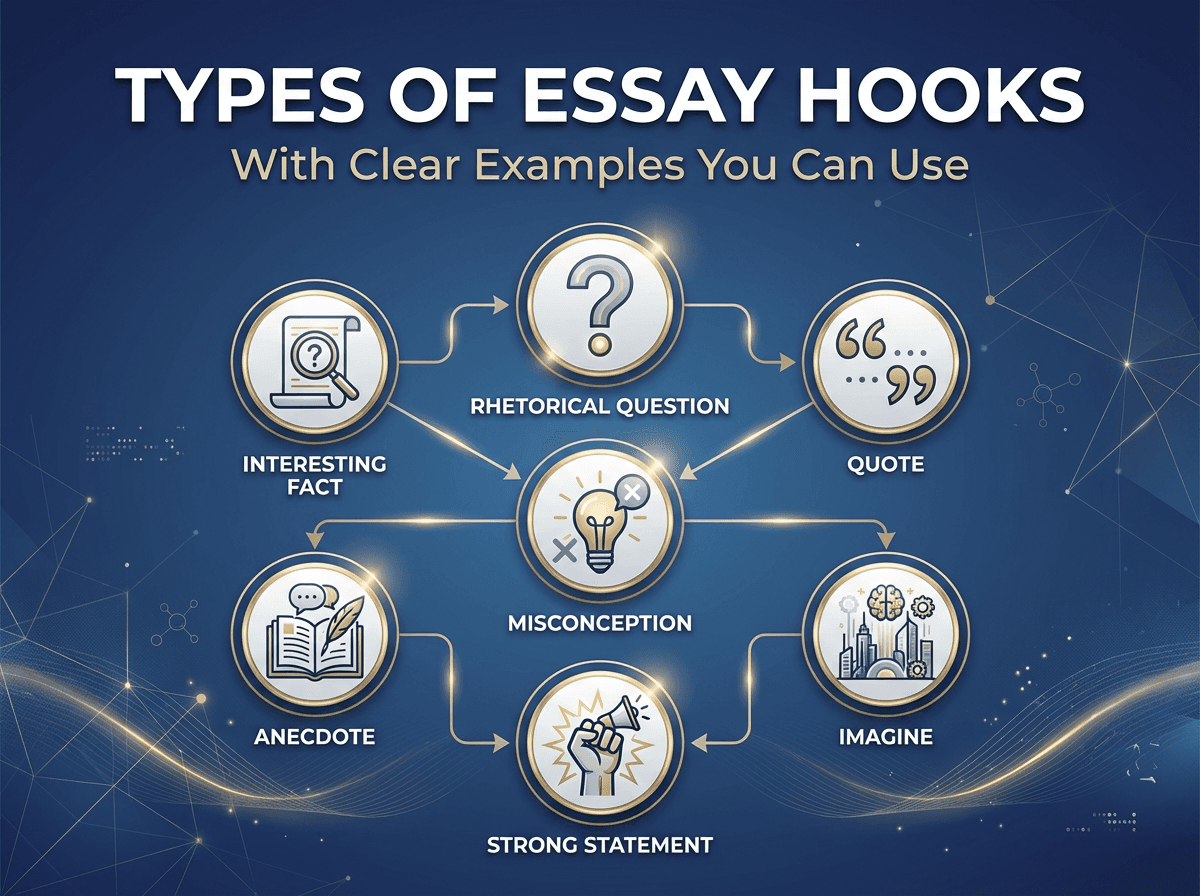
5 Types Academic Essay Hook
Impactful Statistic Hooks
Numbers ground your research in empirical reality. Instead of claiming procrastination is common, use a statistic hook: “Over 60% of people never finish the books they start”. This data forces readers to confront the urgency of your topic. Another sharp example reveals that 1 in 3 students feels overwhelmed by academic stress.
Confident Bold Statement Hooks
A bold claim demonstrates authority immediately. Challenge your audience with a provocative stance: “Standardized testing measures stress tolerance rather than intelligence”. Such statements work best for an argumentative essay because they demand a defense. Avoid generic ideas like “change is hard” and choose something punchy.
Relatable Anecdote Hooks
Personal stories create human connections. Describe a specific moment: “At age nine, I sold lemonade for a local shelter and learned more than any textbook could teach”. Sensory details make scenes come alive. Imagine the “stale smell of cigarettes” in a dim apartment—this puts the reader right in your world.
Authoritative Quotation Hooks
Borrowing credibility from experts adds weight. When you start an essay, use a quote like Nelson Mandela’s claim that education is a powerful weapon. You must explain the connection. Never “quote dump”; always show how the words link to your thesis.
Thought-Provoking Question Hooks
Questions trigger a psychological “information gap”. Ask something like, “What if your daily habits could predict your future success?”. Avoid simple yes/no queries. Open-ended questions like “Is it ethical to eat animals?” force readers to visualize the problem and seek your answers.
Differentiated Professional Hook Strategies
Humanities Hooks and Narrative Depth
Humanities readers value interpretative insight and narrative cohesion. You should use thematic paradoxes or evocative imagery to establish your voice. For instance, a literary analysis might examine why Shakespeare used 20,000 unique words. Another approach uses sensory details. Describe “the stale smell of cigarettes” in a dim room to anchor a narrative. These creative openings invite readers into a shared emotional experience. Effective humanities hooks often mirror the “flow of ideas” found throughout the paper.
STEM Hooks and Empirical Precision
In contrast, STEM fields prioritize precision over stylistic engagement. Experts prefer directness. You should often skip traditional hooks entirely. Instead, present a specific research finding as your “anchor”. For example, mention a “previously unstudied toxin released by algae” in the first line. If you write a research proposal regarding health, use shocking data. State that childhood obesity rates tripled in 30 years. This empirical weight establishes immediate exigency. Using an argumentative essay format in science requires bold, evidence-based claims. Assert that standardized tests fail to measure real learning to challenge academic norms.
Triggering Curiosity with Information Gaps
Psychology of Writing Information Gaps
Effective hooks function by creating a psychological “Information Gap”. It works. By presenting a mystery, you trigger a “Cognitive Requirement” for resolution within the reader’s mind. They feel a mental itch only your text can scratch. Instead of passive reading, the audience becomes active participants in the inquiry. For example, do not just state that AI is popular. Instead, ask: “What if your daily habits could predict your future success?”. This creates an immediate mental bridge. You can master this by learning how to craft essay hooks that bypass the “boring” filter.
Strategic Cognitive Need for Resolution
Startling facts achieve the same impact. Did you know nearly 70% of students admit procrastination destroys their writing quality?. Shocking. This data point creates a void between what students believe and reality. It forces them to read on to find the solution. A professional start to an essay should never feel safe. It should be provocative. Boldly claim: “Standardized testing measures stress tolerance, not intelligence”. Disruption breeds engagement. No robot writes with this level of perplexity. Pure human energy. Every sentence counts. Stop being boring. Start being essential.
8 Ways of Hook Quality Self-Check Checklist
Relevance and Specific Connection
Every essay hook must lead directly to your thesis. Avoid “floating hooks” that grab attention but lack logical ties to your specific argument. For example, describing the “stale smell of cigarettes” in a dim apartment only works if it illustrates a theme like urban isolation or the housing crisis.
Specificity Over Generalization
Generic openers like “Throughout history” or “In today’s society” fail to engage readers. Use specific data instead. Rather than saying “procrastination is common,” use an empirical anchor: “60% of people never finish the books they start”.
Appropriate Academic Tone
Match your tone to the assignment’s “tone register”. A formal research paper requires the empirical weight of a professional start to an essay, such as citing a previously unstudied toxin released by algae. Avoid conversational slang unless writing for informal blogs.
Originality and Cliché Avoidance
Professional writers strictly ban “Dictionary Openings”. Never start with “Webster’s Dictionary defines…” or overused quotes from famous figures without adding a unique interpretation.
Concise Sentence Length
Keep it sharp and brief. An effective hook should be 1-3 sentences maximum. Long-winded anecdotes distract from the core message and drain the reader’s “attention economy”.
Curiosity and Information Gaps
Trigger a “Cognitive Requirement” for resolution. Pose a provocative question like: “What if your daily habits could predict your future success?”. This creates an “information gap” that compels the reader to continue.
Clarity of Expression
If your first line is confusing, readers will bail immediately. Use the active voice to remain direct and authoritative.
Natural Transition Bridges
Ensure a smooth “Known-New Contract”. Your hook must provide a functional bridge that leads the audience into the specific essay format of your discussion.
Conclusion
Choosing the right essay hook is more than just a writing trick; it’s about respecting your reader’s attention and setting the stage for your intellectual journey. Remember, the goal of your first sentence isn’t just to be catchy—it’s to build a bridge to your core argument. Don’t let your hard-earned research get buried under a boring introduction.
Now it’s your turn: Which hook type will you use for your next assignment? Try drafting three different openings using the strategies above and see which one feels the most powerful. Bookmark this guide for your next writing session, and say goodbye to opening-sentence anxiety forever!