
At its core, an informative essay is a piece of academic writing designed to educate, explain, or enlighten a target audience on a specific topic. Whether you are describing a complex biological process or detailing a historical event, your goal is to package research into a digestible, time-saving format.

However, for many students and researchers, the journey from a blank page to a finished draft is often fraught with anxiety and obstacles. Common pain points include:
- Topic Paralysis: Struggling to select a subject that is neither too broad to cover nor too narrow to research.
- Structural Chaos: Finding it difficult to organize a wealth of information into a coherent, logical flow that guides the reader effortlessly.
- The Citation Nightmare: The tedious and confusing requirement to master complex formatting styles like APA, MLA, or Chicago.
- Integrity Fears: A constant, underlying worry about accidental plagiarism or falling short of academic honesty standards in an era of strict digital detection.
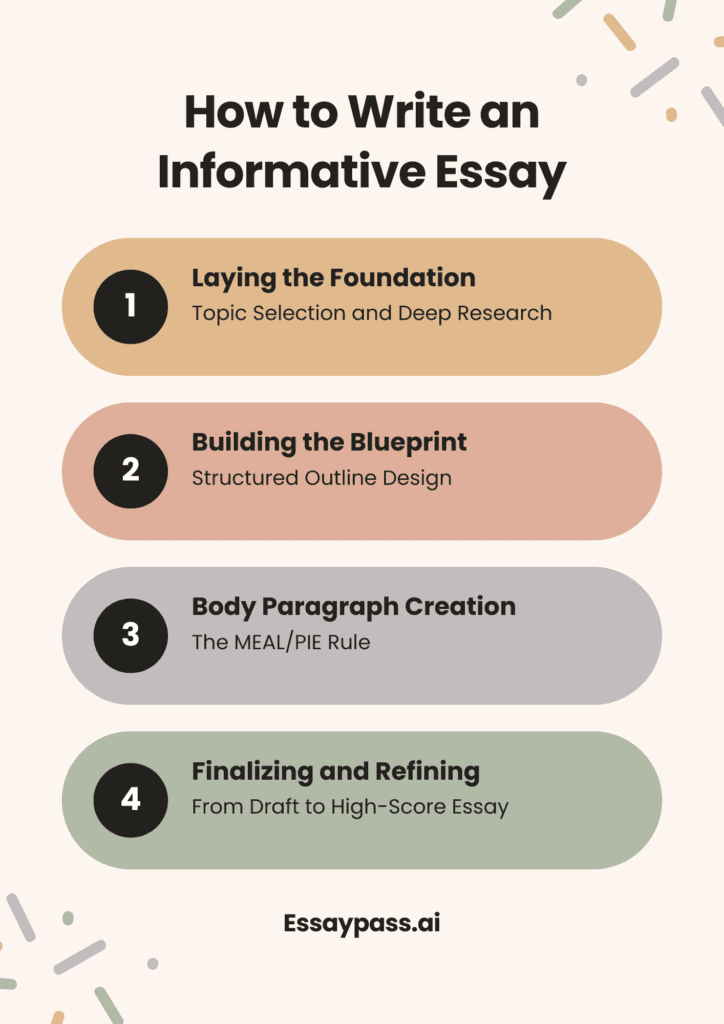
Step 1: Laying the Foundation—Topic Selection and Deep Research
How to Choose a “Just Right” Topic?
The success of an informative essay begins with a well-chosen topic that serves as a strong foundation. A common pitfall for students is selecting a subject that is either too broad or too narrow.
For instance, a topic like “World History” is impossible to cover meaningfully in a standard essay, leading to shallow generalizations.
Conversely, an ultra-specific focus, such as “the impact of a single historical event on one specific neighborhood” or “the effect of a small rain on a specific sidewalk,” may lack sufficient research material or real-world significance. To find the perfect balance, you should narrow your scope to a manageable research question that allows for deep analysis. If you are struggling for inspiration, exploring lists of informative essay topics for students can help you identify a subject that is both academic and engaging.
Identifying Reliable Information: The CRAAP Test
Once your topic is set, the integrity of your work depends entirely on the quality of your sources. In an era of digital misinformation, you must distinguish between scholarly evidence and biased commentary. Professionals use the CRAAP test to evaluate source credibility across five dimensions:
- Currency: When was the info published or updated?
- Relevance: Does it directly contribute to your specific research question?
- Authority: Who is the author or publisher, and what are their credentials?
- Accuracy: Is the information supported by evidence and peer-reviewed?
- Purpose: Why was this produced? Is there a hidden bias or agenda?
EssayPass Feature: AI Literature Search & Summary
Manually vetting hundreds of articles can be overwhelming for any researcher. This is where EssayPass becomes your ultimate writing partner. Instead of struggling with “where to start,” you can use the AI Literature Search & Summary feature to quickly screen massive academic databases. EssayPass identifies high-quality, peer-reviewed sources and generates core point summaries, allowing you to grasp complex research in a fraction of the time while ensuring your essay is built on a foundation of verified, factual data.
Step 2: Building the Blueprint—Structured Outline Design
The Classic Five-Paragraph Structure and Its Variants
A high-quality informative essay is not merely a collection of facts; it is a structured journey that requires a logical flow of information. The most common framework, particularly for students, is the classic five-paragraph structure. This standard blueprint includes:
- An Introduction: To provide background, context, and a clear thesis.
- Three to Five Body Paragraphs: Each focused on a single main idea that educates the reader.
- A Conclusion: To restate the thesis and summarize the key findings without introducing new data.
While this standard configuration serves as an excellent starting point, complex academic or professional topics often require expanded variants. College-level essays frequently utilize 4–7 body paragraphs to provide the depth necessary for a nuanced analysis of the subject.
Crafting a Powerful Thesis Statement
The heart of your blueprint is the thesis statement, which acts as a “roadmap” for the entire paper, telling readers exactly what to expect. For this genre, an effective informative essay thesis statement must be specific and neutral. Unlike persuasive writing, it avoids taking a stance or using biased language; instead, it concisely previews the main points you will explain. A strong thesis ensures that every subsequent paragraph remains unified and moves the overall argument toward its logical conclusion.
Step 3: Body Paragraph Creation—The MEAL/PIE Rule
Ensuring the Four Core Elements in Every Paragraph
The body of your essay is where the primary intellectual work occurs, and each paragraph serves as a discrete building block for your argument. To ensure your writing is unified, coherent, and fully developed, professional writers recommend using structural models like MEAL (Main Idea, Evidence, Analysis, Link) or PIE (Point, Information, Explanation).
- Point (Topic Sentence): Every paragraph must begin with a clear topic sentence that announces the specific claim or “mini-thesis” being addressed. This sentence provides direction and must link directly back to your overall thesis statement.
- Information (Evidence): Support your point with verifiable data, such as statistics, expert quotes, or factual examples gathered from your research. Always introduce your evidence by providing its source and context.
- Explanation (Analysis): This is the most crucial component, constituting the bulk of your paragraph. You must interpret the evidence and explain exactly how and why it supports your point and your larger thesis.
- Link (Transition): Conclude the paragraph by summarizing the main idea and providing a logical bridge or “verbal bridge” to the next point.
Maintaining an Objective and Neutral Tone
The hallmark of an informative essay is its impartial and neutral tone; your goal is to educate the reader, not to persuade them or share personal beliefs. To maintain professional distance, follow these strict linguistic standards:
- Avoid First-Person Pronouns: In academic writing, you must strictly avoid “I,” “me,” or “my”. Phrases such as “I believe” or “In my opinion” detract from the objective tone and turn your research into an opinion piece.
- Filter Biased Language: Avoid “persuasive” or “emotive” words that suggest favoritism or pressure the reader, such as “should,” “must,” or “it is obvious that”. Instead, use hedging language (e.g., “appears,” “suggests,” “typically”) to express uncertainty and avoid absolute, unverified claims.
Step 3: Body Paragraph Creation—The MEAL/PIE Rule
The body of your essay is the “engine room” where research is transformed into knowledge. To ensure each paragraph is unified, coherent, and fully developed, professional writers rely on structured frameworks such as PIE (Point, Information, Explanation) or MEAL (Main Idea, Evidence, Analysis, Link).
Mastering the Four Core Elements of a Paragraph
Every effective body paragraph functions as a discrete unit of thought that moves the reader one step closer to understanding your thesis. Following these four steps prevents disorganized writing and ensures a logical flow:
- Point (Topic Sentence): Start with a clear topic sentence that announces the paragraph’s main idea. This acts as a “mini-thesis” that must link directly back to your overall argument.
- Information (Evidence): Support your point with verifiable data, statistics, or expert quotes from credible sources. Proper evidence proves your claim and establishes your authority as an informed writer.
- Explanation (Analysis): This is the most critical part where you interpret the evidence. You must explain why the information is significant and how it supports your specific point. While this structure is essential for explaining facts, it also forms the basis for more advanced assignments like an analytical essay, where interpreting the “why” and “how” of data is key.
- Link (Transition): Conclude by summarizing the main idea and providing a verbal bridge to the next point. This ensures the reader follows your reasoning without “jarring cognitive leaps”. To ensure these connections are seamless, you can consult our curated list of transition words to help guide your audience through complex information.
Maintaining an Objective and Neutral Tone
The hallmark of an informative essay is its impartial, fact-driven tone. Unlike persuasive writing, your goal is to enlighten the reader, not to sway their opinion. To maintain professional distance, adhere to these strict linguistic boundaries:
- Eliminate First-Person Pronouns: Avoid “I,” “me,” or “my”. Phrases like “I believe” or “In my opinion” detract from the objective tone and can undermine your credibility.
- Filter Out Biased Language: Strictly avoid persuasive words like “should,” “must,” or “it is obvious that”. Instead, let the data speak for itself and use hedging language (e.g., “suggests,” “appears,” or “typically”) to remain balanced and defensible.
EssayPass Feature: AI Paragraph Generation & Polishing
Writing high-quality paragraphs can be a daunting process, especially when attempting to balance evidence with original analysis. When you find yourself stuck at the “blank page” stage, you can leverage the EssayPass AI Essay Writer tool. By entering your specific keywords and main idea, the AI generates a structured, logical draft that follows the PIE/MEAL method.
Furthermore, EssayPass includes a polishing and humanizing feature that automatically detects and removes subjective vocabulary or first-person references. This ensures your final draft maintains the highest level of academic rigor required for top-tier informative writing. To give yourself total peace of mind regarding academic integrity and originality, you can also run your completed sections through an AI detector to verify that your work meets submission-safe standards.
Step 4: Integrating Evidence and Upholding Academic Integrity
After structuring your paragraphs using the MEAL or PIE methods, the next phase focuses on the seamless integration of research and the maintenance of rigorous academic standards. As you transition from a rough draft to a cohesive narrative, your goal is to ensure your essay remains an objective, factual exploration rather than a collection of disjointed quotes. While this guide focuses on informative writing, those looking to broaden their scholarly skills may also benefit from our deep dive into how to write an academic essay for a wider perspective on university-level requirements.
The Art of Evidence Integration
A common pitfall in drafting is “quoting too much,” which occurs when a writer relies on the words of others without providing sufficient original analysis. In a high-quality informative essay, evidence should support your claims, but your analysis must explain the significance of that data.
- Balance Originality with Authority: Aim for a balance where your analysis is at least as long as the evidence you are citing.
- Use Specific Data: Avoid vague generalizations by utilizing verifiable statistics, expert quotes, and peer-reviewed research. If your project requires extensive data synthesis across dozens of sources, mastering how to write a research paper is a vital next step for managing complex evidence chains.
Navigating the “Citation Nightmare”
Maintaining academic integrity is non-negotiable; failing to properly cite sources can lead to accusations of plagiarism and serious academic consequences. You must familiarize yourself with specific style guides, such as how to write an APA essay, to ensure that every fact and paraphrase is attributed correctly.
EssayPass Feature: Verifiable Sources & Turnitin Reports
The most stressful part of the drafting process is often the fear of accidental plagiarism or “hallucinated” sources. EssayPass solves this by providing authentic, citation-backed content with verifiable DOIs and stable links, ensuring your evidence chain is traceable and accurate.
Furthermore, to ensure your work is submission-safe, the EssayPass AI Essay Writer generates 100% original content that includes a dual Turnitin Report. These reports provide a detailed analysis of both AI detection and plagiarism similarity, allowing you to submit your work with total peace of mind. For students weighing the ethical implications of these tools, we recommend exploring the pros and cons of using AI for essays to understand how to use technology as a responsible research partner. Finally, you can always verify the human-like quality of your draft using the EssayPass AI Detector.
Step 5: Finalizing and Refining—From Draft to High-Score Essay
The “So What?” Rule for Conclusions
A common mistake in academic writing is neglecting the conclusion or ending too abruptly. While the introduction focuses on how to start an informative essay by providing a hook and a thesis roadmap, the conclusion is your final opportunity to leave a lasting impression and offer closure. According to the sources, a high-quality conclusion should not merely be a “fake transition” or a repetitive summary of the entire paper.
Instead, you should follow the “So What?” rule:
- Synthesize, Don’t Just Summarize: Restate your thesis in a new way that reflects the “intellectual journey” you have taken the reader on.
- Emphasize Real-World Significance: Move from the specific points of your essay to a broader context. Explain why the information you provided is valuable, and what the reader should take away from it.
- Future Implications: A strong conclusion often includes a prediction, caution, or recommendation regarding the subject’s future impact. This ensures the information remains relevant to the reader long after they have finished the essay.
The Final Proofreading Checklist
Effective revision can transform a rough draft into a polished piece of work. The sources recommend a systematic revision cycle that moves from the “big picture” down to linguistic nuances. Before submission, ensure your essay passes this three-point check:
- Grammar and Accuracy: Double-check all facts, statistics, and citations. Use tools like EssayPass or specialized grammar checkers to eliminate typos and syntax errors that distract from your main points.
- Sentence Structure Diversity: Avoid monotonous writing by employing a mix of sentence structures. Alternate between short, punchy sentences for impact and longer, complex structures for detailed explanation.
- Logical Coherence: Read your paper aloud to check the flow and transitions. Ensure that each paragraph is unified under one main idea and that there are no “jarring cognitive leaps” between sections.
EssayPass Feature: AI Refining & Final Polish When you are nearing the finish line but are short on time, EssayPass serves as your ultimate writing partner. Its advanced AI can help you brainstorm impactful final thoughts, ensure your work is plagiarism-free, and automatically adjust your draft to meet strict academic formatting requirements.