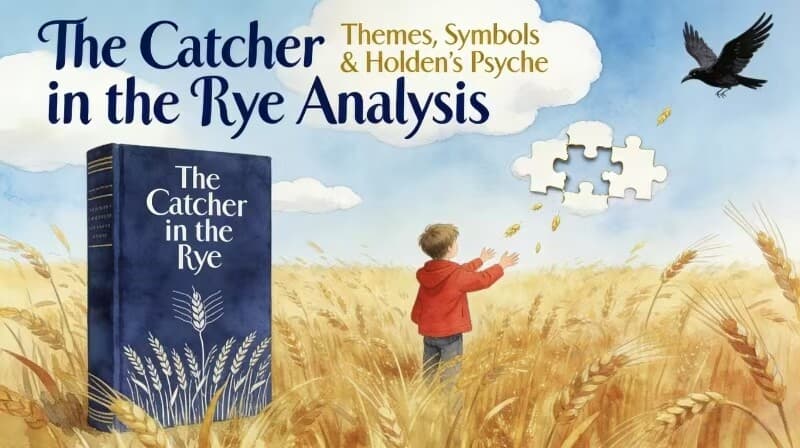
The Catcher in the Rye is a classic coming-of-age novel by J.D. Salinger that explores the inner world of teenage protagonist Holden Caulfield during his journey through New York City. Rather than relying on plot-driven action, the novel focuses on Holden’s thoughts, emotional conflicts, and growing sense of alienation, making it especially rich for literary analysis.
For students tasked with writing an analysis essay, understanding the novel requires more than summarizing events. Strong analysis examines why Holden behaves the way he does and what his perspective reveals about identity, trauma, and authenticity. To start strong, you need to look beyond the surface and develop compelling essay hooks that grab the reader’s attention. This guide explores the novel’s key themes, symbols, and narrative structure to help you develop clear, defensible arguments suitable for academic essays.
Key Themes in The Catcher in the Rye
At its core, The Catcher in the Rye is a bildungsroman—a coming-of-age novel—but one defined by resistance rather than growth. Holden does not move smoothly toward maturity; instead, he actively rejects it. Each major theme reflects this internal conflict.
Phoniness vs. Authenticity
Holden’s obsession with “phoniness” is often misread as simple cynicism. In reality, it functions as a psychological defense mechanism. By labeling others as fake, Holden distances himself from emotional vulnerability and potential rejection.
Key Quote:
“Grand. There’s a word I really hate. It’s a phony. I could puke every time I hear it.” (Chapter 2)
Analysis: Holden’s visceral reaction to polite language reveals his inability to navigate adult social conventions. He interprets politeness as deception rather than as a necessary social tool, exposing his discomfort with emotional ambiguity.
Essay-ready insight: Holden’s condemnation of phoniness reflects projection rather than moral superiority; he attacks insincerity in others to avoid confronting his own fear of emotional exposure.
Innocence vs. Adulthood
Holden views childhood as pure and adulthood as corrupt, rigid, and emotionally dishonest. His desire to preserve innocence—especially in children like his sister Phoebe—reveals a deeper refusal to accept change and loss.
Key Quote:
“The best thing, though, in that museum was that everything always stayed right where it was… The only thing that would be different would be you.” (Chapter 16)
Analysis: Holden values the museum not for its educational value but for its permanence. It represents a world frozen in time, where growth, grief, and responsibility are suspended.
Essay-ready insight: Holden’s fixation on innocence is not nostalgia but avoidance, allowing him to postpone the grief and responsibility associated with adulthood.
Alienation and Loneliness
Although Holden frequently claims to want isolation, his actions contradict this desire. Throughout the novel, he repeatedly reaches out to others—strangers, acquaintances, and authority figures—only to sabotage these interactions.
Key Quote:
“I went into this phone booth. I felt like giving somebody a buzz… but as soon as I was inside, I couldn’t think of anybody to call.” (Chapter 9)
Analysis: This moment captures the self-perpetuating nature of Holden’s loneliness. His problem is not a lack of relationships but his inability to sustain emotional connection due to anxiety and fear of rejection.
Essay-ready insight: The novel presents alienation as self-inflicted: Holden’s fear of intimacy leads him to create the very loneliness he claims to despise.
Symbols and Literary Devices in The Catcher in the Rye
Salinger uses recurring symbols to externalize Holden’s psychological state. These symbols transform abstract emotional struggles into concrete images that recur throughout the novel. If you are learning how to write a book review, identifying these symbols is crucial for a deep evaluation.
The Meaning of the “Catcher in the Rye”
The novel’s title originates from Holden’s misunderstanding of a Robert Burns poem. He imagines himself standing in a field, catching children before they fall off a cliff.
Key Quote:
“I have to catch everybody if they start to go over the cliff… I have to come out from somewhere and catch them.” (Chapter 22)
Analysis: The cliff symbolizes the inevitable fall into adulthood. Holden’s fantasy reveals his desire to protect children from change—a role he adopts to avoid confronting his own unresolved trauma.
Essay-ready insight: The catcher fantasy represents Holden’s attempt to control loss after his brother Allie’s death, revealing his desire to halt emotional pain by stopping change itself.
The Red Hunting Hat
The red hunting hat symbolizes individuality and emotional protection. Holden wears it during moments of vulnerability and removes it when he feels pressure to conform socially.
Key Quote:
“I swung the old peak way around to the back… I liked it that way.” (Chapter 3)
Analysis: Wearing the hat backwards visually separates Holden from others while offering psychological comfort. It functions as a protective barrier against a world he perceives as hostile.
Essay-ready insight: The hat illustrates Holden’s conflict between the desire for a unique identity and the pressure to fit into society.

Holden Caulfield’s Psyche and Narrative Structure
Understanding who tells the story—and from where—is essential to interpreting the novel’s meaning.
Grief, Trauma, and the Unreliable Narrator
Holden is an unreliable narrator whose perceptions are shaped by unresolved grief. The death of his younger brother Allie, emotional neglect from his parents, and experiences of sexual boundary violations contribute to his psychological instability. While Holden tells his own story, students learning how to write a narrative essay should note how his bias shapes the reader’s experience differently than a standard memoir.
Key Quote:
“I’m the most terrific liar you ever saw in your life.” (Chapter 3)
Analysis: Salinger signals early that Holden’s narration cannot be taken literally. His habitual lying allows him to reshape reality into something he can emotionally manage.
Essay-ready insight: Holden’s unreliability strengthens the narrative by forcing readers to interpret events through the lens of trauma rather than objective truth.
The Frame Narrative
The novel is structured as a flashback told from a mental health institution. This framing device suggests that the story represents reflection and recovery rather than random rebellion.
Essay-ready insight: The frame narrative repositions the novel as a confession of crisis, emphasizing healing rather than failure.
Why This Analysis Matters for Literature Essays
Many student essays struggle because they remain at the level of summary. In academic literature courses, professors expect:
-
A clear, arguable thesis
-
Interpretation rather than description
-
Textual evidence linked to psychological or thematic claims
Using focused analytical insights like those above helps you move beyond plot summary. To ensure your arguments flow logically, using the right transition words is essential for connecting these complex ideas smoothly. Additionally, adhering to the correct essay format will give your paper the professional polish it needs to succeed.
Need Help Writing Your Catcher in the Rye Essay?
Analyzing complex themes, selecting effective quotes, and maintaining academic tone can be challenging—especially under time pressure. Whether you are struggling to meet the college essay length requirements or need help refining your thesis, Essaypass supports students at every stage of the writing process.
Essaypass helps you:
-
Build structured, argument-driven literature essays

-
Covers many essay types (analysis, argumentative, reflective, literature review)
-
Ensure originality with optional plagiarism and AI detectoion checks
-
Real academic sources with direct download support
-
AI Agent for revisions and rewriting

If you need help getting started, Essaypass works as an academic assistant—helping you turn literary analysis into clear, well-argued essays with confidence.