
Most 1000-word essays fail for one reason: poor structure.Not weak English. Not grammar. Not vocabulary.Structure. Here’s how to write a focused, high-quality 1000-word essay that meets academic marking criteria.
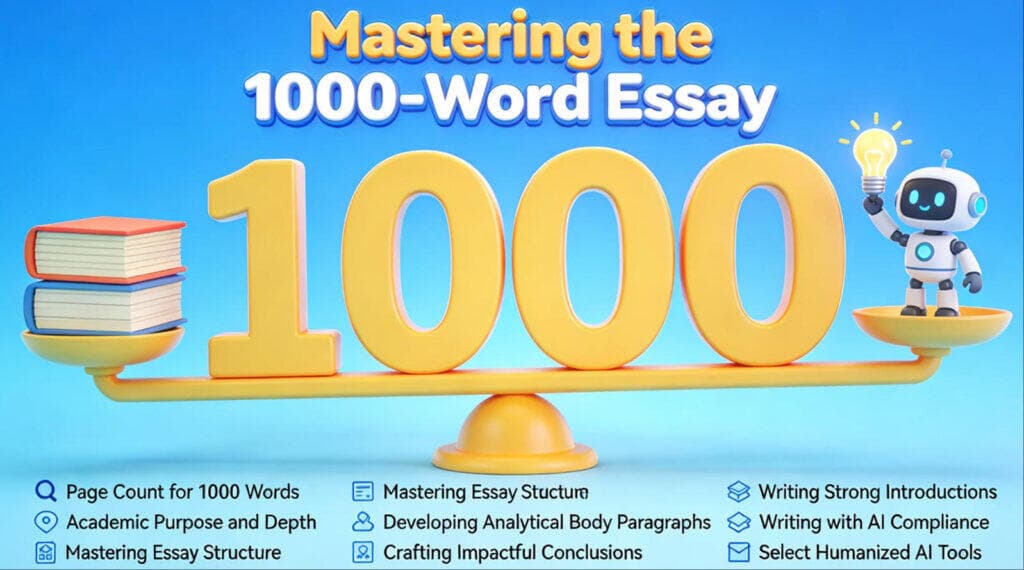
Fundamentals of 1,000-Word Essays
Academic assignments frequently use this length to test your analytical depth beyond surface-level summaries. Understanding the physical and temporal scope helps you plan the writing cycle effectively.
Page Length and Format Requirements
- Standard Length: Double-spaced text in 12-point Times New Roman or Arial typically spans 3 to 4 pages. Single-spacing reduces this footprint to roughly 2 pages.
- Formatting Rules: You must maintain 1-inch margins on all sides.
Examples: A history student following specific essay format rules will find that 1,000 words cover about four pages. This count excludes the title page and the reference list.
Estimated Writing and Research Time
- Average Duration: Most students spend 3 to 4 hours on the entire process, including research and revision.
- Task Breakdown: Allocate 60–90 minutes for scholarly research and 2 hours for drafting.
Examples: A nursing student writing about patient care might finish in 3 hours. However, a complex physics paper could take days due to deep technical research. Check a common essay word count guide to track progress. Stay within the 950–1,050 word safety range to ensure your analysis remains focused.
Essay Structure and Word Distribution
Effective word allocation prevents front-loading, where a writer exhausts the limit on background info before reaching the core analysis. Following a balanced distribution ensures your arguments have enough airtime to be persuasive.
The 10-70-20 Rule for Word Allocation
- Introduction (100–150 words): Start with engaging essay hooks and end with a nuanced thesis statement.
- Body (700–800 words): Dedicate the majority of your word count to the analytical core.
- Conclusion (100–150 words): Synthesize your findings and explore broader implications rather than simply repeating points.
Example: For a history paper, use 120 words to define the era, 750 words to analyze three major socio-economic shifts, and 130 words for the final verdict.
PEEL Method for Paragraph Engineering
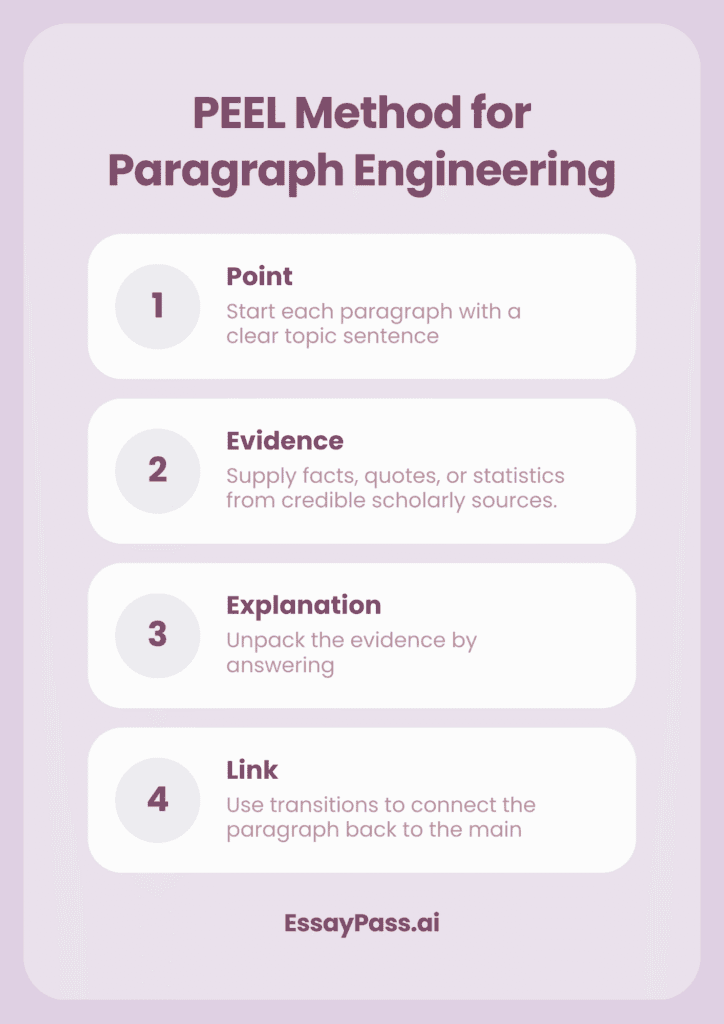
- Point: Start each paragraph with a clear topic sentence that advances your thesis.
- Evidence: Supply facts, quotes, or statistics from credible scholarly sources.
- Explanation: Unpack the evidence by answering “so what?”—explain how the detail proves your point.
- Link: Use transitions to connect the paragraph back to the main essay format.
Example: In a business essay about Apple, cite a 2024 market report, then explain how their R&D spending directly caused their current market dominance.
Academic Reference Requirements
- Source Diversity: Integrate 5–8 peer-reviewed sources from databases like JSTOR or EBSCOhost.
- Citation Consistency: Apply the correct APA style essay format or MLA as required by your instructor.
Example: Cite a recent medical journal study by Dr. Smith instead of a generic news blog to maintain scholarly rigor.
Mastering Paragraph Architecture
Paragraphs act as the engine of a strong analytical essay. Focus each block on one specific idea. Use the PEEL method—Point, Evidence, Explanation, and Link—to build academic depth.
Arguable Topic Sentences
Start with a clear claim. It must be debatable, not just a fact. Do not say: “Shakespeare wrote plays.” Instead, say: “Shakespeare uses violent imagery to reveal psychological decay”. This sets the stage for proof.
Integrating Scholarly Evidence
Support your claim with high-quality data. Use verifiable sources like peer-reviewed journals. For example, cite “Pew Research statistics on social media addiction”. Do not just “drop” quotes into the text. Integrate them smoothly into your own sentences.
Analyzing Why It Matters
Explanation is the most vital part. It should be your longest section. Do not summarize what the author said. Analyze the implications instead. For instance, explain how “Instagram’s infinite scroll feature exploits human dopamine responses”. This shows critical thinking.
Connecting Ideas Smoothly
End with a link to your thesis. It creates flow. Avoid robotic transition words like “In conclusion”. Instead, show how this point leads to the next. A purposeful link helps you master word count by removing fluff.
4 Steps for Eliminate AI Patterns
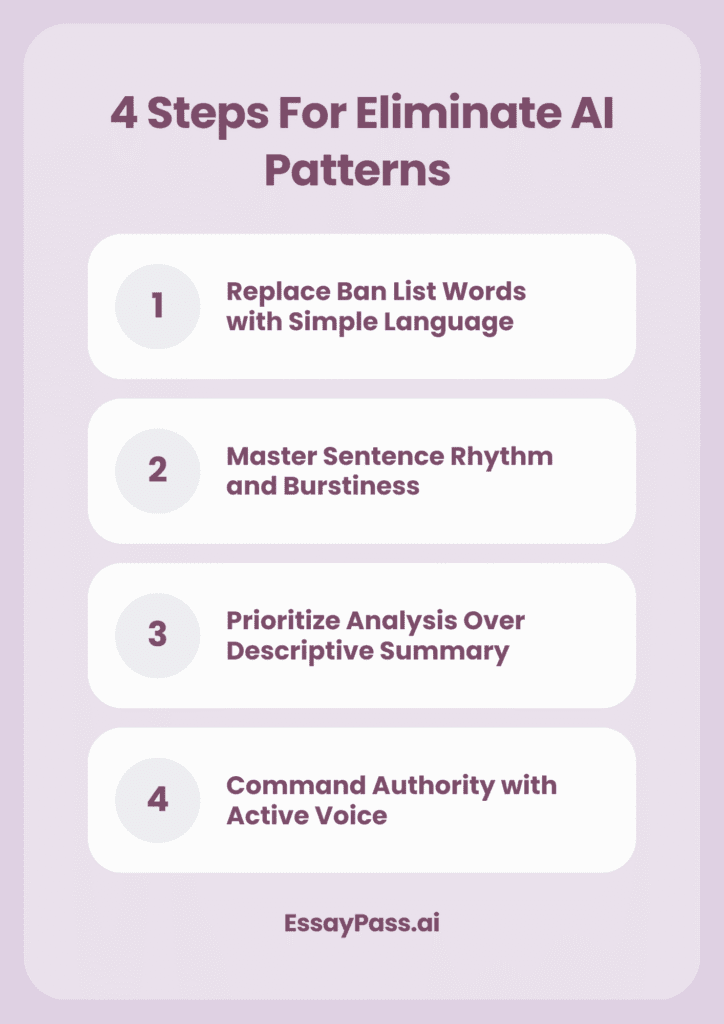
Standard AI outputs often feel static and predictable. To achieve high-quality results, you must bypass “robotic” rhythms by focusing on perplexity and specific vocabulary choices to ensure your work feels authentic and academic.
Replace Ban List Words with Simple Language
Academic success requires clarity over complexity.. Stop using over-complicated “AI-isms” that trigger detection..
- Swap: Change “facilitate” to “help” and “utilize” to “use.”.
- Delete: Remove redundant fillers like “indeed,” “furthermore,” or “due to the fact that.”.
Example: Instead of “investigating” a rhetorical essay structure, simply “study” its components.. Use “most” instead of “the majority of” to keep your prose tight..
Master Sentence Rhythm and Burstiness
AI typically writes in a steady, monotonous beat.. Break this by mixing sentence lengths—the “Short-Long-Fragment” technique..
- The Sprint: “Writing is tough.”.
- The Marathon: “When you combine deep research with an analytical essay framework, your arguments become far more persuasive.”.
- Directness: Avoid starting every sentence with “The tool” or expletive pronouns like “It is.”.
Prioritize Analysis Over Descriptive Summary
The “mark killer” in college papers is stopping at the “what.”. You must provide the “so what.”.
- Descriptive Example: “The president fired the minister yesterday.”.
- Analytical Example: “The sudden firing crashed investor confidence, which immediately devalued the local currency.”.
Actionable Tip: Always link facts back to your research aim.. Check essay conclusion tips to ensure your final synthesis reflects this depth.
Command Authority with Active Voice
- Subject-Verb-Object: Use active voice in at least 85% of your sentences to sound strong and authoritative.
- Avoid Passive Traps: Passive structures create distance and unnecessary wordiness.
Example: Instead of writing “The essay was written by the student,” use “The student wrote the essay”. This ensures you follow essay format rules while maintaining a direct, human tone.
Final Essay Checklist
Academic success depends on precision. Use this checklist to polish your work and avoid common pitfalls.
Eliminate Wordy Phrases
Academic “deadwood” dilutes your impact. Be ruthless. Cut “in order to” and use “to”. Replace “due to the fact that” with “because”. These small changes save space for deep analysis. For example, do not say “The researcher serves to help students.” Just say “The researcher helps students”. Every word must earn its place.
Verify Formatting Requirements
Consistency proves professional rigor. Use 12-point Times New Roman with double-spacing. This typically creates 4 pages. Check your common essay word count targets. Most professors allow a 10% margin. Aim for 950 to 1050 words. Avoid adjusting margins to “stretch” a short paper.
Final Proofreading Steps
Fresh eyes catch hidden errors. Read your draft aloud to find awkward phrasing. This technique identifies run-on sentences and weak verbs. Check that every citation matches your editing and proofreading standards. Verify subject-verb agreement. Fix comma splices. A clean submission signals scholarly maturity.